Category Archives: Worldview

NOT “UNDER LAW”? (2)

foundations-destroyedPMT 2016-092 by Kenneth L. Gentry, Jr.

This article continues and concludes the previous one. I am showing that the New Testament does not set aside God’s law as a righteous standard for all men.

Paul’s Liberty in Christ
We must comment on the meaning of his tricky statement.

First, when Paul refers to Christ’s “law” he appears to mean Christ’s “authority” (cp. Mt. 28:18; Eph. 1:21; Phil. 2:9-10; Col. 1:17-1) — not a new system of laws and obligations. Paul is under Christ’s lordship; he is Christ’s servant or slave (1 Cor. 9:16-17; 7:22). Continue reading

NOT “UNDER LAW”? (1)

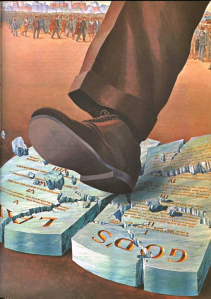
law-under-footPMT 2016-091 by Kenneth L. Gentry, Jr.

Does God’s law apply to the new covenant era? Is postmillennialism lawless? Or does postmillennialism expect the worldwide influence of God’s law? Many Christians believe the law is God’s Law Emeritus. They believe the New Testament sets aside God’s law. But is this the case?

Many Christians believe that Paul sets aside the Old Testament law for “the law of Christ.” In 1 Corinthians 9:21, Paul wrote: “to those who are without law, [I am] as without law, though not being without the law of God but under the law of Christ, that I might win those who are without law.” The italicized phrases suggest that Paul here declares that in Christ — and, therefore, in the Christian era, our era — a new law prevails, which he calls: “the law of Christ.” This new law of Christ supplants the older law of God as the ethical norm for Christian behavior. Continue reading

POLITICAL POSTMILLENNIALISM (2)

god-politicsPMT 2016-087 by J. Vaden Cavett

(This is Part 2 of a study began in the last blog posting)

In Deuteronomy 28 the Lord declares the curses that will fall upon Israel if they break covenant. One feature of this malediction is to be found in verse 30. It reads, “You shall betroth a wife, but another man shall ravish her. You shall build a house, but you shall not dwell in it. You shall plant a vineyard, but you shall not enjoy its fruit.” This curse is pronounced as a covenant sanction for those with whom God was making covenant. As we know, like Adam they transgressed the covenant; there they dealt faithlessly with the Lord (Hosea 6:7). So, God promises to make a New Covenant based upon better promises. Isaiah refers to this New Covenant as The New Heavens and Earth. Continue reading

POLITICAL POSTMILLENNIALISM (1)

religion-politicsPMT 2016-086 by J. Vaden Cavett

How do we keep our heads up in a shifting political climate? We must rely on a stout, optimistic, and biblical worldview. Pessimistic eschatology works against us as we seek to glorify God in our toil. But biblical optimism is jet fuel in our tanks. Postmillennialism is high octane orthodoxy and it’s about to squeal your tires.

Postmillennialism teaches that the one thousand years of peace described in Revelation 20 will be enjoyed before Jesus returns to judge the quick and the dead. This view is called “postmillennialism” because Christ returns after (post) his millennial reign. The Gospel will prosper, the masses will be converted, and nations and their rulers will submit to King Jesus. This belief is far removed from the prevailing notion that the world is going to Hell in a hand basket. Continue reading

CHRISTIANITY AND CULTURE

Worldview 2PMT 2016-065 by John M. Frame

Gentry note: God created man as a culture-building creature. The Bible frames in a Christian worldview that is designed to mold culture. Postmillennialists believe in the ultimate success of this culture-molding call. Therefore, we would do well to study the Christian influence on culture. Frame gives several helpful lectures on this whole question. This is his first one: “What Is Culture.”

My general topic is “Christianity and Culture.” I have five sessions with you. In the first, this morning, I’ll ask, “What is Culture?” Tomorrow we will discuss “Christ and Culture,” asking how the Bible describes the relation of Christ to all the cultures of the world. In the third lecture, “Christ and our Culture,” I will get more specific, applying what we’ve learned to the culture we live in, that of the present-day Western world. The fourth lecture, “Christians in our Culture” will discuss ourselves: how should we respond? How should Christians relate to present-day culture: do we flee, fight, set up an alternative, or what? The last lecture, “Culture in the Church,” will discuss what use the church can make of culture in its ministry: in its evangelism, its nurture of believers, and its worship. Continue reading

DID PAUL TRY TO TRANSFORM SOCIETY?

Man on buildingPMT 2016-064 by Christopher Hume

One of the practical implications of a robustly postmillennial theology is the need to transform our society according to the Word of God. To the great detriment of our nation, the church in America has largely embraced a pessimistic outlook of the future and has therefore abandoned the effort to build a Christian society. An objection from many sincere Christians is that the New Testament “does not focus on political issues.” In fact, the Apostle Paul is often cited as the prime example of one who did not really get involved with political issues. Paul, the reasoning goes, was simply focused on “preaching the gospel” and did not spend time trying to change the culture or society (which includes laws, institutions, etc.). However, my contention is that the Apostle Paul not only tried to change the societal and political landscape, he succeeded! Continue reading

AN INVITATION TO YOU

Bible studyPMT 2016-063 by Kenneth L. Gentry, Jr.

Postmillennialism does not arise among Christians as a natural reflex — though it should if they pray the Lord’s Prayer believingly (“Your kingdom come / Your will be done, / On earth as it is heaven,” Matt. 6:10) and understand the Great Commission rightly (“Go therefore and make disciples of all the nations . . . and lo, I am with you always, even to the end of the age” (Matt. 28:19, 20).

Our age is one of simplistic Christianity and social collapse. Neither of these problems is helpful for suggesting postmillennialism as an eschatological option. Continue reading