MESSIAH AND ISRAEL’S “RETURN”

PMW 2023-091 by Kenneth L. Gentry, Jr.Global map

Isa. 43:5–7 is a glorious prophecy. It reads:

“Fear not: for I am with thee: I will bring thy seed from the east, and gather thee from the west; I will say to the north, Give up; and to the south, Keep not back: bring my sons from far, and my daughters from the ends of the earth; Even every one that is called by my name: for I have created him for my glory, I have formed him; yea, I have made him.”

Despite initial appearances, these verses do not refer solely to Israel’s return from the Babylonian dispersion. Rather they refer beyond historic Israel to spiritual Israel gathered out from the nations through the worldwide spread of the gospel (Psa. 22:27–28; Isa. 2:2–4; Matt. 28:18–20; John 12:32; 1 Cor. 15:24–26). Isaiah is looking beyond the Babylonian exile to ultimate eschatological issues. Israel’s return from exile was an historical event that served as a typological pointer to worldwide redemption.

Continue reading

LUCIFER?

PMW 2023-090 by Kenneth L. Gentry, Jr.Babylonian king

Isa. 14:12 is a little understood text. The KJV’s translation has the word “Lucifer” here. “Lucifer” (“light-bearer”) is the Latin Vulgate translation of the Hebrew helel, which means “shining one.” This translation has helped promote a radical misunderstanding of the text in the modern world.

“How art thou fallen from heaven, O Lucifer, son of the morning! how art thou cut down to the ground, which didst weaken the nations!” (KJV)

Despite popular opinion today (and by many ancient and medieval writers), Lucifer is not Satan. Notice: (1) The taunt is clearly directed against “the king of Babylon” (v. 4). (2) It speaks of the fall of “the man who made the earth tremble” (v. 16), who has “ruined your country” (v. 20). (3) It associates him with other earthly kings who have died (vv. 18–19). (4) It speaks of his burial problem (v. 20). (5) Furthermore, this taunt-oracle opens a series of prophecies against various earthly kings: Babylon (14:4), Assyria (14:24), Philistia (14:29), Moab (15:1), Damascus (17:1), Egypt (19:1), Jerusalem (22:1, 9–10), and Tyre (23:1). It would be out of keeping with the series to import Satan into this taunt.
Continue reading

A STANDARD FOR THE NATIONS

PMW 2023-089 by Kenneth L. Gentry, Jr.Cross over all

Isaiah provides us with a glorious and encouraging Messianic prophecy in Isaiah 11. Let us quickly summarize his teachings.

Isa. 11:1–2: a shoot will spring from the stem of Jesse
Along with Assyria, Israel has been chopped down to a stump (10:18–19, 33–34). Yet the Messiah, the true Davidic king, will arise from the lineage of Jesse (vv. 1, 10; David’s father, 1 Sam. 16:10–31). Christ is the greater David who was typified in David. He will be endowed with “the Spirit of the LORD” (v. 2), thereby exercising wisdom, understanding, counsel, strength, knowledge, and the fear of the LORD (v. 2).

Isa. 11:3–6: with righteousness He will judge the poor
Where Israel’s rulers failed and earned God’s judgment, the Messiah will exercise righteous rule (cf. v. 9).
Continue reading

KINGDOM GRADUALISM

PMW 2023-088 by Kenneth L. Gentry, Jr.Gradualism

God’s redemptive kingdom develops gradually over time, unfolding incrementally. It begins small and will eventually grow to dominance. In a number of verses, we can see this principle of gradualism in God’s providence.

An historical indicator of kingdom gradualism appears in the Promised Land’s conquest. In Deuteronomy 7:22 we read: “And the Lord your God will clear away these nations before you little by little; you will not be able to put an end to them quickly, lest the wild beasts grow too numerous for you.” Here Moses specifically informs Israel that gradual conquest is for her good, allowing her people to conquer where they could secure and maintain control.
Continue reading

PSALM 45 AND THE MESSIAH

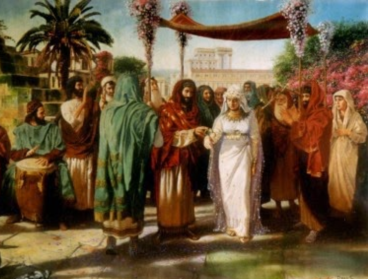
PMW 2023-087 by Kenneth L. Gentry, Jr.Ancient wedding

Psalm 45:1–7 is a royal wedding hymn psalm. It engages in praise that is so exalted that it is primarily Messianic in function. However, it could apply to an earthly king in an ideal sense as the goal at which his rule should aim. Yet its Messianic purpose is the ancient view among both Jewish and Christian interpreters. We even see its Messianic function in the New Testament (Heb. 1:8–9). In this regard, notice the following.

The title of this Psalm is the longest by far in all the Psalms: “For the choir director; according to the Shoshannim. A Maskil of the sons of Korah. A Song of Love.” This emphasizes its deep and solemn significance in presenting the glorious wedding hymn — for the Messiah.

Continue reading

BIBLICAL TYPOLOGY

typologyPMW 2023-086 by Kenneth L. Gentry, Jr.

A biblical “type” is an Old Testament person, event, or institution that serves as an anticipation of a greater New Testament person, event, or thing, which is known as an “anti-type.” The Old Testament type is a God-ordained matter that is intentionally designed as a pointer to its future, greater “fulfillment.” Thus, Scripture often engages in a recurring pattern of divinely-ordained relationships between the Testaments.

True “types” are not just accidental similarities which we may develop by our own interpretive ingenuity. They are God-ordained similarities that are purposely embedded in Scripture and serve a significant theological purpose. The type may not be understood initially by the saints in the Old Testament, but they are finally demonstrated as such in the New Testament, usually through specific confirmation.

Continue reading

THE SONS OF GOD IN GENESIS 6

PMW 2023-085 by Kenneth L. Gentry, Jr.Seth v Cain

The episode occurring in Genesis 6:1–4 is quite difficult to interpret and has been the subject of much debate. Though there are several interpretations of this passage, historically two views have dominated the debate: (1) the angelic offspring view and (2) the human seed-line view.

Though the seed-line view is the traditional Christian understanding, perhaps the oldest view in extra-biblical antiquity is the angel-human interpretation. It is found as far back as 200 B.C. in the non-biblical book of 1 Enoch (6:11–7:6) as well as in the first-century book by Josephus called Antiquities (1:3:1). This view holds that fallen angels came down to earth and engaged in sexual relations with women who then bore giants as their offspring.

The seed-line view holds that the godly line of Seth (4:25) that has been the focus of Genesis since Genesis 5:3 is beginning to intermarry with unbelieving women (“whomever they chose” without reference to their faith. These women would be largely represented by the Cainite line (4:17ff). This appears to be the proper interpretation due to its fitting the context and avoiding bizarre results.
Continue reading