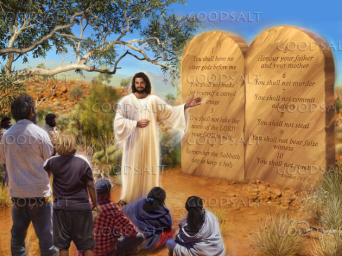
PAUL & THE LAW OF CHRIST

PMW 2023-084 by Kenneth L. Gentry, Jr.Law and Jesus

In 1 Corinthians 9:21 we read the following statement by Paul:

“to those who are without law, [I am] as without law, though not being without the law of God but under the law of Christ, that I might win those who are without law.”

The italicized phrases in this statement have presented material to anti-theonomists, suggesting that Paul here declares that in Christ — and, therefore, in the Christian era — a new law prevails, which he denominates: “the Law of Christ.” This new Law of Christ supplants the older Law of God as the ethical norm for Christian behavior.
Continue reading

CALVIN AND POSTMILLENNIALISM

PMW 2023-083 by Greg L. BahnsenDoubting prayer

INTRODUCTION

When we understand the distinctive character of postmillennialism (i.e., historical optimism”), it is important to go on and see that this position is not eccentric in terms of the outlook of orthodox theology, nor is it a recent innovation (associated, as some erroneously say, with the rise of nineteenth-century humanistic optimism). Rather, the postmillennial hope has been the persistent viewpoint of most Reformed scholars from the sixteenth century into the early twentieth century. In light of that fact, the position deserves to be examined again today for its biblical support and not lightly dismissed as somehow an obvious theological mistake. That is, there is no prima facie reason to reject postmillennialism as foreign to the thinking of the most respectable theological teachers or the unwitting parallel to specific secular movements. The position has been endorsed by the most dependable and outstanding theologians and commentators from the Reformation to the present.
Continue reading

MISGUIDED REJECTIONS OF POSTMILLENNIALISM (2)

PMW 2023-082 by Greg L. BahnsenWeak man

Gentry note:
In the previous posting, Bahnsen noted the misguided and failed attempts to dismiss postmillennialism based on (1) newspaper exegesis, (2) misrepresentation, and (3) the application of two-edged criticism (which applies to the critic as well as the position criticized). In this posting he continues.

OT VS. NT ISSUE

There are current day charges against the position which are premature or unfounded. To this category belongs the allegation that postmillennialism is founded on Old Testament passages rather than New Testament evidence, that the New Testament knows nothing of the proclamation of a semi-golden age.

Continue reading

MISGUIDED REJECTIONS OF POSTMILLENNIALISM (1)

Bible and newspaperPMW 2023-081 by Greg L. Bahnsen

It must be observed that postmillennialism lost favor (and today remains held in disfavor) with conservative theologians for manifestly unorthodox and insufficient reasons. Extra-biblical reasoning, as well as lazy or poor scholarship, has intruded itself into Christian discussions of eschatology.

NEWSPAPER EXEGESIS

Alva J. McClain says of postmillennialism: “This optimistic theory of human progress had much of its own way for the half-century ending in World War I of 1914. After that the foundations were badly shaken; prop after prop went down, until today the whole theory is under attack from every side. Devout Postmillennialism has virtually disappeared.”

J. Barton Payne’s massive Encyclopedia of Biblical Prophecy mentions postmillennialism only once, and that merely in a footnote which parenthetically declares “two world wars killed this optimism.”

Merrill F. Unger dismisses postmillennialism in short order, declaring: “This theory, largely disproved by the progress of history, is practically a dead issue.”
Continue reading

THE NEW CREATION IN CHRIST

PMW 2023-080 by Geerhardus Vos

Gentry note:
As noted in my last posting, a new version of several of Geerhardus Vos’ works on eschatology will soon be published. This book collects together some of his important eschatological articles and updates them in the process — removing his awkward, cumbersome, early-20th century writing style. In this particular excerpt from the updated Vos, he deals with the concept of a new creation in Christ.

Vos observations:
The recognition of the eschatological source of the term “new ktisis” has been held back by its assumed individual use in 2 Corinthians 5:17: “Wherefore if any man is in Christ, he is a new creature.” And likewise by the exclusively subjective-soteriological reference the representation seemed to suggest. Both obstacles also make themselves felt in regard to Titus 3:5. But in regard to neither of the two passages can these objections obscure the quite perceptible eschatology texture.

Continue reading

TWO PROBLEMS WITH AION TERMINOLOGY

PMW 2023-079 by Geerhardus Vos

Gentry note:
Soon a new version of several of Geerhardus Vos’ works on eschatology will be published. This book collects together some of his important eschatological articles and updates them in the process — removing his awkward, cumbersome, early-20th century writing style. In this clip from updated Vos, we will note his helpful observations on the Greek words kosmos and aion. These words overlap in meaning and significance, making it easy to confuse matters when interpreting biblical texts. I hope this posting is helpful.

Continue reading

THE WOMAN IN HEAVEN (3)

PMW 2023-078 by Kenneth L. Gentry, Jr.Woman with 12 stars

This is the third and final installment studying the woman in Revelation 12. So, let us now continue and conclude our study.

THE CROWN OF TWELVE STARS

The “crown of twelve stars” (12:1c) is a stephanos, a victor’s wreath (cp. 2:10; cf. 6:2; cp. 1Pe 5:4), rather than a diadēma, a crown representing political rule (L-N 1:76, 77). Ideal Israel embodied in the faithful remnant is deemed victorious, despite her diminished count and difficult circumstances. Unfortunately, the historical manifestation of the ideal community — Israel after the flesh — ultimately fails in that she does not recognize the true light that she should have accepted (Jn 1:4–5, 9–11; 3:19–20; 5:33–40). As a result we learn that “it is not the children of the flesh who are children of God, but the children of the promise are regarded as descendants” (Ro 9:8; cp. Ro 8:14; Gal 4:28). Consequently, earthly, corporate Israel’s failed light-bearing function is taken over by the new covenant church (Mt 5:14–16 //; Ac 13:46–47; 26:18, 23; 2Co 4:6; cp. Col 1:12; 1Th 5:5) which is the “Israel of God” (Gal 6:16), the “true circumcision” (Php 3:3). Therefore, in Revelation God’s judgments against earthly Israel darken her lights (8:12; cp. 6:12; 9:2) and cause her shining stars to fall (6:13). Continue reading