INTRODUCING ISAIAH (2)

PMW 2023-095 by Kenneth L. Gentry, Jr.isaiah preaching 2
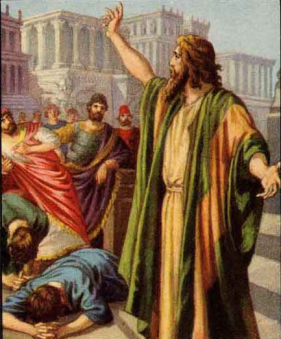
In this posting, I am continuing a brief historical and literary introduction to the Book of Isaiah. Such knowledge is helpful for better interpreting the text. We move now to consider:

PURPOSE

Isaiah ministered during a dangerous, tumultuous, and critical time. Judah and Israel have major world powers Egypt (Isa. 19), Assyria (Isa. 36), and Babylon (Isa. 13) either on the scene or looming in the near future. This problem is compounded by Israel’s unfaithfulness (e.g., 1:10–11; 6:9; 42:14–25; 43:22–28; 48:1–2). Therefore, some of Isaiah’s leading purposes include:

Isaiah calls Judah and Israel to repentance. Isaiah opens with a call to heaven and earth to serve as witnesses to God’s legal indictment against Judah and Israel (1:2–9). It was important for Isaiah to call the people to repentance by teaching salvation by grace (e.g., Isa. 1:18–20; 40:2; 43:1–7, 25; 44:28; 51:2; 55:1–13; 63:7–9).
Continue reading

INTRODUCING ISAIAH (1)

PMW 2023-094 by Kenneth L. Gentry, Jr.Isaiah mosaic

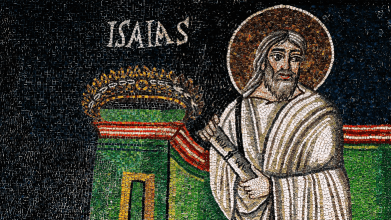
Isaiah is one of the best-known, best-loved and most studied OT prophets. When opening a book of the Bible, it is always helpful to have at least a general understanding of several key issues. The Bible is an historical book dealing with real history. The more we know about its setting and issues, the better we can understand it. In this brief series I will introduce Isaiah.
Continue reading

CHRIST AND THE REBELLIOUS SON LAW

PMW 2023-094 by Kenneth L. Gentry, Jr.Mob violence

Christ upholds God’s Law. And this includes his upholding one of the laws most commonly misunderstood and employed today. This law is often used in arguing against the continuing relevance of God’s Law in the civil sphere. He upholds the law calling for capital punishment for incorrigible criminality. Even the parents of a dangerous individual are expected to turn him over to civil authorities for capital punishment:

And He answered and said to them, “And why do you yourselves transgress the commandment of God for the sake of your tradition? For God said, ‘Honor your father and mother,’ and, ‘He who speaks evil of father or mother, let him be put to death.’ But you say, ‘Whoever shall say to his father or mother, “Anything of mine you might have been helped by has been given to God,” he is not to honor his father or his mother.’ And thus you invalidated the word of God for the sake of your tradition.” (Matt 15:3–6)

Continue reading

THE TWO WITNESSES OF REVELATION (2)

PMW 2023-093 by Kenneth L. Gentry, Jr.

This is the second and concluding article on the identity of the two witnesses in Revelation. In this installment, I present my own view and a portion of my evidence for it.

The first view is that the two witnesses may represent the whole Old Testament order (religious and civil) or content (law and prophecy). The second view is that the two witnesses may represent first century Christianity as a whole.

Third, more probably, the two witnesses may represent Continue reading

THE TWO WITNESSES OF REVELATION (1)

PMW 2023-092 by Kenneth L. Gentry, Jr.
The two witnesses in Rev. 11 have generated much discussion among Revelation enthusiasts. Though they only appear here in John’s forensic drama, they play an important role regarding the temple’s destruction. But debate continues over their identity. In this and my next blog posting, I will present the three leading options on their identity. Continue reading

MESSIAH AND ISRAEL’S “RETURN”

PMW 2023-091 by Kenneth L. Gentry, Jr.Global map

Isa. 43:5–7 is a glorious prophecy. It reads:

“Fear not: for I am with thee: I will bring thy seed from the east, and gather thee from the west; I will say to the north, Give up; and to the south, Keep not back: bring my sons from far, and my daughters from the ends of the earth; Even every one that is called by my name: for I have created him for my glory, I have formed him; yea, I have made him.”

Despite initial appearances, these verses do not refer solely to Israel’s return from the Babylonian dispersion. Rather they refer beyond historic Israel to spiritual Israel gathered out from the nations through the worldwide spread of the gospel (Psa. 22:27–28; Isa. 2:2–4; Matt. 28:18–20; John 12:32; 1 Cor. 15:24–26). Isaiah is looking beyond the Babylonian exile to ultimate eschatological issues. Israel’s return from exile was an historical event that served as a typological pointer to worldwide redemption.

Continue reading

LUCIFER?

PMW 2023-090 by Kenneth L. Gentry, Jr.Babylonian king

Isa. 14:12 is a little understood text. The KJV’s translation has the word “Lucifer” here. “Lucifer” (“light-bearer”) is the Latin Vulgate translation of the Hebrew helel, which means “shining one.” This translation has helped promote a radical misunderstanding of the text in the modern world.

“How art thou fallen from heaven, O Lucifer, son of the morning! how art thou cut down to the ground, which didst weaken the nations!” (KJV)

Despite popular opinion today (and by many ancient and medieval writers), Lucifer is not Satan. Notice: (1) The taunt is clearly directed against “the king of Babylon” (v. 4). (2) It speaks of the fall of “the man who made the earth tremble” (v. 16), who has “ruined your country” (v. 20). (3) It associates him with other earthly kings who have died (vv. 18–19). (4) It speaks of his burial problem (v. 20). (5) Furthermore, this taunt-oracle opens a series of prophecies against various earthly kings: Babylon (14:4), Assyria (14:24), Philistia (14:29), Moab (15:1), Damascus (17:1), Egypt (19:1), Jerusalem (22:1, 9–10), and Tyre (23:1). It would be out of keeping with the series to import Satan into this taunt.
Continue reading