INTRODUCING THE TWO WITNESSES (2)

2 Witnesses (2)PMW 2024-067 by Kenneth L. Gentry, Jr.

I am continuing my introduction to the mysterious “two witnesses” of Revelation 11. This article should be read in conjunction with the preceding, which it continues. After noting first that the overall drift of Revelation expects their appearance, we must now note:

Second, John records their ministry immediately after Christ prohibits him from measuring the temple, directs him to cast it out, and explains that its host city will be “tread underfoot” (11:2). And once again I would note that their ministry covers the same time period as the temple’s treading (11:2, 3). Their witness is so strongly linked with the period of God’s judgment on Jerusalem and the temple that it must be dealing with that event.

Third, as noted above, Jesus specifically calls these two prophets in Jerusalem (11:8) “my two witnesses” (11:3). This strongly suggests that they preach the same message as Christ in this book which is, in fact, “the revelation of Jesus Christ” (1:1). Due to their redemptive-historical significance, I will spend more time on this point than that of the preceding two and the following five. Continue reading
INTRODUCING THE TWO WITNESSES (1)

2 Witnesses (1)PMW 2024-066 by Ken Gentry

The two witnesses of Revelation are a constant source of intrigue for readers of Revelation. Despite their brief appearance in John’s drama, I constantly receive questions about them by email and in conferences. This intrigue is largely due to John’s rather abruptly introducing them, despite not previously alluding to them: “I will grant authority to my two witnesses, and they will prophesy for twelve hundred and sixty days” (Rev. 11:3). We must understand the two witnesses’ redemptive-historical significance in pre-70 Jerusalem and their narrative function in John’s forensic drama.

The sudden appearance of these two as “witnesses” in Revelation should not be altogether surprising. After all, Revelation’s main movement begins with a vision of God on his judicial throne (4:1ff) which quickly focuses on a sealed document (Rev. 5), the opening of which initiates the dramatic judgments to follow (Rev. 6). Revelation is a court drama.

Furthermore, in the first vision that opens the current interlude and vision set (10:1–11:14), Christ formally and dramatically swears an oath to God (10:5–6). In fact, Revelation is a book in which John himself “bore witness” (1:2, cp. 1:9) and in which witnesses frequently appear (2:13; 6:9; 12:11, 17; 17:6; 19:10; 20:4), including the chief witness, “the faithful witness” Jesus Christ (1:5; 3:14). The two witnesses here (11:3, 7a) are also “prophets” (11:3, 6, 10), just as John’s entire book is a “prophecy” (1:3; cp. 10:11; 22:10, 18-19). Whether or not we can identify these two witnesses in history (see discussion below), we must at least understand their prophetic witness in a “juridicial and religious” sense. Continue reading

OBJECTIONS TO NERO

ObjectionPMW 2024-065 by Kenneth L. Gentry, Jr.

Our study of 666 as a reference to Nero, though widely held, is not accepted by all scholars. There are certain problems that some see with the Nero designation. I will mention two of the major ones.

The Silence of Early Church Fathers

It is frequently argued that in one of the earliest treatments of Revelation 13 there is no mention of Nero as a likely candidate. The reference to which we refer was written by Irenaeus, Bishop of Lyons, around A.D. 180.

Not only does Irenaeus not mention Nero, but he mentions other possibilities: Euthanos, Laetinos, and Teitan. [1] If Nero was the actual meaning of the riddle, why did not Irenaeus know this, since he wrote about the matter 100 years later? Why do no other church fathers suggest it?

This would certainly appear to be a reasonable objection to our theory. In fact, it is the strongest argument against it. However, in the final analysis it cannot overthrow the positive evidence for the theory, for two reasons. Continue reading

THE WAR AGAINST THE SAINTS

Nero persecutorPMW 2024-064 by Kenneth L. Gentry, Jr.

As I continue this study series on 666 and its application to Nero Caesar, we must now note that in the text the Beast is said to “make war with the saints and to overcome them” (Rev. 13:7). In fact, he is said to conduct such blasphemous warfare for a period of 42 months (Rev. 13:5).

Remarkably, the Neronic persecution of Christianity — the first and one of the most gruesome — lasted almost precisely that length of time. The persecution of Christianity by Nero began in the latter part of November, A.D. 64. It ended with the death of Nero, which occurred on the ninth of June, A.D. 68. [1] But for a few days, this represents a period of almost 42 months! How significant! Not only does Nero’s name fit the number of the Beast, but his persecution lasted the very time required by the Beast’s war against the saints. Continue reading

616?

616PMW 2024-063 by Kenneth L. Gentry, Jr.

This is my third study in a brief series on the number 666 found in Revelation 13:18 (and on many cash register receipts found in the pockets of people in emergency rooms, who had a heart attack when they were startled to find their store receipt with this precise figure!)

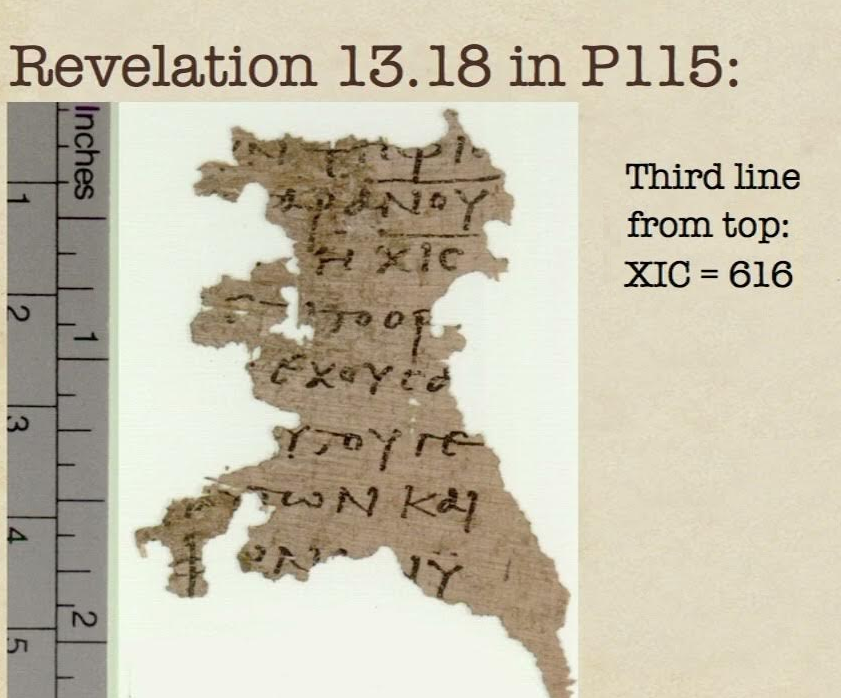
The Textual Variant 616
If you have a Bible with marginal references you will notice something of interest regarding Revelation 13:18. Your reference may say something to the effect: “Some manuscripts read 616.” The fact is that the number 666 in some ancient versions of Scripture is actually changed to 616. But why? Was it changed accidentally, or on purpose? Continue reading

666 AND DUAL IMAGERY

2 for 1PMW 2024-062 by Kenneth L. Gentry, Jr.

This is the second in a series on the infamous number 666, which is found in Revelation 13:18 (and, though this is irrelevant, also in 1 Kings 10:14; 2 Chron. 9:13; and Ezra 2:13). As we continue our study on this number, we must note the issue of:

Dual Imagery

In fact, before we actually point to the one indicated by John’s number, a widely recognized problem associated with the Beast imagery must be mentioned. Almost all commentators agree that the Beast imagery in Revelation shifts between the generic and the specific. That is, sometimes the Beast seems to picture a kingdom, sometimes a particular, individual king of that kingdom. [1]

The Beast of Revelation 13:1 and 17:1 has seven heads, which represent seven individual kings (Rev. 17:10). Thus, the Beast seems to be the kingdom in general. Yet at other times, the Beast is spoken of as if a specific individual. His number is the number of “a man” (Rev. 13:18). The beast is said to be one of his own heads (Rev. 17:11). The generic and specific are merged in Revelation 13:3 where the Beast as a whole is said to die when one of his heads dies, and he is said to come back to life when that head comes back to life (Rev. 13:3). Continue reading

666?

666 RoutePMW 2024-061 by Kenneth L. Gentry, Jr.

One of the continuing interests that laymen have in Revelation regards the number 666. This dreaded number appears in Revelation 13:18:

“Here is wisdom. Let him who has understanding calculate the number of the beast, for the number is that of a man; and his number is six hundred and sixty-six.”

Who among us has not feared $6.66 coming up on his cash register receipt? Or worse yet, 666 appearing in his Social Security number!

The significance and usefulness of this number lies in the fact that in ancient days alphabets served a two-fold purpose. Letters functioned, of course, as phonetic symbols from which written words could be formed. But they also served as numerals, in that the Arabic numbering system was a much later development of history. Roman numerals are perhaps the most familiar example of this. Continue reading