Category Archives: Revelation

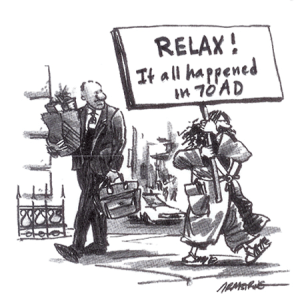
REVELATION AS PAST TENSE (2)

Objects are nearerPMW 2022-011 by Kenneth L. Gentry, Jr.

(NOTE: Oops! This should have been published on 2/4/22. But I accidentally saved this as a draft! Sorry about that. They say there are three signs of old age: (1) Memory Loss. Unfortunately, I can’t remember the other two. But enough about my failing memory.)

In my first article in this series I introduced the first of four arguments for approaching Revelation from the preterist perspective. The first article focused on the temporal indicators that John places in Revelation. Lexically, it is clear that he expected the events to “soon” take place (Rev 1:1) because “the time is near” (Rev 1:3).

But after placing that argument as the foundation stone for the preterist house, we need to notice that there are other indications as well. In this installment I will consider Audience Indicators. Revelation did not fall down out of heaven as book of concepts. It was given in a real, historical context. It is what scholars call, “occasional literature.” That is, it was written regarding a certain occasion, which I believe to be the fall of Jerusalem and the temple in AD 70. Continue reading

REVELATION AS PAST TENSE (3)

Look both waysPMW 2022-012 by Kenneth L. Gentry, Jr.

This is my third installment on the question of the evidence that Revelation was fulfilled in the first century. As surprising as this conclusion is for the modern evangelical, the proof is in Revelation itself. In this article I will consider the Historical Indicators for preterism.

I agree with the Puritan Talmudic scholar, John Lightfoot: Revelation appears to prophesy Christ’s judgment upon the Jews in A.D. 70. John’s opening statement of purpose (1:7), the seven letters (2:9; 3:9), and the body of Revelation (4-19; e.g., 7:1-8; 11:1-8) all reflect this truth. Continue reading

REVELATION AS PAST TENSE (1)

Revelation past tensePMW 2022-010 by Kenneth L. Gentry, Jr.

Due to the widespread influence of dispensationalism, the preterist approach to Revelation shocks many Christians. So it is important to carefully introduce them to the exegetical rationale for this approach.

I believe we should present a four-fold exegetical justification for preterism in Revelation. These justifications are rooted in interpretive demands derived from the text itself, not from theological predispositions (e.g., anti-premillennialism) or from traditional predilections (e.g., Moses Stuart, Milton Terry).

So I will begin with in this first article with: Temporal Indicators. Continue reading

“EVERY MOUNTAIN WAS MOVED”

Mountains shakePMw 2021-095 by Kenneth L. Gentry, Jr.

In Rev 6 one of the more dramatic images involves the shaking of all the mountains as God’s wrath falls. This is sometimes used as evidence against preterism and a first-century fulfillment of Rev. But does it undermine preterism? I think not. And here is why.

“And the sky was split apart like a scroll when it is rolled up; and every mountain and island were moved out of their places. And the kings of the earth and the great men and the commanders and the rich and the strong and every slave and free man, hid themselves in the caves and among the rocks of the mountains” (Rev. 6:14–15). Continue reading

LONG REIGN IN SHORT BOOK?

Close farPMW 2021-069 by Kenneth L. Gentry, Jr.

Although the vast majority of Revelation focuses on events that will occur “soon” (Rev 1:1, 3), the Revelation 20 section on the thousand years begins, but is not completed, in the first century. It projects itself into the distant future, allowing a glimpse of the end result of the events beginning in the apostolic era. Continue reading

THE SIGNIFICANCE OF AD 70

Temple destroyedPMW 2021-060 by Kenneth L. Gentry, Jr.

Today we are so distant from the events of AD 70, so removed from the ancient culture, so little acquainted with the first-century Jewish outlook, and so accustomed to the Christian perspective, we tend to overlook the enormous redemptive-historical significance of AD 70. Those events are not merely another sad instance in the history of “man’s inhumanity to man which makes countless thousands mourn.” They serve not as demonstration of “nature, red in tooth and claw.” Neither do they merely remind us of “the carnage of war, the blood-swollen god.”

But such is mistaken. Rather the devastating events of the Jewish War are the historical manifestations of the furious wrath of the offended God of Israel. Transcendent realities stand back of these temporal events. With Nahum we see the smoke of destruction as the dust clouds from God’s feet (Na 1). We learn that truly “it is a fearful thing to fall into the hands of the living God” (Heb 10:27) for “our God is a consuming fire” (Heb 10:31). Continue reading

WHY WILL SATAN BE LOOSED?

Broken chainsPMW 2021-053 by Kenneth L. Gentry, Jr.

I continue to receive this question on a regular basis. So I thought it a good idea to re-visit it.

In Rev 20 John focuses briefly on ultimate eschatological events that look well beyond the short time frame of the book. This is anticipated in his referring to the thousand years (Rev 20:2, 3, 4, 5, 6, 7), which by definition must extend beyond the “near” / “at hand” time frame. “Now, although the closing part of the Revelation relates beyond all doubt to a distant period, and some of it to a future eternity, yet the portion of the book which contains this is so small, and that part of the book which was speedily fulfilled is so large, that no reasonable difficulty can be made concerning” the book’s claim to focus on near-term events” (Moses Stuart, Apocalypse, 2:5).

But you may ask why Satan will be loosed. You will have to ask John, not me — for he does not say. Just as God surprisingly allows Satan to enter Eden and tempt Adam and Eve, so does he allow Satan’s re-release to tempt the nations live for a long time under Christ’s rule (cf. G. R. Beasley-Murray, Revelation, 291). Continue reading