
PMW 2025-052 by Kenneth L. Gentry, Jr.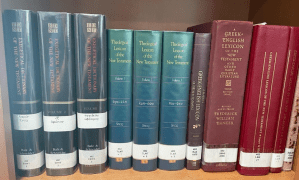
Introduction
The academic world has recently released a new, updated Greek-English lexicon that is certain to replace the standard lexicons currently in use today. Research in ancient Greek continues unabated at major research universities, with more powerful research tools providing deeper insights into ancient culture and language. And this one will surely displace the universally accepted standard lexicons, such The Liddell-Scott-Jones Lexicon, Thayer’s Greek-English Lexicon, and the Bauer-Danker-Arndt-Gingrich Greek-English Lexicon.
The current batch of Greek-English lexicons has proven helpful to scholars for years. But some academic questions remained as linguistic hurdles impeded fully understanding the Greek, especially New Testament Koine Greek. Now we are witnessing a major upheaval with this publication of the latest, upgraded lexicon, which is invested more strongly in AI-enhanced research.
This new lexicon is called, quite appropriately, New Lexicon of the 21st Century and Beyond. And it certainly will be a tremendous boon for scholars — especially for preterist scholars, as we will see. Plus with the new layout and 100% computer-generated text, the cost of this lexicon will fall well below those currently available — perhaps even 50% less. Let me explain how this can be in this review. Continue reading
 PMT 2017-080 by Janelle P (Open Doors)
 PMT 2017-079 by Eric Metaxas & G. Shane Morris (Breakpoint)
 PMT 2017-077 by Grant Wyeth (The Diplomat)
 PMT 2017-012 by Sarah Eekhoff Zylstra (Christianity Today)
 PMT 2017-011 by Sarah Eekhoff Zylstra
 PMT 2016-090 by Jeremy Weber in Christianity Today
 Postmillennial Worldview
Recent comments