Category Archives: Great Commission

MATT. 16:27-28: AD 70 AND FINAL JUDGMENT (2)

PMW 2025-087 by Kenneth L. Gentry, Jr.

In my preceding article I began a brief study of Matthew 16:27 and 28. I am providing evidence that Jesus speaks of the “coming of the Son of Man” as applying to his Second Coming at the Final Judgment to end history. Upon declaring this, he adds a note about his near-term coming, which demonstrates his authority at the destruction of Jerusalem and the temple in AD 70. This article will conclude the argument by providing my fourth point, following upon the preceding three.

So now we must note not only the wording of the passage, but its flow, setting, and purpose.

In v. 28 Jesus inserts the “truly I say to you” formula (v. 28), which he often uses. He always uses this formula as a bold underscoring of something he has said. So? How does it function here? This will explain his rationale in the setting of his current instruction. Continue reading

DOMINION COMMANDED

PMW 2025-067 by Kenneth L. Gentry, Jr.
The postmillennial hope is not just a hope. It is a command given to use by Christ himself. We must exercise our hope in promoting his kingdom on earth.

The postmillennial view is the only one of the four major evangelical eschatologies that builds its case on the very charter for Christianity, the Great Commission (Mt 28:18–20). David Brown wrote over a century ago:

“The disciples were commissioned to evangelize the world before Christ’s second coming; not merely to preach the Gospel, ‘for a witness,’ to a world that would not receive it till he came again . . . but to accomplish, instrumentally, the actual ‘discipleship of all nations,’ to baptize them when gathered in, and to train them up as professed Christians in the knowledge and obedience of the truth, for glory – all before his second coming. In the doing of this, He promises to be with them – not merely to stand by them while preaching a rejected Gospel, and to note their fidelity, but clearly to prosper the work of their hands unto the actual evangelization of the world at large, before his coming.”
Continue reading

THE NATIONS AND THE GREAT COMMISSION

PMW 2024-087 by Kenneth L. Gentry, Jr.

Introduction

I have had several interested readers send me a question regarding the Great Commission. One reader sent the following question:

I’ve been wondering this: is the Great Commission telling us to baptize nations themselves or baptize individual people? What is “them?” KJV says “teach all nations, baptizing them…” implying to me that we are meant to disciple the nations, not people in them (although that would be part of it, but my point is that it’s not complete). Therefore, if that’s true then I think that would imply we need to “Christianize” the world. I know postmillenialism implies that. Thank you!

I hope I have saved the relevant portions of his extended question. And I believe I have. So now, to work! Continue reading

JESUS REJECTED TURNS TO THE GENTILES

PMW 2024-050 by Kenneth L. Gentry, Jr.Jesus commissions

I am now at the conclusion of Matthew’s Gospel. Though I did not survey the entire Gospel, I showed it’s beginning and ending provided the rationale for the destruction of the temple and the judgment of Israel. And in the process of Israel’s rejecting their Messiah, we have seen evidence for the inclusion of the Gentiles. This last point comes to full expression in the last words of the Gospel.

Matthew 27

In Matthew 27:1 “all the chief priests” discuss with the “elders of the people” how to kill Jesus. In verses 11–12 Jesus appears before the Roman procurator Pilate where the chief priests and elders accuse him. In verses 15–21 when Pilate tries to release Jesus, the chief priests resist him: “but the chief priests and the elders persuaded the multitudes to ask for Barabbas, and to put Jesus to death” (v. 20). When Pilate attempts again to release him, “they kept shouting all the more, saying, ‘Let Him be crucified’” (v. 22). Continue reading

THE GREAT OMISSION

PMW 2023-075 by Benjamin SherrillEmpty mailbox

Idahoan Pastor Toby J. Sumpter recently tweeted what he deems is the newly edited version of the Great Commission for modern evangelicals:

“A moderate amount of power has been given to Me — mostly in Heaven and a little on earth, therefore try your best to make disciples, maybe a few from every nation? — baptize them and teach them only your favorite parts of the New Testament.”

The quote makes some chuckle, but to a large part of the evangelical world it is a sad, but true reality: Welcome to the great omission! In 2018 Barna Group [1], a Christian research organization, released the results of a study conducted on pastors, churchgoers, and U.S. adults which demonstrated that 51% of those surveyed did not know what the Great Commission was! If 51% of the surveyors had never even heard of the Great Commission (this included pastors mind you), I wonder out of those who have heard of the Great Commission, how many actually understand and are actively obeying this great command? Continue reading

THE GOSPEL, SECOND COMING & ‘THIS AGE’ (2)

PMW 2022-100 by B. B. Warfield

Gentry note:
This is the second part of Warfield’s helpful article on postmillennialism.

Warfield continues:

The Great Commission
Let us turn, however, to the Great Commission itself (Matt. 28:19, 20). From it surely we may learn the precise nature of the mission that has been committed to the Church of our age. The task laid upon it, we note, is that of “discipling all the nations,” and the means by which this discipling is to be accomplished is described as baptism and instruction — obviously just the ordinary means by which the Church is extended through the ministry of the gospel. The full point of the matter comes out, however, only in the accompanying promise: “And lo, I am with you always, even unto the end of the world.”

The promise, of course, must correspond with the command. The Lord would not encourage his followers to fulfill his command to disciple all nations, by promising to be continuously with them (“all the days”) while time lasts (“even unto the end of the world”), unless the process of discipling the nations here commanded was itself to continue unbrokenly to this end. Of course, everything depends on the meaning of the phrase, “unto the end of the world.” But that is not doubtful.


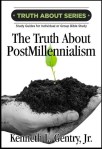
The Truth about Postmillennialism

By Ken Gentry

A group Bible study guide for explaining the optimistic prophetic hope for this world to be accomplished before Christ’s Second Coming. Establishes the postmillennial system in both the Old and New Testaments. Touches on key eschatological issues, such as creation, covenant, interpretive methodolgy, the great tribulation, the Book of Revelation, the Jewish Temple, and more. It presents and answers the leading objections to postmillennialism.Twelve chapters are ideal for one quarter of Sunday School.

See more study materials at: www.KennethGentry.com


Our Lord employs it twice elsewhere in his explanations of the parables of the tares and the drawn net (Matt. 13:39, 40, 49). In the former he declares that “the harvest is the end of the world,” and explains that to mean that, as, “the tares are gathered up and burned with the fire; so shall it be in the end of the world; the Son of Man shall send forth his angels, and they shall gather out of his kingdom all things that cause stumbling, and them that do iniquity, and shall cast them into the furnace of fire: there shall be weeping and gnashing of teeth; then shall the righteous shine forth as the sun in the kingdom of their Father.” In the latter he explains that in the end of the world” the angels shall come forth, and sever the wicked from among the righteous, and shall cast them into the furnace of fire: there shall be the weeping and the gnashing of teeth.” “The end of the world” here is clearly the last judgment and the consummation of the kingdom.

Continue reading

THE GOSPEL, SECOND COMING & ‘THIS AGE’ (1)

PMW 2022-099 by B. B. Warfield

Gentry note:
This article (under the shorter title “The Gospel and the Second Coming”) is from volume 1 of The Selected Shorter Writings of B. B. Warfield. It gives Warfield’s brief argument for postmillennialism. It also shows that this theological giant back in the early 1900s recognized the two-age structure of redemptive history (“this age” and “the coming age”). This is significant in that some current-day writers wrongly believe is an amillennial construct, despite being held by Greg Bahnsen, Keith Mathison, me (!) and others. Though I do not agree with ever angle he presents within, here is Warfield’s insightful article.

The Gospel, Second Coming & “This Age”

The Millennium
The term “millennium” has entered Christian speech under the influence of the twentieth chapter of the book of Revelation. From that passage, imperfectly understood, there has also been derived the idea that is connected with this term. We say, from that passage imperfectly understood. For the book of Revelation is a symbolic book; that is to say, what it describes it describes not directly but indirectly, through the medium of symbols. To take its description literally is therefore to substitute the symbol for the reality. That is what is done when the opening verses of the twentieth chapter are read as if they predicted a period of long duration in the earthly history of the Church, in which Satan is to deceive the nations no more and the resurrected martyrs are to live and reign with Christ.

Continue reading