1 JOHN 2:2 BY B. B. WARFIELD (1)

Cross all men“Jesus Christ the Propitiation for the Whole World” (1)
PMW 2025-069 by Benjamin B. Warfield

[Gentry note: This is an excellent article by renowned postmillennial Princeton scholar, B. B. Warfield.]

“And he is the propitiation for our sins; and not for ours only, but also for the whole world.”
(1 John 2:2)

As a means of comforting Christians distressed by their continued lapses into sin, John, in the opening words of the second chapter of his first Epistle, is led to assure them that “we have an Advocate with the Father, Jesus Christ, a Righteous One”; and by way of showing how prevailing his advocacy is, to add, “And he is himself a propitiation for our sins.” There he might well have stopped. Continue reading

WHEN DOES THE ‘ALREADY’ END?

PMW 2025-072 by Ardel Caneday

Gentry Note:
This article on the Two-Age redemptive historical scheme is quite helpful. After reading it, I wrote to Dr. Caneday (my old Grace Seminary friend) to let him know that not all postmills agree with Wilson and Brito on the matter. In fact, I follow Bahnsen in subscribing to Vos’ Two-Age view while maintaining the posmillennial hope. I am currently working on a book on the topic. If you would like to financial contribute to this project, please see my final note below. Even if you would not like to contribute, I hope you will before my hitmen set sail towards your house. But now for Caneday’s article:

“Already But Not Yet”: When Does the “Already” End? When Christ Returns or When Jerusalem’s Temple Was Destroyed?
by Ardel Caneday

Within my lifetime, not only academics but lay people also have become increasingly familiar with “the already but not yet”—the biblical concept of the overlapping of two ages—the present age and the age to come. This became evident when “Progressive Dispensationalism” emerged with the publication of Dispensationalism, Israel and the Church (1992). A feature that distinguishes this newer form of dispensationalism is the belief that Christ Jesus already reigns, fulfilling the promise to David (Psalm 110), but not yet are all his enemies put under his feet. Hence, concerning Christ’s reign, “inauguration is present, but consummation is not.”[1] While distinguishing their view from “Classical Dispensationalism,” they also contended that their “formulation of ‘the already, not yet’ kingdom” was different from George Ladd’s.[2] Nevertheless, they set in motion rapprochement with non-dispensationalists that accelerated profitable conversations among scholars from both views throughout the past thirty years.[3]

Continue reading

THE CENTER-POINT AND THE TWO AGES

PMW 2025-071 by Oscar Cullmann
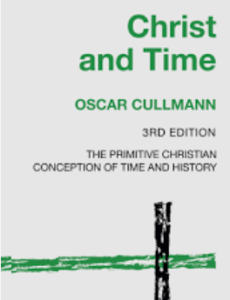
Gentry note: As I research my book on the Two-Age view of redemptive history, I have found an older work by Oscar Cullmann quite insightful and valuable. It was originally published in 1950, then as a third edition in 1962. The post below is from pages 81–84 of his book, Christ and Time.
Cullmann (pp. 81–84) We have seen that the Biblical time line divides into three sections: time before the Creation; time from the Creation to the Parousia; time after the Parousia. Even in Judaism we find interwoven with this threefold division, which is never discarded, the twofold division into this age and the coming one — a division that goes back to Parsiism. In this Jewish two-fold division everything is viewed from the point of view of the future. The decisive mid-point of the two-part time line here as the future coming of the Messiah, the coming appears of the Messianic time of salvation, with all its miracles. At that point we find in Judaism the great dividing point that separates the entire course of events into the two halves. This accordingly means that for Judaism the mid-point of the line which signifies salvation lies in the future. Continue reading

JESUS AGAINST DISPENSATIONALISM

PMW 2025-070 by Kenneth L. Gentry, Jr.

I have quickly glanced at several of the kingdom parables in my previous posts. In this posting I will continue doing so. This time we come to two parables that are strongly postmillennial: The parables of the mustard seed and of the leaven. Let’s quickly review this powerful parables.

The Parable of the Mustard Seed (Mt 13:31–32) and the Parable of the Leaven (Mt 13:33). These two parables instruct us regarding the kingdom’s gradual development and ultimate outcome. I will consider these parables a little more closely since they greatly impact the postmillennial argument.

Continue reading

POSTMILLENNIAL PARABLE OF THE SOWER

PMW 2025-068 by Kenneth L. Gentry, Jr.

The Apostle Matthew appears, at least in part, to place the Kingdom Parables in the narrative context, according to R. T. France, in order to explain the “problems” surrounding the kingdom. In Matthew 12:28 we read: “if I cast out demons by the Spirit of God, then the kingdom of God has come upon you.” But if the kingdom now exists, why does it not show itself? Remember: the Jews expect a political Messianic kingdom. Why does it appear so small and weak? Why do so many reject it? Indeed, most of Israel is rejecting the king, as we see in Mt 13:57: “And they took offense at Him. But Jesus said to them, ‘A prophet is not without honor except in his home town, and in his own household.’” Continue reading

DOMINION COMMANDED

PMW 2025-067 by Kenneth L. Gentry, Jr.

The postmillennial hope is not just a hope. It is a command given to use by Christ himself. We must exercise our hope in promoting his kingdom on earth.

The postmillennial view is the only one of the four major evangelical eschatologies that builds its case on the very charter for Christianity, the Great Commission (Mt 28:18–20). David Brown wrote over a century ago:

“The disciples were commissioned to evangelize the world before Christ’s second coming; not merely to preach the Gospel, ‘for a witness,’ to a world that would not receive it till he came again . . . but to accomplish, instrumentally, the actual ‘discipleship of all nations,’ to baptize them when gathered in, and to train them up as professed Christians in the knowledge and obedience of the truth, for glory – all before his second coming. In the doing of this, He promises to be with them – not merely to stand by them while preaching a rejected Gospel, and to note their fidelity, but clearly to prosper the work of their hands unto the actual evangelization of the world at large, before his coming.”
Continue reading

OUR EARTHLY HOPE

PMW 2025-066 by Kenneth L. Gentry, Jr.

In his letter to the troubled Corinthian church, Paul lists three Christians virtues while exhorting them to a closer walk with Christ: faith, hope, and love (1 Cor. 13:13). This three-fold cord of holy values provides a strong bond of commitment for the Christian, and has tied the Church of Jesus Christ together throughout the ages.

Faith and love are not only beautiful threads knitting together the fabric of the Christian life, but are easily recognized as such. They weave a strong carpet for the Christian walk; they serve as dual strands tugging us forward in our holy calling. And though hope is certainly not a detached thread from the Christian garment, it has been snagged loose and at best is only partially visible to the eye of faith today. Continue reading