
UNDERSTANDING THE OLIVET DISCOURSE

PMW 2022-058 by Kenneth L. Gentry, Jr.

On this site, my most popular postings deal with either the Book of Revelation or the Olivet Discourse. The main focus of my site is obviously the postmillennial hope and its affirmation of the glorious progress of the gospel to victory in history. However, the judgment issues emphasized in both Olivet and Revelation are necessary to understand if one is going to defend gospel victory.

I recently spoke at a conference where I gave five lectures on Matthew’s version of the Olivet Discourse. This was videotaped and is now in available as a DVD set titled “Understanding the Olivet Discourse.” The lectures were well received and the DVDs are doing well, for which I am thankful and encouraged.

The five lectures I presented covered all the major issues in Matthew 24–25, providing a helpful study on this noteworthy teaching by Christ. In the present article I will provide a brief introduction to the lectures, hoping to whet your appetite. This DVD set should be a helpful means for presenting the orthodox preterist view of the Lord’s great discourse. I highly recommend your buying it for that purpose — as does my wife, two of my three children, and two of my six grandchildren (the others were in bed asleep when I asked them if they would recommend viewing the lectures, due to elementary school starting the next day).

Continue reading

REVELATION’S PARAENETIC IRRELEVANCE?

PMW 2022-058 by Kenneth L. Gentry, Jr.

Many opponents of the preterist analysis complain that it removes any practical usefulness and continuing relevance of Revelation today. This is a rather common complaint. It arises from the evangelical conviction that “all Scripture is inspired by God and profitable for teaching, for reproof, for correction, for training in righteousness” (2 Tim 3:16). Thus, if it renders Revelation irrelevant, it must not be a proper hermeneutic approach.

Continue reading

A NEW HYPERPRETERISM REBUTTAL

PMW 2022-057 Kenneth L. Gentry, Jr.

Though Hyperpreterism (a.k.a. Full Preterism) remains a small movement, it also remains a tenacious and noisy one. While Hyperpreterists believe they are giving sound advice regarding biblical interpretation and scriptural eschatology, they provide 99% sound and only 1% advice.

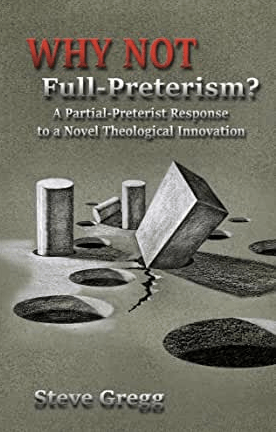
Yet Hyperpreterism does exist and it is present in some evangelical communities and local churches. Therefore, it is deserving of evangelical critiques. And Steve Gregg has provided a helpful, large-scale critique and rebuttal of this eschatological error, titled: Why Not Full-Preterism? A Partial-Preterist Response to a Novel Theological Innovation. Gregg is the host of the national Christian talk show, The Narrow Path. He is also the author of the invaluable book Revelation: Four Views: A Parallel Commentary (1997; rev. 2013).

Continue reading

APOSTOLIC SUFFERING

CryingPMW 2022-056 by Kenneth L. Gentry, Jr.

In my last blog article I introduced the question: “Is the church called to suffer?” The suffering church motif is widespread in evangelical theology. And one reason it is so is because the church is suffering and has long suffered. Another reason though is that there are numerous verses in the New Testament that seem to confirm this perception.

In the opening article I cited several well-known theologians who make this argument. How can the postmillennialist respond? I am dealing with this question in several articles because of its significance — and because of confusion regarding postmillennialism itself. Continue reading

CHRISTIANITY’S FIRST SUFFERING

PMW 2022-055 by Kenneth L. Gentry, Jr.Suffering christ

I am continuing a response to the claim that God has called the church to be a suffering church throughout her history. Though the church certain has suffered in her past and does suffer in the present. . . . And though she must suffer in patient faithfulness. . . . She is not called to always suffer on earth. She is faithfully suffering unto glory. Her time of victory will come before the end.

Let us now look at some other verses deemed to require that the church be always and only a suffering community. Continue reading

WHAT IS “SUFFERING”?

Jail BiblePMW 2033-054 by Kenneth L. Gentry, Jr.

I am continuing a postmillennial response to the evangelical claim that the church is called to suffer in history. If so, this would undermine the postmillennial hope. Postmillennial victory cannot be true if the church is always to suffer.

Now we must note:

Persecution is serious external oppression

As we reflect on this point in the debate we must bear in mind a vitally important matter: The only kind of suffering that contradicts post-millennialism is suffering rooted in dangerous external threats and oppression (especially when designed to suppress or punish the Christian faith). The New Testament era Christians are indeed a suffering people, enduring “threats and murder” (Ac 9:1–2), capital punishment (Ac 7:59; 12:1–2), and imprisonments and beatings (2Co 11:23–25), while being made a “public spectacle” and having their “property seized” (Heb 10:32–34). And were these conditions to continue until the end, postmillennialism could not be true. Continue reading

QUICK ARGUMENT FOR REVELATION’S EARLY DATE

PMW 2022-052 by Kenneth L. Gentry, Jr.

Introduction

Revelation 17:8–10 is an important passage that helps us determine the date in which John composed Revelation. That passage reads as follows:

[17:8] The beast that you saw was, and is not, and is about to come up out of the abyss and go to destruction. And those who dwell on the earth, whose name has not been written in the book of life from the foundation of the world, will wonder when they see the beast, that he was and is not and will come. [17:9] Here is the mind which has wisdom. The seven heads are seven mountains on which the woman sits, [17:10] and they are seven kings; five have fallen, one is, the other has not yet come; and when he comes, he must remain a little while.

Since there is a serious debate over the dating of Revelation, and since we are in one of the passages that offers us evidence for its date (Rev. 15–19), I thought I would introduce you to the debate. Continue reading