PRACTICAL OBJECTIONS CONSIDERED

Globe meltingPMW 2024-101 by Kenneth L. Gentry, Jr.

Ironically, the most hope-filled eschatology is the least liked in our contemporary setting. And this despite its strong presence in the 1600-early 1900s. As we contemplate this fact, we must recognize that the most popular objections against postmillennialism are practical concerns. They are frequently brought against postmillennialism in the popular literature. But to no avail, for there are easy answers to them. Let’s see how this is so.

“World conditions contradict postmillennialism”

Too many evangelicals get their understanding of biblical prophecy from reading the newspapers through their faulty interpretive lens. They point out a truly conservative Christian concern: America is in a great moral and spiritual decline today. And such a decline contradicts postmillennialism’s historical expectations. For instance, dispensationalist theologian Paul N. Benware responds against postmillennialism that “the idea that the world is getting better and better does not at all seem to be in line with reality. The evidence points rather to a world that is growing more and more wicked.”]
Continue reading
POSTMILLENNIALISM IN ACTS AND PAUL

Paul preachingPMW 2024-100 by Kenneth L. Gentry, Jr.

Though we had a brief interruption in this series due to a special Christmas article, we are now back to considering the presence of postmillennialism the New Testament. We are now in the Book of Acts as we move beyond the Gospels themselves. Having shown the establishment, expectation, and exhortation to the postmillennial hope in the teachings of Jesus, we now look just briefly at the proclaiming of the kingdom by his apostles after his departure to heaven.

The Gospels fit perfectly in the coherent message of Scripture that begins in creation, develops through covenant, and is promised victory in the Psalms and Prophets. And all that we learn in the Gospels undergirds what we hear so frequently in the remainder of the New Testament: the proclamation of the “kingdom of God.” In Acts 3:15 Peter preaches Christ as the “prince of life.” In Acts 5:29 he asserts his obligation to disobey civil authority when it demands that he cease preaching Christ. His rationale is important: “He is the one whom God exalted to His right hand as a Prince and a Savior” (Acts 5:31). The word “prince” here may literally be translated “leader, ruler, prince.” He is exalted as prince or ruler. Continue reading

CHRISTMAS AND POSTMILLENNIALISM

PMW 2024-099 by Kenneth L. Gentry, Jr.

Christmas is here, and quite appropriately it will be followed by a new year. Since Christ came to effect a new creation!

We must not forget the message of Christmas; we must take it with us in the new year God is granting us. So as we enter this season, let us consider the postmillennial hope embedded in Christmas. Unless my memory fails me, Bing Crosby sang: “I’m Dreaming of a Postmillennial Christmas.” If he did not, he should have! Whereas Elvis was apparently an amillennialist when he sang: “I’ll Have a Blue Christmas.” Which might explain the howling of the Jordanaires in the background of this song.

Postmillennialists can easily use Christmas texts to present the postmillennial hope. Continue reading

POSTMILLENNIALISM IN THE GOSPELS (3)

PMW 2024-098 by Kenneth L. Gentry, Jr.

Having well-introduced the presence of the postmillennial hope in Jesus’ teaching in the Gospels, we now come to his formally commissioning his disciples for world-wide dominion. Christianity is not to end up like the Essenes in Qumran: a brief blip in religious history destined to quickly fade away. Christ is establishing his kingdom for the long run, as we can see in the Great Commission

As a king ruling over a kingdom destined to grow, the Lord directs his servants to promote that growth. And as their sovereign, he not only commands their labor but promises his presence with them to accomplish his goal. He is a king with a mission.

Christ’s post-resurrection, pre-ascension Great Commission clearly declares his enthronement and his mission to world conquest. We must hear and follow the sovereign declaration of the risen Lord.

“And Jesus came up and spoke to them, saying, ‘All authority has been given to Me in heaven and on earth. Go therefore and make disciples of all the nations, baptizing them in the name of the Father and the Son and the Holy Spirit, teaching them to observe all that I commanded you; and lo, I am with you always, even to the end of the age.’” (Matt 28:18–20)

Continue reading

POSTMILLENNIALISM IN THE GOSPELS (2)

Mustard SeedPMW 2024-097 by Kenneth L. Gentry, Jr.

This is the second in a series on postmillennialism in the Gospels. In this article I will highlight the optimistic expectation for the advance of the kingdom in history.

Jesus presents his kingdom through his teaching and his practice, his words and his actions. He especially describes his kingdom in his Kingdom Parables, one of his major recorded discourses (Matt 13:1–52). Here he speaks in parables so that his followers might “know the mysteries of the kingdom of heaven” (Matt 13:11). These parables explain the mystery character of the kingdom, highlighting its hidden nature, small presence, and wavering condition (Matt 13:9–17, 19–22, 35–28, 31, 33, 44–45).

The Lord does not present a kingdom such as the first-century Jews and current-day dispensationalists expect. He does not lead a catastrophically-imposed, immediately-victorious, globally-dominating, military-political kingdom. Rather, he teaches something radically different. In fact, even his followers (who held first-century Jewish expectations) are initially confused about his kingdom: they “were hoping that it was He who was going to redeem Israel” (Luke 24:21; cp. Matt 13:36). Continue reading

POSTMILLENNIALISM IN THE GOSPELS (1)

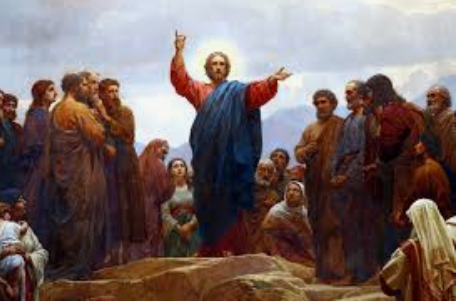
Christ preachingPMW 2024-097 by Kenneth L. Gentry, Jr.

THE APPROACHING OF THE KINGDOM

In the Gospels we discover Christ being introduced to Israel and the world through the ministry of John Baptist (Luke 1:76). John himself even fulfills prophecy by being the Messiah’s forerunner (Isa 40:3; Matt 3:3). He prepares the way for Jesus by preaching: “Repent, for the kingdom of heaven is at hand” (Matt 3:2). And Jesus picks up on this theme as he begins his own ministry in Mark 1:14–15:

“And after John had been taken into custody, Jesus came into Galilee, preaching the gospel of God, and saying, ‘The time is fulfilled, and the kingdom of God is at hand; repent and believe the gospel.’”

Let’s consider three crucial factors flowing out of this important pronouncement.

First, Jesus declares “the time” has arrived. What is “the time” to which he refers? It surely speaks of the prophetically-anticipated time, the time of the coming of David’s greater Son to establish his kingdom. We may surmise this in that he immediately adds: “the kingdom of God is at hand.” After all, the Father sent Christ into the world in “the fullness of time” (Gal 4:4; Eph 1:10), to initiate the “favorable year of the Lord” (Luke 4:16–21). This favorable year of the Lord is also called “the acceptable time . . . the day of salvation” (2 Cor 6:2). It is the very day righteous men and angels in the old covenant long desired to see (Matt 13:17; Luke 2:28–30; 10:24; John 8:56; Heb 11:13, 39–40; 2 Pet 1:10–11). Continue reading

TWO AGES ARE NOT TWO COVENANTS

Two ages sunPMW 2024-095 by Kenneth L. Gentry, Jr.

Through my GoodBirth Ministries I am seeking to raise support to allow me to work virtually full time on a new book on the two ages of redemptive history. This two-age concept, along with its corollary, the “Now but Not Yet” principle, are essential for understanding God’s plan in history. Much confusion regarding this matter reigns among evangelical Christians, especially among those who are not well-trained in academic issues related to eschatology.

In this article I simply want to briefly introduce the idea of the two ages. And I want to do so by showing that it has wide support among the three major eschatological views (obviously excluding dispensationalism, which is losing its academic voice in the market place of ideas). In my planned book on the two ages, I will provide about 250 pages of arguments to flesh out this crucial matter. But for now, I will show that I am not alone! Continue reading