RE-IMAGINING THE MILLENNIUM (4)

Heavenly hostPMW 2025-07 by Kenneth L. Gentry, Jr.

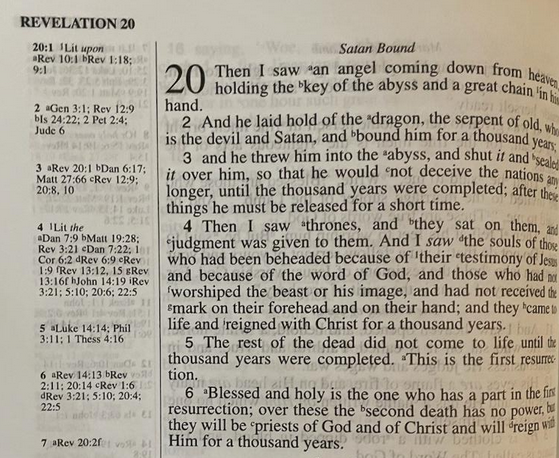
I am continuing a study of that pesky passage, Revelation 20, which so dominates eschatological discussions. I believe that this passage is almost totally misconstrued by the large majority of scholars and lay readers, as I have been noting. But now I am ready for my last comments on the matter as we come to John’s statement regarding:

The Rest of the Dead

Now having changed my view regarding the occupants on the thrones of Revelation 20:4, another issues arises: Who are “the rest [hoi lopoi] of the dead” (Rev 20:5) that are being set over against the enthroned ones? Since Revelation 20:1–6 is linked with Revelation 19:11–21, John’s context offers a clue to understanding “the rest of the dead” who “did not come to life until the thousand years are completed” (Rev 20:5). We should interpret this group contextually in terms of John’s literary flow and dramatic story-line. Continue reading
RE-IMAGINING THE MILLENNIUM (3)

MartyrPMW 2025-006 by Kenneth L. Gentry, Jr.

I am continuing a study on Revelation 20 and the “millennium.” This passage is radically misinterpreted virtually throughout contemporary discussions. So, here I continue my thoughts from my last posting.

The Explanation Offered

My three changes appear in two places in the text. Though seemingly small, they carry radical implications. In my view, the eschatological debate (the “millennial” views) does not need to come to Revelation 20 at all. It is better waged elsewhere in Scripture — almost everywhere else in Scripture (hence the size of my He Shall Have Dominion: A Postmillennial Eschatology, which builds up the postmillennial eschatology from a wide range of Old Testament and New Testament Scriptures). Postmillennialism and amillennialism certainly do not depend on Revelation 20, though dispensationalism and premillennialism absolutely do. In fact, Revelation 20, though serving as the foundational passage for premillennialism and dispensationalism, actually creates irresoluble problems that undermine those systems. Continue reading

RE-IMAGINING THE MILLENNIUM (2)

Revelation 20PMW 2025-005 by Kenneth L. Gentry, Jr.

I am continuing some reflection upon the millennial passage in Revelation 20. Rightly or wrongly, this text dominates the eschatological discussion. Before reading this article, you will need to read the preceding one.

The Issues Impacted

First, I originally held that two groups were in view Revelation 20:4. I held the common Augustinian view that the martyrs represent deceased Christians in heaven (the Church Triumphant) and the confessors represent living saints on the earth (the Church Militant). And together these two groups picture all Christians throughout Church history. I no longer accept this interpretation.

Second, I also previously held that the fact that they “came to life and reigned with Christ” (Rev 20:4c) portrayed the new birth experience, where the Christian arises from spiritual death to sit with Christ in heavenly places. I still believe this doctrinal position, for it is taught in various places in Scripture (see especially Eph 2). But I do not believe this is a proper exegetical position here in Revelation 20. In other words, I now believe that this view is good theology but bad exegesis — if we try to draw it from Revelation 20.
Continue reading

RE-IMAGINING THE MILLENNIUM (1)

PRevelation commentariesMW 2025-004 by Kenneth L. Gentry, Jr.

Revelation 20 is not only a hotly debated passage in a hotly debated book, but it is a passage that has greatly impacted the eschatological debate. And unnecessarily so! According to Warfield, Revelation 20 is the tail that wagged the dog. And he is correct.

Revelation 20 has given the name to the several eschatological schools: premillennialism, amillennialism, and postmillennialism. Each name has “millennium” (which means, “thousand years”) in it, which is obviously drawn from Revelation 20. This text’s outsized impact on the eschatological debate is unfortunate for several reasons: (1) the idea of a thousand year reign of Christ is only found in one book; (2) it is only found in one chapter of that one book; (3) it is only found in one-half of that one chapter of that one book; and (4) that book is the most symbolic book in all of Scripture.
Continue reading

BIBLICAL OBJECTIONS CONSIDERED (2)

Burning churchPMW 2025-003 by Kenneth L. Gentry, Jr.

This is my second article on biblical objections to postmillennialism. Biblical objections are serious. If they are based on a proper understanding of the biblical passage being brought forward. Unfortunately, attempts to undermine postmillennial using Scripture passages also fails for lack of proper evidence. I must be brief, but I will consider two passages frequently thrown against the postmillennial hope.

Luke 18:8

“I tell you that He will avenge them speedily. Nevertheless, when the Son of Man comes, will He really find faith on the earth?”

Regarding this verse dispensationalists Wayne House and Thomas Ice argue that: “This is ‘an inferential question to which a negative answer is expected.’ So this passage is saying that at the second coming Christ will not find, literally, ‘the faith’ upon the earth.” Were this the case, postmillennialism would certainly be mistaken. How could Christians be optimistic if the entire Christian faith is prophetically determined to disappear from the earth? Unfortunately for the pessimistic readings of this passage, this is not the case as we may see from the following observations:
Continue reading

BIBLICAL OBJECTIONS CONSIDERED (1)

Bible DebatePMW 2025-002 by Kenneth L. Gentry, Jr.

In this brief series I am considering objections thrown up against the postmillennial hope. The most serious class of problems for any eschatological system is the biblical objection. If one’s eschatology does not arise from Scripture itself, it is not a biblical doctrine. We must have a “thus saith the Lord” justifying our prophetic system. Let us consider some of the leading biblical texts brought against the postmillennial hope.

MATTHEW 7:13–14

“Enter by the narrow gate; for wide is the gate and broad is the way that leads to destruction, and there are many who go in by it. Because narrow is the gate and difficult is the way which leads to life, and there are few who find it.”

This famous passage seems to undermine the postmillennial hope of a world converted to Christ. How does postmillennialism account for this comment by our Lord himself? Continue reading

DOCTRINAL OBJECTIONS CONSIDERED

Sin 2PMW 2025-001 by Kenneth L. Gentry, Jr.

As I am considering objections to postmillennialism, I will not move from popular practical objections to a more serious class of objections: those related to doctrinal issues. Eschatology is a doctrine, therefore, any doctrinal problems would be self-destructive for the system.

“SIN UNDERMINES THE POSTMILLENNIAL HOPE”

Many evangelical scholars reject postmillennialism because of the Bible’s strong commitment to the doctrine of sin. According to amillennialist Hanko, postmillennialism “is a mirage, therefore, a false hope, because it fails to reckon properly with the fact of sin” and “cannot take sin as seriously as do the Scriptures.” This sounds like a strong objection on the surface. Its beauty, however, is only skin deep. Continue reading