Category Archives: Uncategorized

REVELATION’S “MANY WATERS” AND JERUSALEM (1)

PMW 2022-059  by Kenneth L. Gentry, Jr.

The “many waters” mentioned in Revelation 17 is often used to counter the Jewish-harlot interpretation of Revelation.

Rev. 17:1 and 15 read:

Then one of the seven angels who had the seven bowls came and spoke with me, saying, “Come here, I will show you the judgment of the great harlot who sits on many waters” (v. 1).

And he said to me, “The waters which you saw where the harlot sits, are peoples and multitudes and nations and tongues” (v. 15).

This is a frequent challenge brought against the Babylon=Jerusalem interpretation. And it certainly offers a reasonable interpretation. In fact, it is a key argument in favor of the identity of the harlot as Rome among standard preterists (as opposed to my Redemptive-historical preterism, which sees the bulk of Revelation as directed against Jerusalem and Israel). Thus, it deserves a response. I will provide a two part response, beginning in this posting and continuing in the next. Continue reading

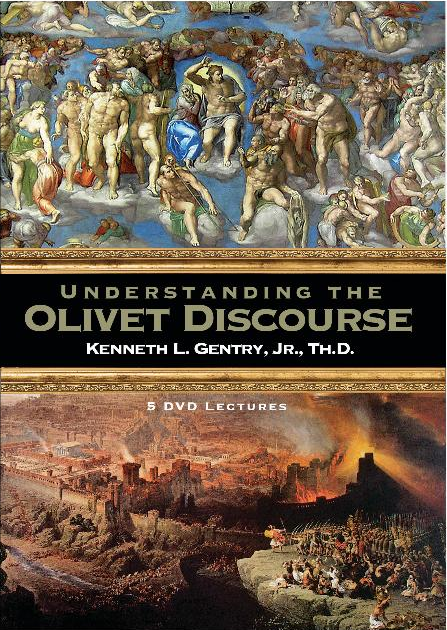
UNDERSTANDING THE OLIVET DISCOURSE

PMW 2022-058 by Kenneth L. Gentry, Jr.

On this site, my most popular postings deal with either the Book of Revelation or the Olivet Discourse. The main focus of my site is obviously the postmillennial hope and its affirmation of the glorious progress of the gospel to victory in history. However, the judgment issues emphasized in both Olivet and Revelation are necessary to understand if one is going to defend gospel victory.

I recently spoke at a conference where I gave five lectures on Matthew’s version of the Olivet Discourse. This was videotaped and is now in available as a DVD set titled “Understanding the Olivet Discourse.” The lectures were well received and the DVDs are doing well, for which I am thankful and encouraged.

The five lectures I presented covered all the major issues in Matthew 24–25, providing a helpful study on this noteworthy teaching by Christ. In the present article I will provide a brief introduction to the lectures, hoping to whet your appetite. This DVD set should be a helpful means for presenting the orthodox preterist view of the Lord’s great discourse. I highly recommend your buying it for that purpose — as does my wife, two of my three children, and two of my six grandchildren (the others were in bed asleep when I asked them if they would recommend viewing the lectures, due to elementary school starting the next day).

Continue reading

REVELATION’S PARAENETIC IRRELEVANCE?

PMW 2022-058 by Kenneth L. Gentry, Jr.

Many opponents of the preterist analysis complain that it removes any practical usefulness and continuing relevance of Revelation today. This is a rather common complaint. It arises from the evangelical conviction that “all Scripture is inspired by God and profitable for teaching, for reproof, for correction, for training in righteousness” (2 Tim 3:16). Thus, if it renders Revelation irrelevant, it must not be a proper hermeneutic approach.

Continue reading

IS THE SECOND ADVENT “IMMINENT”? (2)

PMW 2022- by Kenneth L. Gentry, Jr.

In my last article I opened a brief analysis of the doctrine of the imminent return of Christ. I began setting up the matter and also showing its problems for dispensationalism. In this article I will conclude the study.

Often dispensationalists try to distinguish between Christ’s return being imminent and its being soon. This strives to protect them against charges of date-setting. This does not protect them from the charge, however, because it is inconsistently held.
In a letter to me dated June 1, 1994, from Thomas D. Ice, Executive Director of the Pre-Trib Research Center, Ice writes: “We distinguish between imminent and soon in the sense that soon would require a near coming, while imminent would allow, but not require a soon coming.” Bundled in that very letter was his first newsletter entitled: “The Pre-Trib Research Center: A New Beginning.” The first sentence of the newsletter (once past the headings) was: “Our purpose is to awaken in the Body of Christ a new awareness of the soon coming of Jesus.” The system giveth and taketh away. In fact, in a book edited by Ice, Tim LaHaye speaks of “the soon coming of Christ.” Continue reading

THE STRENGTH OF PRETERISM IN REVELATION

PMW 2022-034 by Kenneth L. Gentry, Jr.

I am an exegetical preterist. By that I mean that I come to the text of Scripture and am led by the textual indicators in many biblical passages to adopt a preterist analysis of those passages. I am not a theological preterist. A theological preterist is one who comes to Scripture with the pre-commitment that all prophecy has been fulfilled and preterism controls all of biblical eschatology.

Many theological preterists (aka Hyper-preterists) began as partial preterists but in their excitement they took a bridge too far. This is like an enthusiastic Calvinist who becomes a Hyper-Calvinist. He refuses to do personal evangelism and invest in missions because God is absolutely sovereign and will see that all the elect are saved. The Hyper-Calvinist is certainly Calvinistic, but he has abused the Cavinistic system. Sadly, the Hyper-preterist has a heavy-duty HP hammer and every Bible verse he sees looks like a nail to be driven into his system. Thankfully more and more of those who shot beyond the bounds of historical preterism to become Hyper-preterists are beginning to make their way back to a full evangelical faith.

Unfortunately, like a squeaky wheel those who abuse a system tend to get much attention for the grating noise they make. And even more sadly, it is easy to write-off a system because of some proponents who have taken it too far.

But the orthodox preterist must answer serious objections to the preterist system. And in the book of Revelation there are many issues that can raise serious objections. One objection that I often hear is: Since Revelation is almost wholly fulfilled it is irrelevant to use today. There seems to be no point in our having it in the Bible.

The problem with this complaint is that we could do away with much of the Bible on that basis. For instance, Paul’s letter to the Corinthian church is very personal and deals with several local issues troubling that church 2000 years ago. Yet, what Christian would declare 1 and 2 Corinthians to be irrelevant to us today?

Properly considered, Revelation is somewhat like 1 Corinthians in that it deals with ancient issues, but in a way that establishes abiding principles for us today. I will have more to say on this in a later PostmillennialWorldview article. But for now, we need to press the point that: When Revelation was written, it was much needed in the era of the establishing of the new covenant church in the world.

______________________________________________________________________________________________________________

The Book of Revelation Made Easy

This book introduces the reader to the reasons for the preterist analysis of Revelation. Very helpful for those who are not acquainted with the strengths of preterism in Revelation.

This book is available at : http://www.KennethGentry.com

_____________________________________________________________________________________________________________

Three of the leading strengths of preterism are due to its original relevance:

First, preterism’s relevance. Preterism retains and emphasizes the relevance of Revelation for John’s first-century audience (the seven churches in Asia Minor and apostolic Christianity more broadly, Rev. 2–3). The nascent faith was enduring a worsening period of persecution and oppression (1:9; 6:9–11; 14:13; 17:6) that would require Christians to strive to “overcome” (2:7, 11, 17, 26; 3:5, 12, 21).

John writes to a particular people at a particular time, and those people are urged to carefully “hear” (1:3) what Revelation presents. As Isbon Beckwith (319) well notes: “Like ‘every scripture inspired of God’ the Apocalypse was certainly meant to be to those to whom it first came ‘profitable for teaching’ (2 Tim. 3:16), and so the writer must have counted on its being understood in its chief lessons.” This differs radically from futurism which must argue that “the full meaning of the Apocalypse shall only be understood ‘when all has come to pass’ (Abraham Kuyper, p. v). John Walvoord (8) admits that “as history unfolds and as prophecy is fulfilled in the future, much will be understood that could be only dimly comprehended by the first readers of the book.”

Second, preterism recognizes John’s time-frame. Preterism takes seriously Revelation’s time-frame indicators: “the things which must shortly take place” (1:1, 22:6) in that “the time is near” (1:3; 22:10). These temporal qualifiers appear in the introduction and the conclusion of Revelation, so that any unprejudiced original reader should expect that what he will hear and what he should understand is a prophecy about fast-approaching events. Not only so but these temporal delimiters appear well before and immediately after the perplexing symbolic visions. Consequently, they appear in the more didactic and less dramatic sections.

Third, deals with a fundamental redemptive-historical issue. Preterism dramatically presents major redemptive-historical matters: the demise of Judaism and the temple system (after 2000 years of Jewish focus and 1500 years of tabernacle/temple worship) and the universalizing of the Christian faith as it permanently breaks free of its maternal bonds to temple-based Israel. We must understand that “the patriarchal family was only a stage in the development of the people of God, so national and territorial Israel in the Old Testament period was a stage toward the development of an international and global people of God. This is not just a ‘Christian idea’ but intrinsic to the Old Testament itself” (N. T. Wright 1994: 2). Wright notes the OT evidence, citing especially Zech. 2:11a: “And many nations will join themselves to the Lord in that day and will become My people.” See also: Gen. 12:3; Psa. 22:27; 47:8ff; 72:17; 86:9; 87:1ff; 102:13–22; Isa 11:1–9, 10, 12; 19:19–25; 25:1ff; 42:6; 44:5; 45:22ff; 49:6; Jer. 16:19; Amos 9:12; Hag. 2:6ff; Zech. 8:20—23; Mal. 1:11.

During its earliest years Christianity gravitates to the temple (e.g., Acts 2:46; 3:1; 5:20, 42; 21:26; 22:17; 24:11) and Jerusalem (e.g., Acts 1:4; 6:7; 8:1; 15:2; 19:21). Thus, this covenantal transition is a major, recurring theme in the NT. We see this especially in Hebrews which has this as its central, controlling point: John “depicts the replacement of the Old Covenant by Christianity in language reminiscent of the epistle to the Hebrews” (Martin Hopkins, 44). But we also witness numerous allusions to AD 70 in many texts in the Gospels (e.g., Matt. 8:11–12; 21:43; 22:1–7; 23:35–38; 24:1–34) as well as elsewhere (Acts 2:16–21, 37–40; 7:48–53; 1Thess. 2:14–16).

Fourth, preterism establishes an example for all ages of the church. By enduring such catastrophes as appearing in Revelation, the first-century church serves as an example of Christ’s providential protection of his people — giving hope for not only that day but all ages. If Christ can deliver the church in its infancy during its weakest stage of development from two ubiquitous enemies, then the future looks bright with hope.

____________________________________________________________________________________________________________

The Book of Revelation and the Postmillennial Hope (DVD lectures)

These three 50-minute lectures explain how Revelation does not contradict the postmillennial hope, as many assume.

This DVD set is available at : http://www.KennethGentry.com

LEV 10 AS DIVINE PROHIBITION?

PMW 2018-037 by Kenneth L. Gentry, Jr.

One of the recurring images of the postmillennial advance of the kingdom in Scripture is of the joy exhibited by use of wine. We see this in Isaiah 25:6; 55:1; Joel 2:19; 2:24; 3:18; Amos 9:13; and Zechariah 10:7.

Unfortunately, there are Christians who oppose any consumption of alcohol (even in moderation) and who therefore miss the beauty of this image. And they have several Scriptures they bring to the debate. One frequently cited passage in Leviticus 10:8–11:

The LORD then spoke to Aaron, saying, “Do not drink wine or strong drink, neither you nor your sons with you, when you come into the tent of meeting, so that you may not die — it is a perpetual statute throughout your generations — and so as to make a distinction between the holy and profane, and between the unclean and the clean, and so as to teach the sons of Israel all the statutes which the LORD has spoken to them through Moses.”

Continue reading

IS REVELATION PAST? (3)

PMW 2021-028 by Kenneth L. Gentry, Jr.

This is my third installment on the question of the evidence that Revelation was fulfilled in the first century. As surprising as this conclusion is for the modern evangelical, the proof is in Revelation itself. In this article I will consider the Historical Indicators for preterism.

I agree with the Puritan Talmudic scholar, John Lightfoot: Revelation appears to prophesy Christ’s judgment upon the Jews in A.D. 70. John’s opening statement of purpose (1:7), the seven letters (2:9; 3:9), and the body of Revelation (4-19; e.g., 7:1-8; 11:1-8) all reflect this truth.

Just after mentioning the nearness of the events (1:1, 3) and just before alluding to the dire circumstances of his original audience (1:9), verse 7 warns: “Behold he comes with the clouds, and will see him every eye and those who him pierced, and will wail over him all the tribes of the land. Yes, amen” (Alfred Marshall, The Interlinear Greek-English NT; cp. Robert Young, Literal Translation). Though this sounds like a Second Advent reference, the following evidence points to A.D. 70.

Coming with the Clouds

Cloud-coming language often speaks of historical divine judgments. For instance, Isaiah 19:1a warns: “An oracle concerning Egypt: See, the LORD rides on a swift cloud and is coming to Egypt” (cp. Ps 18:7-15; 104:3; Joel 2:1,2; Na 1:2ff.; Zep 1:14,15). This speaks of the Assyrian king Esarhaddon conquering Egypt in 671 B.C. As Young notes: “The scene does not necessarily suggest that the Lord comes from the Temple at Jerusalem nor from heaven, but merely that He comes as a judge” (Isaiah, 2:14), i.e., providentially, not personally.

Interestingly, John follows Jesus in merging Zechariah 12:10 and Daniel 7:13. Like John, Jesus mentions the “coming on the clouds” (cp. Mt 24:29-30) against Israel (Mt 23:36-24:2, 16). And like John, Jesus ties the events to the near future: “all these things shall come upon this generation” (Mt 24:34).

Those Who Crucified Christ

Christ’s judgment-coming is against: “they who pierced him.” Jesus blames the Jews for his death: “Christ began to show His disciples that He must go to Jerusalem, and suffer many things from the elders and chief priests and scribes, and be killed” (Mt 16:21; cp. Mt 20:18-19; 21:33-43; Mk 8:31; Lk 9:22). The apostles also lay the covenantal blame for his crucifixion upon Israel: “Then know this, you and all the people of Israel: It is by the name of Jesus Christ of Nazareth, whom you crucified” (Ac 4:10a; cp. Jn 19:5-15; Ac 2:22, 23, 36; 3:14, 15; 4:8-10; 5:30; 10:39; 1Th 2:14-16). Revelation 1:7 must refer to the first century in that those who “pierced him” are now long since deceased.


Survey of the Book of Revelation

(DVDs by Ken Gentry) Twenty-four careful, down-to-earth lectures provide a basic introduction to and survey of the entire Book of Revelation. Professionally produced lectures of 30-35 minutes length.

See more study materials at: www.KennethGentry.com


The Tribes of the Land

This judgment brings mourning upon “all the tribes of the land” (1:7; Marshall’s Interlinear). These “tribes” (phyle) must be the tribes of Israel (cf. Mt 19:28; Lk 22:30). TDNT notes that the Septuagint “with few exceptions . . . has phyle, so that this becomes a fixed term for the tribal system of Israel” (9:246). Revelation clearly mentions those Jews who were saved out from “the tribes” of Israel (7:4-8; cp. 21:12); and John sets these over against other “tribes and peoples” beyond Israel (7:9; cp. 11:9).

What is more, John associates these “tribes” with “the land” (tes ges), the well-known Promised Land (cp. Lk 21:23). As Edersheim observes: “Palestine was to the Rabbis simply ‘the land,’ all other countries being summed up under the designation of outside the land.”1 Indeed, the OT mentions “the tribes” and “the land” together in numerous instances (e.g., Ge 49:16; Nu 26:55; Jos 14:1; 19:51; Eze 45:8; 48:29).

In the seven letters John specifically mentions the defection of the Jews from God. He even informs the churches that Christ will vindicate them by judging the Jews:

• “I know your tribulation and your poverty (but you are rich), and the blasphemy by those who say they are Jews and are not, but are a synagogue of Satan.(2:9)

• Behold, I will cause those of the synagogue of Satan, who say that they are Jews, and are not, but lie, behold, I will make them to come and bow down at your feet, and to know that I have loved you.” (3:9)2

Surely this humiliation of the Jews was in the lifetime of the recipients of Revelation — in A.D. 70 when the Jews were “cast out” (Mt 8:10-12) and the kingdom was given to the gentiles (Mt 21:40-43).

The Temple and Holy City

Revelation expressly mentions the coming destruction of the temple, and with language drawn from the Olivet Discourse.

“Jerusalem will be trampled on by the Gentiles until the times of the Gentiles are fulfilled” (Lk 21:24b).

“But exclude the outer court; do not measure it, because it has been given to the Gentiles. They will trample on the holy city for 42 months” (Rev 11:2).

Note that both of these passages inform us that the “holy city/Jerusalem” will be “trampled” by the “gentiles.” And both appear in prophecies confined to the short term (1:1, 3; 22:6, 10; Lk 21:31-32). Evidently, these texts are referring to the same events, with John deriving his cue from Christ’s discourse about A.D. 70 (Lk 21:6-7).


Blessed Is He Who Reads: A Primer on the Book of Revelation By Larry E. Ball

A basic survey of Revelation from an orthodox, evangelical, and Reformed preterist perspective. Ball understands John to be focusing on the destruction of Jerusalem and the temple in AD 70. Insightful. Easy to read.

For more Christian studies see: www.KennethGentry.com


Interestingly, the time of the formal imperial engagement of the Jewish War until the destruction of the temple was forty-two months. According to Bruce, after the initial Jewish uprising in A.D. 66, Vespasian “arrived the following spring [A.D. 67] to take charge of operations. . . . Titus began the siege of Jerusalem in April, 70. The defenders held out desperately for five months, but by the end of August, the Temple area was occupied and the holy house burned down, and by the end of September all resistance in the city had come to an end.”3 From Spring A.D. 67 to September A.D. 70, covers a period right at forty-two months. This is a remarkable correspondence which fits relevantly with all the other data.

And now: three down, one more to go! My next article will conclude this series.