
Category Archives: Theology

THEONOMY AND ACTS 25

Theonomy tablesPMT 2015-128 Kenneth L. Gentry, Jr., Th.D.

Theonomy is not an essential element of postmillennialism. Many postmillennialists are even opposed to theonomy. But it is a component of the form of postmillennialism that I have adopted. And it fits well with the outlook for future ethical conduct rooted in God’s word.

But some scholars point to Acts 25:11 as biblical evidence against the theonomic thesis.

“For if I am an offender, or have committed anything worthy of death, I do not object to dying; but if there is nothing in these things of which these men accuse me, no one can deliver me to them. I appeal to Caesar.” Acts 25:11

Continue reading

ESCHATOLOGY IN THE CHRISTIAN PHILOSOPHY OF HISTORY (2)

Philosophy History 2PMT 2015-043 by Kenneth L. Gentry, Jr.

Postmillennialism involves the whole system of biblical doctrine. In the basic Christian philosophy of history, eschatology is a key plank. In my last blog article I began a brief overview of the basic elements of the Christian view of history. In that article I focused on the basic doctrine of God. I will now complete my overview by considering the remaining elements.

Creation

All of reality derives from a personal, moral, sovereign being. The Christian’s creational viewpoint puts man under God and over nature (Ge 1:26–27; Ps 8). It imparts transcendent meaning to temporal history and sets before man a high calling. Continue reading

HAGEE’S ERRORS ON ISRAEL (3)

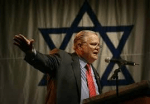
This is Part 3 of a three part review of Hagee’s widely-read, but wholly erroneous study of Israel. John Hagee 3Hagee, In Defense of Israel: The Bible’s Mandate for Supporting the Jewish State (Lake Mary, Flo.: FrontLine, 2007). This is a continuation of my last article highlighting Hagee’s theological errors.

4. The Jews are not responsible for Jesus’ death

Hagee vigorously argues that “one of those deadly New Testament myths is that the Jews killed Jesus, yet no justification can be found in the New Testament to support this lie” (p. 125). He defines Anti-Semitism as “a poisonous stream of venom” wherein “Christian leaders [labeled] the Jews as ‘Christ killers” (p. 20). He announces that “the Jews are not Christ killers” (p. 122). Continue reading

HAGEE’S ERRORS ON ISRAEL (1)

HageeThis is Part 1 of a three part review of Hagee’s very confused, very popular book on Israel: John Hagee, In Defense of Israel: The Bible’s Mandate for Supporting the Jewish State (Lake Mary, Flo.: FrontLine, 2007).

This book was written by New York Times best-selling author John Hagee, pastor of a 19,000 member megachurch in San Antonio. It presents the argument that the Christian Church is biblically obligated to support the political state of Israel on the basis of its fulfillment of biblical prophecy (pp. 84-85) and for the well-being of America (p. 84). It is virtually a hagiography for the Jews which borders on Judeolatry. Hagee almost implies that the Jews and Israel can do no wrong, for he does (as we shall see) call upon Christians to support them as we do God himself: unconditionally.

As I begin this review I have two confessions to make: (1) I had never read a Hagee book before, and (2) I never will again. This work presents dispensationalism gone to seed. The fact that he is a widely popular, multi-million selling, and influential Christian writer demonstrates the tragedy that “my people are destroyed for lack of knowledge” (Hos. 4:6). Continue reading

EXILE THEOLOGY v. DOMINION THEOLOGY

Christian dominionPMT 2014-135 By Larry E. Ball (author: Blessed Is He Who Reads: A Primer on the Book of Revelation)

The battle between Exile Theology and Dominion Theology is important to understand. It is vital to notice that both sides quote the Bible. It’s just a matter of which passages are quoted.

For example, the exile crowd reminds us that the faithful are like Abraham who was a stranger and an alien (exile) upon the earth (Heb. 11:13). Christians must set their affections on the things above and not on the things on the earth (Col. 3:2). We are to pass our time as sojourners here on the earth (1 Pet. 1:17). “For I reckon that the sufferings of this present time are not worthy to be compared with the glory which shall be revealed in us” (Rms. 8:18). Continue reading

CURRENT WEAKNESS; FUTURE GLORY

PMT 2014-099 by Kenneth L. Gentry, Jr.Heaven

You have suffered long enough: this is my last article in a series on the question of suffering, the church, and postmillennialism. I have been dealing with the charge that God has called the church to suffer in this age, which would seem to undermine the postmillennial expectation. But postmillennialists affirm the reality of suffering — and even in the time of Christianity’s highest advance before Christ returns! How can this be?

We must recognize that even the very height of earthly, postmillennial glory pales in comparison to the “weight of glory” that is ours, and that stirs our deepest longings as sons of God (cf. Php 1:23). As recipients of the mysteries of the kingdom of God, Christians experience “the heightened form which our desire for this future [resurrection] state assumes. For it is not mere desire to obtain a new body, but specifically to obtain it as soon as possible” (cf. 2Co 5:1–10) (G. Vos, Redemptive History, 46). Continue reading

IS THE CHURCH CALLED TO SUFFER?

PMT 2014-094 by Kenneth L. Gentry, Jr.Weeping

Most non–postmillennial eschatologies argue that the church is called to endure suffering throughout the entirety of history. They argue that they are optimistic, in that the church has a hope for glory, though only beyond the present era and after the return of Christ. By this maneuver they attempt to discount charges of pessimism against their position, while simultaneously seeking to undermine the postmillennial system. If this is so, no room exists in the biblical view of the church for a long era of righteousness, peace, and prosperity.

In this brief series of articles I will be responding to the very widespread argument for the suffering-church motif. To set the table, let us first note many proponents of this motif:

William Hendriksen teaches as strongly as conceivable that the gospel age “will finally result in the complete destruction of the church as a mighty and influential organization for the spread of the Gospel. For, finally every tribe and people and tongue and nation will worship antichristian government.” (Hendriksen, More Than Conquerors, 178) Continue reading