Category Archives: Revelation

REVELATION AS A DRAMA

PMW 2023-058 by Kenneth L. Gentry, Jr. Greek drama
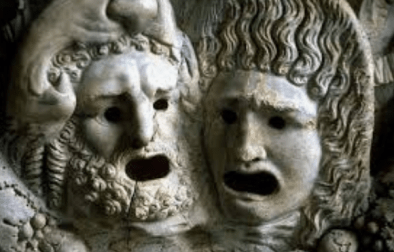
In this short series I will be providing insights into John’s method of presenting his material in Revelation. My commentary on Revelation should be out this Fall. [1] It will be titled: The Divorce of Israel: A Redemptive-historical Approach to Revelation. Thus, I understand Revelation as involving God’s divorcing of Israel as his (old covenant) wife as he takes a new bride (the new covenant church).

I will build the case for Revelation as a drama involving God’s relationship to Israel in this three-part series. So, let us begin by noting that it is presented as a drama.

Scholarly Notices

A growing number of scholars suggest that “the basic format of the book — a pageant of visions — draws on the theatrical model of a succession of scenes” (DBI 714). For instance, Smalley (1994: 105) suggests that “if we interpret the Apocalypse in its entirety as a drama, this is, given the nature of John’s material, a natural and uncomplicated exercise. Revelation lends itself to such an interpretation.”
Continue reading


NEW CREATION & NO MORE SEA? (2)

PMW 2023-048  by Kenneth L. Gentry, Jr.No more sea 2

In my last article (PMW 2023-047) I opened the question regarding the meaning of John’s statement in Rev 21:1: “Then I saw a new heaven and a new earth; for the first heaven and the first earth passed away, and there is no longer any sea.” Why is there “no longer any sea?” In the previous article I discounted the literal interpretation as well as the chaos approach. But now, what does it mean?

I believe the idea of the sea here pictures a barrier separating man from God. Let me explain. You have read this far, why not? Continue reading

THE NEW CREATION & MORE SEA? (1)

PMW 2023-047 by Kenneth L. Gentry, Jr.No more sea 1

In Rev 21:1 an unusual statement appears at the coming of the new heavens and earth: “and there is no longer any sea.” Commentators have long debated the meaning of the absence of the sea (thalassa) in this text. Is this literal? And if it is literal, why would the sea not be part of the consummate order? Or is it metaphorical? And if so, of what is it a metaphor? Continue reading

REVELATION’S SEVEN ORACLES (3)

PMW 2023-031 by Kenneth L. Gentry, Jr.

This is the final installment in a three-part study of seven “letters” to the seven churches in Revelation. I have been arguing that they are not really letters at all. Rather they are judgment oracles. This fits perfectly with the preterist understanding of Rev as a covenant lawsuit against Israel. In the previous article I offered the first two arguments for the oracular nature of these seven messages. In this article I will complete my argument by presenting my final three points.

Third, the oracles are a part of the crucial, introductory vision of the Son of Man and even flesh out this visionary unit that extends from 1:9 all the way through to 3:22. The oracles are not separate, free-standing material. Unfortunately, this is obscured by the modern chapter divisions imposed upon the text. But we can see the unified nature of this larger section from several lines of evidence: Continue reading

REVELATION’S SEVEN ORACLES (2)

PMW 2023-030 by Kenneth L. Gentry, Jr.

In the preceding article in this three-part series, I introduced the concept that the seven messages that appear early in Rev are not really letters. Rather they should be understood as prophetic oracles built on the covenant lawsuit model of the Old Testament. These seven oracles are important for several reasons. I will highlight two of those in this article, and the remaining ones in my next article.

First, a major reason John writes Rev is to encourage faithfulness through the storm of persecution befalling John’s original Christian recipients. Throughout Rev he urges perseverance through the coming trials (1:3, 9; 12:11; 13:10; 14:4–5; 16:16; 17:14; 21:7). For instance, John opens with: “I, John, your brother and fellow partaker in the tribulation and kingdom and perseverance which are in Jesus, was on the island called Patmos because of the word of God and the testimony of Jesus” (Rev 1:9). So at the very beginning of his book John declares that he and his recipients are “in the tribulation” and that they must also engage in “perseverance.” The several other verses I list above also testify to the urgent call to hold on through the storm. Continue reading

REVELATION’S SEVEN ORACLES (1)

PMW 2023-029 by Kenneth L. Gentry, Jr.

The literary genre of Revelation is one of the key issues in its proper interpretation. The question of genre even affects our understanding of the seven letters in Rev. 2 and 3. The “Seven Letters of Revelation” are a familiar and popular section of John’s Revelation. Unfortunately, these popularly-designated “letters” to the seven churches are not actually letters at all.

Rather the so-called Seven Letters are actually more adapted to Revelation’s overarching literary genre and judgment message. They are prophetic oracles or royal proclamations. And as such they perfectly fit in with the theme and flow of Revelation. Continue reading

WHY THE NUMBER 144,000?

PMW 2023-024 by Kenneth L. Gentry, Jr.

144 000Some readers of Revelation are perplexed as to why 12 squared times 1000 is significant to the original readers in the 144,000? What is at about that number that would lead the original readers to think, ‘Oh that’s a number signifying a perfect amount of Jewish converts?’”

1. The Nature of Revelation

In the first place, no one would suggest Revelation is an easy book whose images leap out at you. John himself is left wondering about things within it from time to time (Rev 7:13, 14; 17:6-7). Continue reading