Category Archives: Revelation

REVELATION, RE-APPLICATION, INTERPRETATION

PMW 2024-058 by Kenneth L. Gentry, Jr.

All Christians are called by God to study the Bible, for it is his Word designed for and graciously given to us for our good. As Paul says: “All Scripture is inspired by God and profitable for teaching, for reproof, for correction, for training in righteousness; so that the man of God may be adequate, equipped for every good work” (2 Tim. 3:16–17).

And because of this, the Bereans are commended for their studious diligence in seeking to understand the Scriptures: “Now these were more noble-minded than those in Thessalonica, for they received the word with great eagerness, examining the Scriptures daily to see whether these things were so” (Acts 17:11). Continue reading

DOMITIAN’S PERSECUTION (AGAIN)

PMW 2024-052 by Kenneth L. Gentry, Jr.domition 2

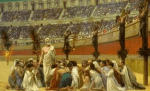
I keep hearing and reading folks referring to Domitian’s severe persecution of Christians, claiming that it was much more severe and widespread than Nero’s earlier persecution. This is significant in light of the debate over the dating of Revelation. Late-date advocates argue that Revelation was written about the intense persecution under the emperor Domitian. Whereas early date advocates argue that it was written prior to Nero’s persecution twenty years earlier.

I have found that too often people are simply regurgitating what they have heard someone else say. They do this as if it were self-evident that Nero’s persecution paled in comparison to Domitian’s. But when we read many competent biblical and historical scholars, we see a serious diminishing of this proposed understanding of early persecution. In this article I will simply cite a few academic sources that should discourage us from simply assuming Domitian was a great persecutor, a beast . . . in fact, the beast of Revelation. Continue reading

EARLY DATE DIFFICULTIES (3)

Nero redivivusPMW 2024-039 by Kenneth L. Gentry, Jr.

I am continuing a brief series on problems scholars have with the early (pre-AD 70) date of Revelation. I am using his Leon Morris’ book: The Revelation of St. John (2d. ed.: Grand Rapids: Eerdmans, 1987) as my main source. Let’s get to work!

A most unusual phenomenon seems to appear in Revelation, according to Morris. His third argument is very popular among late-date theorists. This evidence regards the very unusual and ancient legend known as the Nero Redivivus myth. Morris briefly explains the myth and confidently employs it: “Again, it is urged that the book shows evidence of knowledge of the Nero redivivus myth (e.g. xvii. 8, 11). After Nero’s death it was thought in some circles that he would return. At first this appears to have been a refusal to believe that he was actually dead. Later it took the form of a belief that he would come to life again. This took time to develop and Domitian’s reign is about as early as we can expect it” (Morris 37). Continue reading

EARLY DATE DIFFICULTIES (2)

Roman persecutionPMW 2024-038 by Kenneth L. Gentry, Jr.

Revelation’s early date is generally held by modern postmillennialists of the preterist variety. I have argued elsewhere positively for the early date. So here I am offering a short series that briefly responds to late-date evidences. I am focusing on Leon Morris’ arguments, due to their cogency, succinctness, and his stature as a Revelation commentator.

Morris discovers “indications that Revelation was written in a time of persecution.” This evidence is felt to accord “much better with Domitian.” [1] W. G. Kümmel is quite confident that “the picture of the time which the Apocalypse sketches coincides with no epoch of the primitive history so well as with the period of Domitian’s persecution.” [2] Morris, Kümmel, and a number of other scholars list this as among their leading arguments for the A.D. 95-96 date. Continue reading

THE REVELATION OF WHOM?

Revelation 1-1PMW 2024-020 by Kenneth L. Gentry, Jr.

The opening words in Revelation declare that it is a revelation of Jesus Christ (1:1a).

The fuller representation of Jesus’ name as “Jesus Christ” occurs only in Rev’s first five verses (1:1, 3, 5; both names are mentioned in 20:4 but not together). The name “Jesus” appears alone nine times (1:9 [2x]; 12:17; 14:12; 17:6; 19:10 [2x]; 22:16, 20). “Lord Jesus” is mentioned two times in the conclusion (22:20–21). He is referred to simply as “Lord” twice (11:8; 14:13).

Though Paul frequently uses “Jesus Christ” (Ro 1:4, 6–8; 1Co 1:1–3; 2Co 1:2–3; Gal 1:1; Eph 1:1–3; Php 1:11; Col 1:1, 3; 1Th 1:1; 2Th 2:1–2; 1Ti 1:16; 2Ti 2:8; Tit 1:1; etc.), as does Luke in Acts (Ac 2:28; 3:6; 4:10; 8:12, 37; 9:34; 10:36, 48; 11:17; 15:26; 16:18; 20:21; 28:31), it occurs only rarely in the Gospels: three times in Matthew (1:1, 18; 16:21 [in two early mss]), once in Mark (1:1), and none in Luke. John uses this double name only twice in his Gospel, once in the opening (1:17) and later he records it as Jesus’ self-reference in his high priestly prayer (17:3). But he uses it more frequently in his first epistle which has a strong emphasis on the incarnation (1Jn 1:3; 2:1; 3:23; 4:2; 5:6, 20; 2Jn 7).
Continue reading

SPEAKING IDOL AND JEWISH TEMPLE

PMT 2024-003 by Kenneth L. Gentry, Jr.Priest ministering

Here in Rev the temple speaks as an image of the emperor-god. When the Pharisees rebuke Christ for not stopping those who praise him at the triumphal entry, “He answered and said, ‘I tell you, if these become silent, the stones will cry out!’” (Lk 19:40). This probably signifies that the stones of the temple will declare him when not one is left on another in AD 70 (cp. Lk 21:5-6) (See: R. C. H. Lenski, Luke, 966; E. E. Ellis, Luke [NCBC], 226). Prosopopoiia clearly appears as a major feature in the later chapters in Rev where two cities are presented as women, one an evil harlot, the other a righteous bride (Rev 17; 21). Continue reading

THE TEMPLE IN REVELATION 11

Temple 2PMW 2024-001 by Kenneth L. Gentry, Jr.
Revelation is an important book in eschatological discussions. The most vigorous Revelation debate in ecclesiastical circles today revolves around the dispute between preterism and futurism. Preterism holds that Revelation was largely fulfilled not long after John wrote it. Futurism holds that it deals largely with events yet to come.

Because of this debate, the identity of the temple in Rev 11 arises as a serious matter. In Revelation 11:1, 2 we read:

And there was given me a reed like unto a rod: and the angel stood, saying, Rise, and measure the temple of God, and the altar, and them that worship therein. But the court which is without the temple leave out, and measure it not; for it is given unto the Gentiles: and the holy city shall they tread under foot forty and two months.

Here we find a Temple standing in a city called “the holy city.” Continue reading