

Category Archives: Revelation

REVELATION AND LITERALISM (1)

Literal hand soapPMW 2020-043 by Kenneth L. Gentry, Jr.

By all accounts, Revelation is a difficult book. But naive Christians make it even more difficult than it needs be. A serious problem tripping up the modern would-be interpreter is the assumption of literalism when approaching Revelation. Too many contemporary prophecy students resist the symbolic approach to John’s glorious prophecy. “Literalism!” becomes the rally cry for those who believe Revelation lies in our approaching future.

I would point out that despite the popular claim of literalism: no one takes Revelation literally. We take it as God’s truth, to be sure. And it certainly deals with factual historical events. But we cannot take it as God’s truth in literal form. Let us see how this is so. Continue reading
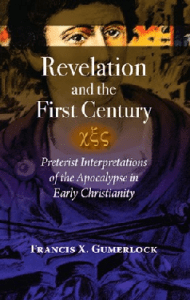
GUMERLOCK’S “REVELATION AND THE FIRST CENTURY”

Gumerlock bookPMW 2020-042 by Kenneth L. Gentry, Jr.

The preterist approach to Revelation holds that Revelation is to be understood as already fulfilled in the first century. Consequently, it has a strong historical interest.

Ironically though, many critics of the preterist approach to Revelation attempt to discredit it on an historical basis. They argue such things as:

“Preterism goes against the witness of the very early church” (Mal Couch).

“Alcazar, a [17th century] Spanish Jesuit, started the idea that the Apostle John . . . was writing about what was happening in his own day, and that his Antichrist was probably the Emperor Nero or some other early persecutor” (Duncan McDougall). Continue reading

COMPUTERS, THE BEAST, AND 666

666 computerPMT 2015-117 by Kenneth L. Gentry, Jr.

Once again I am offering some succinct answers to a reader’s question. Sometimes brevity can more quickly assist our understanding. (But please do not tell the publisher of my upcoming 1700 page commentary on Revelation.) Here is today’s question and brief answer.

Reader’s question

What is the “Mark of the Beast”? And since your answer will obviously have to have some first century application, isn’t it at all curious to you that for the first time in human history — with microchips, retinal scanners, a growing one-world economy, etc.—that the technology exists to make the “Mark of the Beast” a reality?

My response:

Thanks for your question. This type of thinking is fairly common in our American dispensationalist-dominated religious environment. Continue reading

SATAN AND HIS ANGELS IN REV 12:4

Satan rev 12PMW 2020-032 by Kenneth L. Gentry, Jr.

A reader asks:

Dr. Gentry, I just got done watching your Revelation series on DVD. I just had a few questions.

I noticed you didn’t really touch much on Rev 12:4, and I’ve always been curious as to the meaning of that verse. A lot of people use it to say that when Satan rebelled he took a third of the angels with him. But that verse doesn’t seem to be talking about his rebellion at all, but rather his defeat during Christ’s earthly ministry. If that’s the case, then are there any other verse that talk about a “third of the angels”? Or is Scripture actually silent about that?

My reply:

Thanks for watching my lectures on Revelation in the “Survey of the Book of Revelation” DVD set. Obviously I could not deal with every verse and every topic in the twenty-four lectures, but this is a good question and deserves a reply. Please consider the following comments on Rev 12:4. Clearly, the dragon is Satan, as John makes clear in Rev 12:9. But what does he mean we he speaks of his “tail” which “swept away a third of the stars of heaven and threw them to the earth”? Continue reading

UPDATING EARLY-DATE SCHOLARSHIP

PMW 2020-027 by Kenneth L. Gentry, Jr.

Introduction

An early-date composition is important for the preterist analysis of the Book of Revelation. For if Revelation were written prior to the destruction of the temple in AD 70, the way is at least open for considering the prospect that John’s great prophetic work is looking ahead to that dramatic redemptive-historical event. Unfortunately, the majority opinion of scholars today is that Revelation was written much later than AD 70, no earlier than Domitian’s reign some twenty years later.

But cracks in this dike of scholarly opposition to the early date are showing. A growing number of scholars from a broad array of religious convictions (spanning conservative-evangelicals to liberal-critical scholars) is turning back to the early-date view that was the majority opinion in the nineteenth and early twentieth-centuries. And for this shift, I am grateful. I also believe it is important to make this news known in our current setting. For the preterist analysis of Revelation is often written off with a wave of the hand that ends with the pointing of the finger to the majority of scholars. Continue reading

GOD’S DIVORCE DECREE IN REVELATION (8)

PMW 2020-016 by Kenneth L. Gentry, Jr.

This is my final article on the study of Revelation’s seven-sealed scroll. In this one I will be focusing on Revelation 5 and the divorce grounds.

Covenantal marriage requires formal, legal grounds for divorce. In Deuteronomy 24:1 we read that the husband must find something morally “unclean” (ervah) in her. Jesus affirms the moral grounds for issuing a covenantal divorce in Matthew 5:31–32 and 19:7–9: “fornication” (porneia). In Isaiah 50:1 God’s divorce decree against Israel mentions her “iniquities” (peshaim). In Jeremiah 3 her divorce decree appears in the context of a statement regarding her being covenantally “faithless” (meshubah) and “treacherous” (bagad) (Jer 3:6, 8). Whatever these terms mean, they show the necessity of moral grounds for divorce. In biblical law no one could secure a divorce for “any cause at all” — contrary to the Pharisees’ challenge to Jesus (Mt 19:3; see also: Jos., Ant. 4:8:23; m. Gitt. 9:10). Continue reading

GOD’S DIVORCE DECREE IN REVELATION (7)

PMW 2020-015 by Kenneth L. Gentry, Jr.

As we continue our study of Revelation’s seven-sealed scroll, we must continue with our insights into Jesus’ earthly ministry, which I began in the last article.

During his three and one-half year ministry, the Lord comes to his own but they do not receive him (Jn 1:11). The Apostle John is particularly concerned to demonstrate this recurring problem (Jn 12:37–41), so that he characteristically calls them “the Jews” in order “to denote the Jewish nation as hostile to Jesus.” And no wonder! They are of their father the devil (Jn 8:44). Early in John’s Gospel we witness the Baptist’s wilderness message (Jn 1:23) which reminds us of God’s marrying Israel in the wilderness (Ex 19:1–2); see an allusion to the coming destruction of the temple (Jn 2:19); learn of the dullness of Israel’s leaders (Jn 3:10); and discover that worship will be de-centralized away from the temple (Jn 4:21–23). In John’s Gospel “Jesus is largely rejected in Jerusalem and Judaea” whereas “it is in Galilee and Samaria that he is received and that many believe in him.” In Jerusalem “‘the judgment of this world’ and of its ruler takes place.” Continue reading