Category Archives: Resurrection

POSTMILLENNIALISM IN 1 CORINTHIANS 15

Last enemyPMW 2023-006 by Gregg Strawbridge

Gentry note: This paper was originally delivered to 1999 Evangelical Theological Society meeting in Boston. Its original, full title was “An Exegetical Defense of Postmillennialism from 1 Corinthians 15: The Eschatology of the Dixit Dominus.”

Overview
This paper is exegetes Paul’s allusion to the first verse of the Dixit Dominus (Psa 110:1: “The LORD says to my Lord: ‘Sit at My right hand, Until I make Thine enemies a footstool for Thy feet.’” / 1Co 15:25: “For He must reign until He has put all His enemies under His feet.”). It shows that Christ is reigning in the exact sense of this verse during the interadvental period. This study gives special attention to the chronology of the events of 1 Corinthians 15:22–26, supported by the emphatic frequency of the NT teaching that Christ ascended to the “right hand” fullfilling the Dixit Dominus. Significant reflection is given to the chronological argument that death, the last enemy, is overcome at the parousia when those alive will be “changed” (1Co 15:23, cf 15:52-54). The study concludes by noting the difficulties such an exegesis raises for preterist (full preterist), dispensational, premillennial, and pessimistic amillennial eschatologies.

The Dixit Dominus in the NT
The importance of the Dixit Dominus (Psa 110) and particularly the first two verses are paramount. The first verse of Psalm 110 is directly quoted or referred to at least 21 times in the New Testament—more than any other Hebrew Scripture verse. Including references to the later verses of the Psalm in Hebrews (Heb 5:6, 7:17, 7:21, 5:10, 6:20, 7:11, 7:15), the Psalm is referred to some 28 times in the New Testament. It is quite an understatement, then, to say that this passage is highly significant for a theology of Messiah and His kingdom.

The Dixit Dominus in Paul’s Resurrection Defense
One of the most significant theological expositions of Psalm 110:1 is found in 1 Corinthians 15:25 and the context.
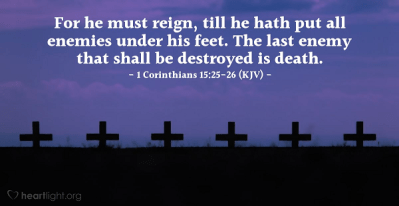
For as in Adam all die, so also in Christ all shall be made alive. But each in his own order: Christ the first fruits, after that those who are Christ’s at His coming, then comes the end, when He delivers up the kingdom to the God and Father, when He has abolished all rule and all authority and power. For He must reign until He has put all His enemies under His feet. The last enemy that will be abolished is death. (1Co 15:22–26).

Context and Purpose of 1 Corinthians 15:25–26
The entire chapter of 1 Corinthians 15 is directed to the question of the validity of bodily resurrection, as indicated in 15:12, “some among you say that there is no resurrection of the dead.” In fact, the words for “resurrection” are used 22 times in the passage (15:4–52). In developing his answer Paul provides sequential language, moving from Christ’s resurrection to the “end” (telos). Why does Paul’s defense of resurrection include an explanation involving the kingdom and reign of Christ? Because resurrection regards death, and death is a kingdom enemy. So, Paul must discuss the reign of Christ and invoke kingdom concepts.


The Harrowing of Hell (by Jay Rogers)
This postmillennial book examines the power of the Gospel, not only to overcome all opposition, but to rise far above the powers of hell. The term “Harrowing of Hell” refers to idea that Christ descended into Hell, as stated in the Apostles’ Creed.

For more Christian educational materials: www.KennethGentry.com


The specific context of 15:25–26 is the origin of death (“for as in Adam all die”), the Messianic deliverance from death (“so also in Christ all shall be made alive”), and the sequence of this deliverance: “But each in his own order: Christ the first fruits, after that those who are Christ’s at His coming.” The term “order” is from the root tagma. The tagma (“proper order”) proceeds in the following manner: Christ was resurrected, “after that” (epeita) the resurrection of “those who are Christ’s at His coming” (parousia) (v. 23), “then comes the end.” Paul is giving a chronological sequence of events in using adverbs epeita and eita which are for “marking the sequence of one thing after another.”

The Telos
The phrase epeita to telos (“then comes the end”) is elucidated by Paul. Contextually, the “end” (telos) is “when He delivers up the kingdom to the God and Father, when He has abolished all rule and all authority and power” (15:24). Thus, the telos is “when” the kingdom is consummated. The “end” is not when the kingdom is initiated, but rather when it is finalized. The idea that the telos is an end period is not warranted by Paul’s grammar, contextual discussion, nor his use of the term. Neither does the syntax support the “end period” concept. Continue reading
IRREFUTABLE REFUTATION OF HYPER-PRETERISM

PMW 2023-005 by Jason L. BradfieldWhat if

Gentry note: Jason once adopted Hyper-preterism as his theological commitment. He has since left the movement to become part of mainstream Reformed evangelical thought. This is an excellent article by a former insider.

INTRODUCTION

For starters, let’s define some terms. By “hyper-preterism,” I include any belief system that argues for the past fulfillment of all prophecy, which necessarily includes the general resurrection of the dead. Whether a system is labeled “full-preterism,” “pantelism,” or “covenant eschatology,” it makes no difference to this refutation. I can not care less what any of these systems positively state regarding the general resurrection. At one time, I counted at least six different views among them. They can hash out their heretical opinions amongst themselves. But what they all have in common is that an “all-is-fulfilled eschatology” must of necessity deny a general, self-same, bodily resurrection.

The purpose of this post is to demonstrate beyond any reasonable doubt that this same denial existed among a few at the church in Corinth, and in I Corinthians 15, esp. verses 12-18, Paul destroys their false belief. Paul affirms belief in the bodily resurrection, and since this has not occurred, it remains a prophecy yet to be fulfilled. Continue reading

OVER-REALIZED ESCHATOLOGY AT CORINTH (2)

PMW 2022-092 by Kenneth L. Gentry, Jr.Resurrection empty tomb

In my last blog post, I began a two-part study of the over-realized eschatology problem at Corinth. Throughout 1 Corinthians Paul has to continually rebuke and correct the Christians there. I am pointing out the source of their confusion and abuse of privilege: they have adopted an “over-realized eschatology.” I recommend that you read the previous post before reading this one.

But now, let us re-start our study

What is “realized eschatology”?

Now simply put, the problem Paul faces at Corinth is what we may call an “over-realized eschatology.” Let me explain what I mean by first presenting what a legitimate “realized eschatology” is.

After the resurrection of Christ in the first-century, redemptive history entered into a “realized eschatological” experience. That is, Christ completed his work of redemption by means of his death, burial, resurrection, and ascension. And because of this, redemptive history, which began with the protoevangelium in Genesis 3:15, finally entered what the New Testament calls “the last days” (Heb. 1:2), “the ends of the ages” (1 Cor. 10:11), “the consummation of the ages” (Heb. 9:26), “these last times” (1 Pet. 1:20), and so forth. That is, the eschatological-redemptive hope of the Old Testament finally began coming to fruition in Christ. Continue reading

OVER-REALIZED ESCHATOLOGY AT CORINTH (1)

PMW 2022-091 by Kenneth L. Gentry, Jr.Resurrection glory

Christ’s resurrection and ours

First Corinthians 15 is an important chapter regarding the resurrection. Here Paul clearly ties the believer’s resurrection to Christ’s, requiring that we understand both in the same way (Phil. 3:20–21). For he states that Christ’s resurrection was the “first fruits” of the believer’s resurrection (1 Cor. 15:20). This first fruits image establishes two important truths:

(1) Christ’s resurrection is actually the beginning of the general resurrection of the dead. This is because the first fruits of a harvest are a part of the full, final harvest, though occurring before the full harvest (cf. 1 Cor. 15:12–13). Continue reading

THE “SPIRITUAL BODY” IN 1 CORINTHIANS

PMW 2022-088 by Kenneth L. Gentry, Jr.

Paradise Now and Not Yet: Studies in the Role of the Heavenly Dimension in  Paul's Thought With Special Reference to His Eschatology: Lincoln, Andrew  T.: 9780801056727: Amazon.com: BooksIntroduction

A key problem with  contemporary American Christianity is its disinterest in a careful study of Scripture. This encourages church membership decline as people drift away from the unnourishing pablum diet offered in too many churches. Sadly, it also gives heresies a footing in that true Christians have an internal emptiness due to their spiritual thirst for God’s word — even when they do not really recognize it (apparently confusing it with heartburn). Heresies can gain traction within evangelical circles when purveyors of heresy act like they are digging deeply into Scripture. We need Spirit-generated true revival whereby God’s people stand up and declare: “To the law and to the testimony! If they do not speak according to this word, it is because they have no dawn” (Isa. 8:20). I do not care how good the band is or how cool the pastor looks in his casual attire, we need more of the word declared in depth from the pulpit! Continue reading

A NEW HYPERPRETERISM REBUTTAL

PMW 2022-057 Kenneth L. Gentry, Jr.

Though Hyperpreterism (a.k.a. Full Preterism) remains a small movement, it also remains a tenacious and noisy one. While Hyperpreterists believe they are giving sound advice regarding biblical interpretation and scriptural eschatology, they provide 99% sound and only 1% advice.

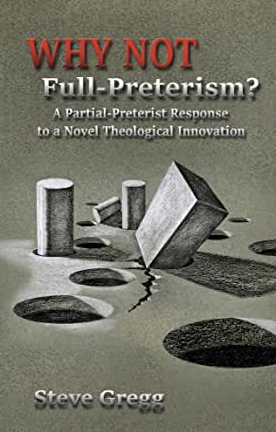
Yet Hyperpreterism does exist and it is present in some evangelical communities and local churches. Therefore, it is deserving of evangelical critiques. And Steve Gregg has provided a helpful, large-scale critique and rebuttal of this eschatological error, titled: Why Not Full-Preterism? A Partial-Preterist Response to a Novel Theological Innovation. Gregg is the host of the national Christian talk show, The Narrow Path. He is also the author of the invaluable book Revelation: Four Views: A Parallel Commentary (1997; rev. 2013).

Continue reading

1 COR 15:45 & CHRIST’S RESURRECTION

PMW 2022-017 by Kenneth L. Gentry, Jr.

A Reader’s Question

Recently a reader wrote to me regarding an article by Sam Frost that I published. He commented:

“Thank you for sharing this! Mr. Gentry, I enjoyed your book Before Jerusalem Fell. As far as ‘full’ and ‘partial’ preterism; I have a lot to learn and am still undecided. If Jesus will literally return in a physical body, could you please explain 1 Cor.15:45 to me?”

Thanks for reading. And for writing. I appreciate your studying God’s word. And I certainly hope and pray that you won’t drift away from historic, orthodox Christianity!

The Interpretive Problem

What does 1 Corinthians 15:45 say that might confuse folks and encourage an aberrant movement? The Mormons love 1 Corinthians 15:29; the hyper-preterists love 1 Corinthians 15:45. This passage reads:

“So also it is written, ‘The first man, Adam, became a living soul.’ The last Adam became a life-giving spirit.”

How are we to understand this? Was Paul teaching us that Christ left his material body behind in becoming a non-material spirit-being? And that we also are to anticipate the same? Not at all! Has the universal, historic, orthodox, public, systematic, corporate church been mistaken since its very beginning? Absolutely not! What then is going on here? Continue reading