Category Archives: Optimism

POSTMILLENNIALISM AND THE MILLENNIUM (2)

Glorious sunrisePMW 2023-045 by Kenneth L. Gentry, Jr.

This is part 2 in a three-part series on Postmillennialism and the Millennium. We are now at the place where we must define what we mean by “postmillennialism.”

So now: What is the postmillennial outlook? Why is it called post-millennial? And what are its expectations?

Postmillennialism teaches that Christ will return to earth after a long era of gospel progress and worldwide righteousness. As the gospel wins greater influence the world will witness a long era of social stability, economic development, and international peace. The basic structure of the postmillennial hope is as follows:

First, Christ came into the world in the first century and established his kingdom, the Messianic kingdom prophesied in the Old Testament. We are in that kingdom now (the “millennium,” if you will) (Luke 17:20–21; Col 1:13).

Second, he confronted and defeated Satan while on earth, through his ministry, death, burial, resurrection, and ascension. Satan is bound from deceiving the nations, so that they are open to the power of the gospel (Matt 12:28–29; Rev 20:3).

Third, he gave the marching orders for his kingdom in the “Great Commission.” This commission is great because it is established on his grant of “all authority,” he command to “make disciples of all the nations,” his directive for us to teach the nations “all that I commanded you,” and his promise that “I am with you always, even to the end of the age” to get it done (Matt 28:18–20).

Fourth, he promised to bless his kingdom with growth, likening it to a mustard seed that begins incredibly small but results in a tree that dominates the garden; and comparing it to leaven that leavens the entire bushel (Matt 13:31–33).
Continue reading

THE IMPOSSIBILITY OF POSTMILLENNIALISM?

PMW 2023-025 by Kenneth L. Gentry, Jr.

Our Lord Jesus Christ ministered for over three years proclaiming the coming of the kingdom of God. But after initially drawing a “great multitude” of followers (Jn 6:2), John records with disappointment that “many of His disciples went back and walked with Him no more” (Jn 6:66). In fact, toward the end of his ministry one of his own twelve disciples turned against him, literally selling him out to the authorities (Jn 13:18; Ac 1:18-19). And even his remaining faithful disciples forsook him in cowardly fear as he was on trial for his life (Mt 26:31, 56; Lk 22:31-34), locking themselves away from opponents (Jn 20:19).

With such a shaky start, what might we expect to become of the kingdom of God, which Christ initially proclaimed as near (Mk 1:15; Mt 4:17) and eventually established as present (Mt 12:28; Lk 17:20-21)? In other words, what is the outlook for the Christian faith in the historical long run? How should we answer a query such as Christ poses: “When the Son of Man comes, will he really find faith on the earth” (Lk 18:8)? Continue reading

THE OPTIMISM OF POSTMILLENNIALISM

PMW 2023-018 by Kenneth L. Gentry, Jr.Smiley faces

People often note how postmillennialism claims to be optimistic and charges other millennial views to be pessimistic. Many even see very little difference between amillennialism and postmillennialism, which were originally deemed one eschatological position up until the last 1800s.

Of course, representatives of the three standard non-postmillennial schools (amillennialism, premillennialism, and dispensationalism) do not like being called “pessimistic.” And we must admit that all four millennial schools are Christian systems committed to the expectation of ultimate redemptive hope. They unite in believing that God will finally conquer sin and Satan and establish an eternal order of glorious perfection. Continue reading

POSTMILLENNIALISM IN 1 CORINTHIANS 15

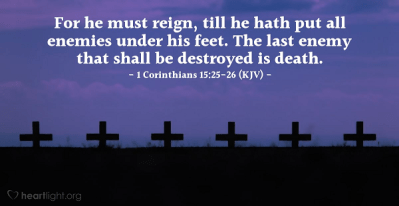
Last enemyPMW 2023-006 by Gregg Strawbridge

Gentry note: This paper was originally delivered to 1999 Evangelical Theological Society meeting in Boston. Its original, full title was “An Exegetical Defense of Postmillennialism from 1 Corinthians 15: The Eschatology of the Dixit Dominus.”

Overview
This paper is exegetes Paul’s allusion to the first verse of the Dixit Dominus (Psa 110:1: “The LORD says to my Lord: ‘Sit at My right hand, Until I make Thine enemies a footstool for Thy feet.’” / 1Co 15:25: “For He must reign until He has put all His enemies under His feet.”). It shows that Christ is reigning in the exact sense of this verse during the interadvental period. This study gives special attention to the chronology of the events of 1 Corinthians 15:22–26, supported by the emphatic frequency of the NT teaching that Christ ascended to the “right hand” fullfilling the Dixit Dominus. Significant reflection is given to the chronological argument that death, the last enemy, is overcome at the parousia when those alive will be “changed” (1Co 15:23, cf 15:52-54). The study concludes by noting the difficulties such an exegesis raises for preterist (full preterist), dispensational, premillennial, and pessimistic amillennial eschatologies.

The Dixit Dominus in the NT
The importance of the Dixit Dominus (Psa 110) and particularly the first two verses are paramount. The first verse of Psalm 110 is directly quoted or referred to at least 21 times in the New Testament—more than any other Hebrew Scripture verse. Including references to the later verses of the Psalm in Hebrews (Heb 5:6, 7:17, 7:21, 5:10, 6:20, 7:11, 7:15), the Psalm is referred to some 28 times in the New Testament. It is quite an understatement, then, to say that this passage is highly significant for a theology of Messiah and His kingdom.

The Dixit Dominus in Paul’s Resurrection Defense
One of the most significant theological expositions of Psalm 110:1 is found in 1 Corinthians 15:25 and the context.
For as in Adam all die, so also in Christ all shall be made alive. But each in his own order: Christ the first fruits, after that those who are Christ’s at His coming, then comes the end, when He delivers up the kingdom to the God and Father, when He has abolished all rule and all authority and power. For He must reign until He has put all His enemies under His feet. The last enemy that will be abolished is death. (1Co 15:22–26).

Context and Purpose of 1 Corinthians 15:25–26
The entire chapter of 1 Corinthians 15 is directed to the question of the validity of bodily resurrection, as indicated in 15:12, “some among you say that there is no resurrection of the dead.” In fact, the words for “resurrection” are used 22 times in the passage (15:4–52). In developing his answer Paul provides sequential language, moving from Christ’s resurrection to the “end” (telos). Why does Paul’s defense of resurrection include an explanation involving the kingdom and reign of Christ? Because resurrection regards death, and death is a kingdom enemy. So, Paul must discuss the reign of Christ and invoke kingdom concepts.


The Harrowing of Hell (by Jay Rogers)
This postmillennial book examines the power of the Gospel, not only to overcome all opposition, but to rise far above the powers of hell. The term “Harrowing of Hell” refers to idea that Christ descended into Hell, as stated in the Apostles’ Creed.

For more Christian educational materials: www.KennethGentry.com


The specific context of 15:25–26 is the origin of death (“for as in Adam all die”), the Messianic deliverance from death (“so also in Christ all shall be made alive”), and the sequence of this deliverance: “But each in his own order: Christ the first fruits, after that those who are Christ’s at His coming.” The term “order” is from the root tagma. The tagma (“proper order”) proceeds in the following manner: Christ was resurrected, “after that” (epeita) the resurrection of “those who are Christ’s at His coming” (parousia) (v. 23), “then comes the end.” Paul is giving a chronological sequence of events in using adverbs epeita and eita which are for “marking the sequence of one thing after another.”

The Telos
The phrase epeita to telos (“then comes the end”) is elucidated by Paul. Contextually, the “end” (telos) is “when He delivers up the kingdom to the God and Father, when He has abolished all rule and all authority and power” (15:24). Thus, the telos is “when” the kingdom is consummated. The “end” is not when the kingdom is initiated, but rather when it is finalized. The idea that the telos is an end period is not warranted by Paul’s grammar, contextual discussion, nor his use of the term. Neither does the syntax support the “end period” concept. Continue reading

THE PLAGUES AND EGYPT’S GODS

PMW 2022-078  by Kenneth L. Gentry, Jr.

The ten plagues that befall Egypt during the period of the exodus, were not only designed to get Israel released from bondage. They were also designed to directly confront the puny gods of Egypt. We need to recognize that the same God who sent the plagues against the gods of the mightest nation in that era is the same God we serve today. And he will overthrow the modern gods of the nations. In this article I will highlight the ten plagues as challenges to Egypt’s gods

Continue reading

HOPELESS HOPE? (2)

HopelessPMW 2022-049 by Kenneth L. Gentry, Jr.

In my last blog post  I began a consideration of the question: “How can we have hope today?” Is hope hopeless. And if it is, what is to become of the postmillennial hope. This is the second and concluding article on that question. I hope you will read the previous article first (see there is hope!).

Earthly Hope in History

The early ante-Nicene church struggled mightily in their task. Initially, they were but a “little flock” (Luke 12:32) who humbly committed their lives to a despised, rejected, and crucified Lord (1 Cor. 2:8). Initially, they were hunted down by the mightiest empire of the world, to be thrown to the beasts for refusing to worship Caesar, to be burned in the fires for affirming Christ’s lordship. Surely their times were fraught with unspeakable terror such as we have not known in modern America. Yet by the grace of God, a little over 200 years after the Apostles left the scene the emperor Constantine professed faith in Christ, lifting the earthly burden from our spiritual forefathers. Christ’s little flock was witnessing His kingdom coming with power, His gospel exercising a growing influence in the world. Continue reading

HOPELESS HOPE? (1)

PMW 2022-048 by Kenneth L. Gentry, Jr.Hope

In his letter to the troubled Corinthian church, Paul lists three Christians virtues while exhorting them to a closer walk with Christ: faith, hope, and love (1 Cor. 13:13). This three-fold cord of holy values provides a strong bond of commitment for the Christian, and has tied the Church of Jesus Christ together throughout the ages.

Faith and love are not only beautiful threads knitting together the fabric of the Christian life, but are easily recognized as such. They weave a strong carpet for the Christian walk; they serve as dual strands tugging us forward in our holy calling. And though hope is certainly not a detached thread from the Christian garment, it has been snagged loose and at best is only partially visible to the eye of faith today.

Certainly all Christians are united in recognizing our ultimate, glorious resurrection hope in our heavenly home. We know that the present fallen order is not all that we may expect in our experience of God’s grace. The beatific vision in Scripture encourages us to keep a hopeful eye on heaven above even as we watch our steps in the earth below. And though eternal life in the presence of God is the ultimate hope of the Christian and the abiding consequence of the gospel, it does not exhaust the full significance of biblical hope. Continue reading