Category Archives: Objections

DOCTRINAL OBJECTIONS CONSIDERED

Sin 2PMW 2025-001 by Kenneth L. Gentry, Jr.

As I am considering objections to postmillennialism, I will not move from popular practical objections to a more serious class of objections: those related to doctrinal issues. Eschatology is a doctrine, therefore, any doctrinal problems would be self-destructive for the system.

“SIN UNDERMINES THE POSTMILLENNIAL HOPE”

Many evangelical scholars reject postmillennialism because of the Bible’s strong commitment to the doctrine of sin. According to amillennialist Hanko, postmillennialism “is a mirage, therefore, a false hope, because it fails to reckon properly with the fact of sin” and “cannot take sin as seriously as do the Scriptures.” This sounds like a strong objection on the surface. Its beauty, however, is only skin deep. Continue reading

PRACTICAL OBJECTIONS CONSIDERED

Globe meltingPMW 2024-101 by Kenneth L. Gentry, Jr.

Ironically, the most hope-filled eschatology is the least liked in our contemporary setting. And this despite its strong presence in the 1600-early 1900s. As we contemplate this fact, we must recognize that the most popular objections against postmillennialism are practical concerns. They are frequently brought against postmillennialism in the popular literature. But to no avail, for there are easy answers to them. Let’s see how this is so.

“World conditions contradict postmillennialism”

Too many evangelicals get their understanding of biblical prophecy from reading the newspapers through their faulty interpretive lens. They point out a truly conservative Christian concern: America is in a great moral and spiritual decline today. And such a decline contradicts postmillennialism’s historical expectations. For instance, dispensationalist theologian Paul N. Benware responds against postmillennialism that “the idea that the world is getting better and better does not at all seem to be in line with reality. The evidence points rather to a world that is growing more and more wicked.”]
Continue reading

MATTHEW READ WRONGLY

PMW 2024-051 by Kenneth L. Gentry, Jr.Confused man

My brief survey of Matthew’s Gospel is important for setting up the broader literary context of the Olivet Discourse with its warning of Israel’s judgment in AD 70. Both Jesus’ regular teaching and frequent actions, as well as Matthew’s overall historical progression and literary presentation powerfully highlight God’s approaching wrath upon Israel. This understanding of Matthew is so clear as to be undeniable. In fact, Lowery — though a dispensationalist — can even speak of “the strong denunciation of Israel that pervades the gospel” and which employs a “strong polemic against Israel.”[1]

This presentation of Israel’s disturbing spiritual condition and foreboding historical expectation is so obvious, strong, frequent, and widespread that many liberal historians and theologians (wrongly) charge Matthew’s Gospel as a prime source of anti-Semitism in the world. Continue reading

EARLY DATE DIFFICULTIES (3)

Nero redivivusPMW 2024-039 by Kenneth L. Gentry, Jr.

I am continuing a brief series on problems scholars have with the early (pre-AD 70) date of Revelation. I am using his Leon Morris’ book: The Revelation of St. John (2d. ed.: Grand Rapids: Eerdmans, 1987) as my main source. Let’s get to work!

A most unusual phenomenon seems to appear in Revelation, according to Morris. His third argument is very popular among late-date theorists. This evidence regards the very unusual and ancient legend known as the Nero Redivivus myth. Morris briefly explains the myth and confidently employs it: “Again, it is urged that the book shows evidence of knowledge of the Nero redivivus myth (e.g. xvii. 8, 11). After Nero’s death it was thought in some circles that he would return. At first this appears to have been a refusal to believe that he was actually dead. Later it took the form of a belief that he would come to life again. This took time to develop and Domitian’s reign is about as early as we can expect it” (Morris 37). Continue reading

EARLY DATE DIFFICULTIES (2)

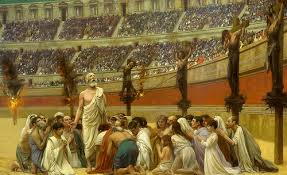
Roman persecutionPMW 2024-038 by Kenneth L. Gentry, Jr.

Revelation’s early date is generally held by modern postmillennialists of the preterist variety. I have argued elsewhere positively for the early date. So here I am offering a short series that briefly responds to late-date evidences. I am focusing on Leon Morris’ arguments, due to their cogency, succinctness, and his stature as a Revelation commentator.

Morris discovers “indications that Revelation was written in a time of persecution.” This evidence is felt to accord “much better with Domitian.” [1] W. G. Kümmel is quite confident that “the picture of the time which the Apocalypse sketches coincides with no epoch of the primitive history so well as with the period of Domitian’s persecution.” [2] Morris, Kümmel, and a number of other scholars list this as among their leading arguments for the A.D. 95-96 date. Continue reading

MISGUIDED REJECTIONS OF POSTMILLENNIALISM (2)

PMW 2023-082 by Greg L. BahnsenWeak man

Gentry note:
In the previous posting, Bahnsen noted the misguided and failed attempts to dismiss postmillennialism based on (1) newspaper exegesis, (2) misrepresentation, and (3) the application of two-edged criticism (which applies to the critic as well as the position criticized). In this posting he continues.

OT VS. NT ISSUE

There are current day charges against the position which are premature or unfounded. To this category belongs the allegation that postmillennialism is founded on Old Testament passages rather than New Testament evidence, that the New Testament knows nothing of the proclamation of a semi-golden age.

Continue reading

MISGUIDED REJECTIONS OF POSTMILLENNIALISM (1)

Bible and newspaperPMW 2023-081 by Greg L. Bahnsen

It must be observed that postmillennialism lost favor (and today remains held in disfavor) with conservative theologians for manifestly unorthodox and insufficient reasons. Extra-biblical reasoning, as well as lazy or poor scholarship, has intruded itself into Christian discussions of eschatology.

NEWSPAPER EXEGESIS

Alva J. McClain says of postmillennialism: “This optimistic theory of human progress had much of its own way for the half-century ending in World War I of 1914. After that the foundations were badly shaken; prop after prop went down, until today the whole theory is under attack from every side. Devout Postmillennialism has virtually disappeared.”

J. Barton Payne’s massive Encyclopedia of Biblical Prophecy mentions postmillennialism only once, and that merely in a footnote which parenthetically declares “two world wars killed this optimism.”

Merrill F. Unger dismisses postmillennialism in short order, declaring: “This theory, largely disproved by the progress of history, is practically a dead issue.”
Continue reading