
Category Archives: Objections

POSTMILLENNIALISM AND SATAN’S LOOSING

PMW 2025-088 by Kenneth L. Gentry, Jr.

Satan loosedI received this question from a reader. I think it might be helpful to other blog readers for me to answer it. Here is the question:

“As I’ve been reading your whole series on Revelation, I have come realize more and more how much we A-Mill Folks agree with you Post Mill Guys. But how does the loosing of Satan coincide with your postmillennial preterist hermeneutic? This seems to be the only area where I have a problem from the Preterist Viewpoint. Please advise where this fits.”

This is a good question that touches on an issue that seems to confront both preterism (Satan’s loosing occurs after 1000 years in a book set to transpire shortly) and to undermine the idea of the universal conquest of the gospel expected by postmillennialism. Postmillennialism is a theological construct whereas preterism is a methodology, rather than a theology. Both merge well in my understanding of postmillennialism. Let me explain. Continue reading
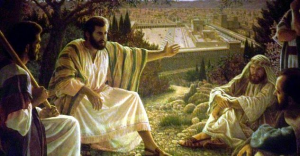
JESUS WAS A PRETERIST (1)

PMW 2022-050 by Kenneth L. Gentry, Jr.

A few years ago I was privileged to hear Dr. Wayne A. Briddle of Liberty University deliver a cogent, careful, and cordial critique of evangelical preterism (which he designated “partial preterism”). Dr. Briddle graciously allowed me a few moments at the end of his presentation to respond. He also asked if I would mind providing him some sort of critique of his presentation for his better understanding of the issues from my perspective. Here is my reply.

Introduction

In his paper, Dr. Bridle provided a helpful summary statement regarding the nature of and evidence for preterism. His summary was apparently designed for an audience not thoroughly familiar with the debate. I commend him for his careful introduction of the topic. His summary should aid any one interested in the basics of preterism and its variant forms (from heterodox Hyper-Preterism or Full or Extreme Preterism to the Orthodox [“partial”] Preterism of R. C. Sproul and Kenneth Gentry). Continue reading

666 AS A HEBREW MISSPELLING?

PMW 2025-073 by Kenneth L. Gentry, Jr.

In this reply to preterist opponents, I will answer the question:
What about the defective spelling of Nero’s name necessary for the value 666? To get the proper value of 666 out of the name Nero Caesar requires an unusual spelling of his name.

This problem is not insuperable, for we do find this spelling in Aramaic documents from Nero’s reign. Who is to say John could not use a defective spelling, especially one which we actually find from that time period? Continue reading

1 JOHN 2:2 BY B. B. WARFIELD (3)

Cross and world“Jesus Christ the Propitiation for the Whole World” (3)

PMW 2025-071 by Benjamin B. Warfield

[Gentry note: This is part 3 of an excellent article by renowned postmillennial Princeton scholar, B. B. Warfield.]

The Meaning of “Propitiation”

The expedient made use of by many commentators in their endeavor to escape from this maze of contradictions is to distinguish between Christ as our “Advocate” and Christ as our “Propitiation,” and to connect actual salvation with him only in the former function. Thus Richard Rothe tells us that “the propitiation in Christ concerns the whole world,” but “only those in Christ have an advocate in Christ,” with the intimation that it is Christ’s advocacy which “makes the efficacy of his propitiation effective before God.” In this view the propitiation is conceived as merely laying a basis for actual forgiveness of sins, and is spoken of therefore rather as “sufficient” than efficacious—becoming efficacious only through the act of faith on the part of the believer by which he secures Christ as his Advocate. This is the view presented by B. F. Westcott also, according to whom Christ is advocate exclusively for Christians, while he is a propitiation for the whole world. His propitiatory death on earth was for all men; his advocacy in heaven is for those only who believe in him. Here, there is a universal atonement taught, with a limited application, contingent on actual faith: “the efficacy of his work for the individual depends upon fellowship with him.” Continue reading

1 JOHN 2:2 BY B. B. WARFIELD (2)

Savior of world“Jesus Christ the Propitiation for the Whole World” (2)

PMT 2025-070 by Benjamin B. Warfield

[Gentry note: This is part 2 of an excellent article by renowned postmillennial Princeton scholar, B. B. Warfield.]

“And he is the propitiation for our sins; and not for ours only, but also for the whole world.”
(1 John 2:2)

The Problem of “the World”

The search for John’s meaning naturally begins with an attempt to ascertain what he intends by “the world.” He sets it in contrast with an “our” by which primarily his readers and himself are designated: “And he is himself a propitiation for our sins, and not for ours only but for the whole world.” John’s readers apparently are immediately certain Christian communities in Asia Minor; and it is possible to confine the “our” strictly to them. In that case it is not impossible to interpret “the whole world,” which is brought into contrast with the Christians specifically of Asia Minor, as referring to the whole body of Christians extended throughout the world. Continue reading

1 JOHN 2:2 BY B. B. WARFIELD (1)

Cross all men“Jesus Christ the Propitiation for the Whole World” (1)
PMW 2025-069 by Benjamin B. Warfield

[Gentry note: This is an excellent article by renowned postmillennial Princeton scholar, B. B. Warfield.]

“And he is the propitiation for our sins; and not for ours only, but also for the whole world.”
(1 John 2:2)

As a means of comforting Christians distressed by their continued lapses into sin, John, in the opening words of the second chapter of his first Epistle, is led to assure them that “we have an Advocate with the Father, Jesus Christ, a Righteous One”; and by way of showing how prevailing his advocacy is, to add, “And he is himself a propitiation for our sins.” There he might well have stopped. Continue reading

BIBLICAL OBJECTIONS CONSIDERED (1)

Bible DebatePMW 2025-002 by Kenneth L. Gentry, Jr.

In this brief series I am considering objections thrown up against the postmillennial hope. The most serious class of problems for any eschatological system is the biblical objection. If one’s eschatology does not arise from Scripture itself, it is not a biblical doctrine. We must have a “thus saith the Lord” justifying our prophetic system. Let us consider some of the leading biblical texts brought against the postmillennial hope.

MATTHEW 7:13–14

“Enter by the narrow gate; for wide is the gate and broad is the way that leads to destruction, and there are many who go in by it. Because narrow is the gate and difficult is the way which leads to life, and there are few who find it.”

This famous passage seems to undermine the postmillennial hope of a world converted to Christ. How does postmillennialism account for this comment by our Lord himself? Continue reading