
Category Archives: hyperpreterism

THE RESURRECTION OF THE BODY

PMW 2022-089 by Philosophical InvestigationsWhat will our resurrected bodies look like?

Resurrection Is Central to Christianity

The resurrection of Christ is a vital foundation for the faith. Paul writes to the Corinthian church:

“If Christ has not been raised, our preaching is useless and so is your faith. More than that, we are then found to be false witnesses about God, for we have testified about God that he raised Christ from the dead. But he did not raise him if in fact the dead are not raised. For if the dead are not raised, then Christ has not been raised either. And if Christ has not been raised, your faith is futile; you are still in your sins. Then those also who have fallen asleep in Christ are lost. If only for this life we have hope in Christ, we are of all people most to be pitied” (1 Cor 15:14-19).

However, Paul is equally definite about the importance of the resurrection of believers too: “If there is no resurrection of the dead, then not even Christ has been raised” (1 Cor 15:13). He goes on to affirm: “Listen, I tell you a mystery: we will not all sleep, but we will all be changed –in a flash, in the twinkling of an eye, at the last trumpet. For the trumpet will sound, the dead will be raised imperishable, and we will be changed” (1 Cor 15:51-52). Continue reading

HYPER-PRETERISM & BIBLICAL ESCHATOLOGY

PMW 2022-085 by Richard L. Pratt, Jr.
Professor of Old Testament

Hyper-preterism, the belief that the New Testament expectation of Christ’s return in glory has already occurred, has taken at least two basic forms. On the one hand, it has become a fairly standard part of critical approaches to biblical faith as they have developed during the modern period. Critical theologians tend to reject the expectation of a future cosmic consummation of the Kingdom of God because they hold that modern rational people can no longer embrace such hopes. Their reflections tend to focus almost exclusively on what Christ has already done, rather than on what he may do in the future. On the other hand, hyper-preterism has also taken root in recent years within circles that are otherwise orthodox and evangelical. These theologians affirm classical views of biblical authority and build their distinctive views of the return of Christ on these assumptions of biblical authority. As strange as it may sound, these conservative hyper-preterists insist that belief in biblical authority requires believers to reject the notion that we are still waiting for a cataclysmic return of Christ. A central line of their reasoning has to do with their understanding of biblical authority and prophecy. In this article, we will explore the contours of this line of reasoning.

Continue reading

A NEW HYPERPRETERISM REBUTTAL

PMW 2022-057 Kenneth L. Gentry, Jr.

Though Hyperpreterism (a.k.a. Full Preterism) remains a small movement, it also remains a tenacious and noisy one. While Hyperpreterists believe they are giving sound advice regarding biblical interpretation and scriptural eschatology, they provide 99% sound and only 1% advice.

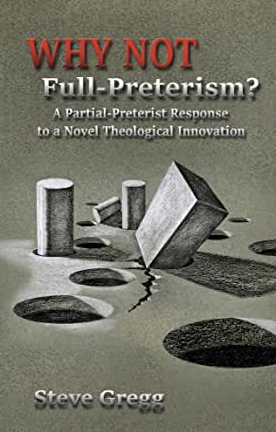
Yet Hyperpreterism does exist and it is present in some evangelical communities and local churches. Therefore, it is deserving of evangelical critiques. And Steve Gregg has provided a helpful, large-scale critique and rebuttal of this eschatological error, titled: Why Not Full-Preterism? A Partial-Preterist Response to a Novel Theological Innovation. Gregg is the host of the national Christian talk show, The Narrow Path. He is also the author of the invaluable book Revelation: Four Views: A Parallel Commentary (1997; rev. 2013).

Continue reading

1 COR 15:45 & CHRIST’S RESURRECTION

PMW 2022-017 by Kenneth L. Gentry, Jr.

A Reader’s Question

Recently a reader wrote to me regarding an article by Sam Frost that I published. He commented:

“Thank you for sharing this! Mr. Gentry, I enjoyed your book Before Jerusalem Fell. As far as ‘full’ and ‘partial’ preterism; I have a lot to learn and am still undecided. If Jesus will literally return in a physical body, could you please explain 1 Cor.15:45 to me?”

Thanks for reading. And for writing. I appreciate your studying God’s word. And I certainly hope and pray that you won’t drift away from historic, orthodox Christianity!

The Interpretive Problem

What does 1 Corinthians 15:45 say that might confuse folks and encourage an aberrant movement? The Mormons love 1 Corinthians 15:29; the hyper-preterists love 1 Corinthians 15:45. This passage reads:

“So also it is written, ‘The first man, Adam, became a living soul.’ The last Adam became a life-giving spirit.”

How are we to understand this? Was Paul teaching us that Christ left his material body behind in becoming a non-material spirit-being? And that we also are to anticipate the same? Not at all! Has the universal, historic, orthodox, public, systematic, corporate church been mistaken since its very beginning? Absolutely not! What then is going on here? Continue reading

MY HYPER-PRETERIST FRUSTRATIONS (2)

PMW 2021-012 by Kenneth L. Gentry, Jr.

In my previous posting I opened a quick two-part testimonial explaining why I do not like interacting with Hyper-preterists. Their argumentative method is terribly frustrating. I will now continue with and conclude my testimonial.

REGARDING PRESTON’S THIRD ARTICLE

Preston:
He writes: “The reader needs to remember, as I have documented, that Gentry takes a decidely [sic] and admittedly non-historical, non-creedal view of Revelation.” A few paragraphs later, he writes: “Gentry, when defending his own unorthodox, non-historical, non-creedal views that stand in opposition to the long standing scholarly consensus on Revelation…” Continue reading

J. S. RUSSELL & MILTON TERRY: “FUTURISTS”?

PMW 2020-054 by Kenneth L. Gentry, Jr.

The Hyper-preterist movement has gained a small foothold among some evangelical Christians. Unfortunately, this aberrant movement makes the same sort of error as Hyper-Calvinism: it takes certain biblical teachings and presses them beyond their Scriptural warrant. By using actual biblical truths and specific Scripture verses, the Hyper-Calvinist can make a doctrinal error sound quite persuasive, as can the Hyper-preterist. Continue reading

IMPORTANT REBUTTAL TO HYPER-PRETERISM

PMW 2019-027 by Kenneth L. Gentry, Jr.

I am a preterist and a postmillennialist. The fact that I am a postmillennialist proves that I am not a Hyper-preterist, for postmillennialism has a number of prophecies that remain to fulfilled. I am, thus, an Orthodox Preterist, sometimes called a “Partial Preterist” by those who have made off with a perfectly good hermeneutic label and mutated it into a whole new unorthodox theology.

Though Hyper-preterism is a very small Internet movement, it has caused debates in no small number of local churches. Thus, I have published several brief critiques/rebuttals to this theological system, such as my chapter in Keith Mathison’s When Shall These Things Be? and my small book Have We Missed the Second Coming? Of course, more needs to be said. And I hope to write more on the topic in the future, when I have completed several current and projected projects. Continue reading