Category Archives: hyperpreterism

WHY I AM MY BODY, NOT JUST MY SOUL

Matthew 10-28PMW 20250-12 by Gregg Allison

Theological anthropology focuses on the doctrine of humanity and explores such topics as the nature and origin of human beings and the image of God. Historically, much discussion has been dedicated to the soul, or immaterial aspect of human nature, with little or no attention given to the body, or material aspect.[1] This essay proposes that the proper state of human beings is embodiment and seeks to rectify some of the historical and (even) contemporary oversight of embodiment. It will pursue this thesis—which I will call the “embodied person” view—by some close interaction with a contemporary theologian, Joshua Farris, and his fine work An Introduction to Theological Anthropology.[2] Both of us hold that humans are composed of soul and body but we emphasize different aspects of that dualist human constitution: Farris, the immaterial; I, the material. Continue reading

SURPRISING ADVANTAGES OF HYPER-PRETERISM

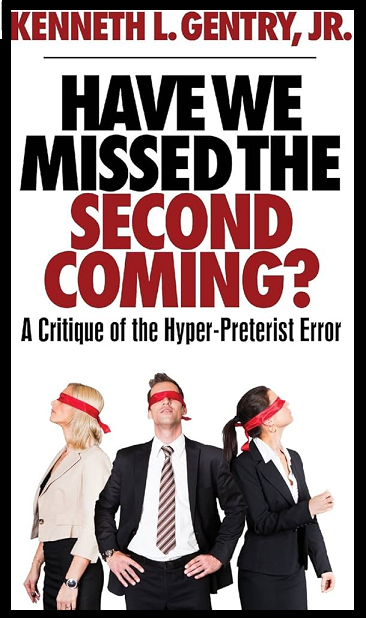
Have we missedPMW 2025-009 by Kenneth L. Gentry, Jr.

As I reflect on the presence of the small, but growing number of Christians committing to hyper-preterism, I have wondered what its drawing power is.

Initially, I thought that one of its strengths was that it is mutating so quickly that there are many versions floating about. Consequently, this conveniently allows for a great variety of options to anyone looking for a new theological hobby horse. The latest version of hyper-preterism (as of today, January 28, 2025) is Gary DeMar’s version, “Gospel Eschatology.” This has evolved from and is set over against other recent versions with their various distinctives. We can think of other versions such as Don Preston’s “Covenant Eschatology,” or Tim Martin’s “Covenant Creation Preterism,” or Max King’s “Transmillennialism” (aka “Corporate Body Preterism”) or Ward Fenley’s “Sovereign Grace Preterism,” or the “Preterist Universalists,” or of the work of the grandfather of hyperpreterism, J. Stuart Russell, author of The Parousia.

However, I really should not be surprised at the hyper-preterist aberration receiving a following. For I have long been amazed at the remarkable growth and influence of the eschatological movement known as the Latter-day Saints (i.e., Mormonism), despite its being patent heresy rooted in absolute absurdity. And as I continue wondering in ever-deepening perplexity and amazement, I am reminded also of the presence of another successful eschatological movement known as the Jehovah’s Witnesses: they have been among us for more than 100 years, happily knocking on our doors and delighting in being sent away without even being warmed and filled.

History teaches us that aberrant movements can gain a foothold within Christian circles and take on a life of their own (unless, of course, they drink the Kool Aid, as in Jim Jones’ “People’s Temple” cult: that movement is definitely “preter,” i.e., past!). It remains to be seen if hyper-preterism will be able to attract enough followers to finally establish itself as a full-blown church. Currently it is basically an Internet movement with occasional small conferences here and there, where self-published books are hawked. But still, I have wondered why some evangelicals are being attracted to it (in any of its several divergent, mutating forms). Recently, however, I believe I have uncovered a few overlooked reasons why some folks are finding it of interest. Consider its following advantages in three major areas of human experience.
Continue reading

PRETERISM, CONCERN, AND CONFUSION

ConfusionPMW 2024-086 by Kenneth L. Gentry, Jr.

I recently had a reader, whose name is “AJ,” express his concerns over preterism as presented on my blogsite. His comments were posted about my one-sentence answer to a brief question he asks regarding Revelation 18:3 and the merchants of the earth. Then he responds at length to that one-sentence reply. I will quote his two comments and my replies. Hopefully these will be of interest not only to AJ but to others.

AJ wrote:

“I respectfully have a question I hope you can answer. I have been researching preterism Versus Futurism and have a Litany of questions. But one I would like to ask here would you reference in your aforementioned quote of Revelations Is the merchants who stand Aloft at sea lamenting the destruction of the Great city. I know it goes on to say all of the merchants in Kings of the Earth grew wealthy from her, yet my research into the economic effects of Jerusalem in the first century ad indicate it had a very, very minor role in trade and certainly did not build the wealth of all the merchants and nations of the earth. There were a couple of coastal cities In that region that Much come up much more important for trade, so how can reasonably these verses about Jerusalem making the whole world wealthy be true? Thank you for taking the time to answer my question. God bless you.”
Continue reading

THE END-TIME RESURRECTION (3)

Resurrection dayPMW 2024-036 by Kenneth L. Gentry, Jr.

In this article I am concluding a three-part series on our resurrection as taught by Paul in 1 Cor 15. This continues the previous presentation outlining Paul’s second argument in his great resurrection chapter. The other two articles need to be consulted before jumping into this one. Unless you are good at back masking, and you can hum well..

(3) Paul’s parallels and contrasts show his concern is not physical v. immaterial, but perishable v. imperishable (v. 42), dishonor v. honor (v. 43a), and weakness v. power (v. 43b). Our resurrected condition is so governed by the Holy Spirit that the weaknesses of our present condition will be totally overcome by the transformational power of the Spirit. Indeed, he emphasizes the difference of glory as the key (vv. 40-41). Continue reading

THE CONFUSED, STUMBLING DISCIPLES

PMW 2024-014 by Kenneth L. Gentry, Jr.Tripping man

I am researching an expansion of my The Olivet Discourse Made Easy book. My expansion is so far-reaching in scope and large in size that I may have to rename it. Perhaps, The Olivet Discourse Made Hard. [1]

In my research I have a large section showing how confused and stumbling were Jesus’ twelve disciples — despite having the best teacher possible! Their confusion plays a large role in their misunderstanding Jesus’ prophecy of the destruction of the temple (Matt. 24:2). They ask two questions of him, the second of which shows their confusion. They ask when shall these things be, then they ask what shall be the sign of your parousia and of the end of the age (Matt. 24:3). As per much first century Jewish and apocalyptic expectations, they believed the temple could not be destroyed without history ending and that the Messiah would wage war against pagans.
Continue reading

OF PRETERISTS AND POSTMILLENNIALISTS (2)

PMW 2023-056  by Kenneth L. Gentry, Jr.

This is the second (and final) presentation of an interview conducted with me on preterism and postmillennialism.

Interviewer: Shifting to a related topic. Do preterist and non-preterist postmillennialists differ significantly in their reading of Matthew 24? Are there different interpretations of the two “days” even among preterists?

Gentry: Matthew 24 has been subjected to a fairly wide variety of interpretive approaches. Perhaps the more widely endorsed one holds that the Lord more or less jumbles together material on A.D. 70 and the Second Advent, in that A.D. 70 is a microcosmic precursor to the Second Advent. This view makes it difficult to sort out the verses in regard to which event the particular verses focus on. Among evangelical preterists two basic positions prevail: that 24:4–34 focus on A.D. 70 and 24:36ff focus on the Second Advent (this is my view, and the view presented by J. Marcellus Kik). The other view holds that all of Matthew 24–25 deals with A.D. 70. Continue reading

SANDLIN ON DEMAR’S HIDDEN VIEWS

PMW 2023-033 by Andrew Sandlin

The following article written by Andrew Sandling, President of Center for Cultural Leadership explains why he (and I and many others!) did not notice Gary DeMar’s commitment to the core principles of hyperpreterism until recently.

Gary DeMar’s Heretical Eschatology: What Did I Know, and When Did I Know It?
By P. Andrew Sandlin

I don’t intend to pursue further the controversy over Hyper-Pretersim (HP) brought to light by this letter signed by a number of Gary’s friends.

But I feel obliged to respond to Gary’s statement that he hasn’t changed his views in about 25 years, and that I have continued to promote him during that time, and only lately have I objected to his views. Have I just over the last few months become more severe in my judgment on heresy? Was I tolerant of Gary’s false teaching for a quarter century and only in the last few weeks become publicly intolerant of it?

The short answer is no. Here’s the longer answer:

Gary is quite correct that I had concerns over his eschatology 25 years ago. The (HP) heresy was rearing its ugly head. Its books were being carried by the late Walt Hibbard at the now defunct Great Christian Books, which was influential in the Reformed camp at that time. By reliable accounts, noted author David Chilton had embraced the HP heresy before his premature death. Many people seemed to have had the impression that to embrace postmillennialism was to embrace preterism, and even heretical HP.

Continue reading