Category Archives: Ethics

DOES GOD OPPOSE ALCOHOL? (5)

Wine negative 5PMW 2024-078 by Kenneth L. Gentry, Jr.

This is my final installment in a series analyzing the leading Scriptures that are deemed to prohibit alcohol consumption. I will start with:

Isaiah 5:21–22

Woe to those who are wise in their own eyes,
And clever in their own sight!
Woe to those who are heroes in drinking wine,
And valiant men in mixing strong drink.

This passage calls down woes upon “heroes in drinking wine.” And rightly so. But clearly this does not universally condemn all wine drinking. This should be evident for a number of reasons:

First, as we have seen, abundant evidence from Scripture shows that wine may be consumed in a righteous manner and by righteous men — including even the Son of God. And Scripture does not contradict Scripture.

Second, we find these verses set in a larger judgment context, where the prophet condemns other normally acceptable practices. For instance, verse 8 calls down woe upon those who “join house to house.” Is multiplying real estate holdings always sinful? In verse 12 we learn that the Jews are attending banquets where music is produced “by lyre and harp, tambourine and flute.” Are public festivities involving music necessarily evil? Continue reading

DOES GOD OPPOSE ALCOHOL? (4)

Wine negative 4PMW 2024-077 by Kenneth L. Gentry, Jr.

This is my fourth installment in a series considering passages in Scripture that seemingly prohibit any consumption of alcohol. We are discovering that these verses have to be ready uncarefully and uncontextually. Let us continue.

Proverbs 23:31-32

Do not look upon the wine when it is red,
When it sparkles in the cup,
When it goes down smoothly-,
At the last it bites like a serpent,
And stings like a viper.

Undoubtedly this passage is one of the most frequently employed texts in the debate over wine drinking. Indeed, prohibitionist Reynolds in his Alcohol and the Bible not only opens his major argument (p. 9) with this passage, but closes his book by referring to it (p. 64). He cites this passage over twenty times in his follow up work, Biblical Approach to Alcohol. We may fairly state that, according to Reynolds and those of like persuasion, this passage is the most significant and compelling prohibitionist statement in Scripture. Reynolds comments: “It is the intent of this essay to prove that Proverbs teaches an absolute prohibition against the beverage use of alcohol.” Before interpreting the passage, then, it will be helpful to cite some of Reynolds’s observations on it. Continue reading

DOES GOD OPPOSE ALCOHOL? (3)

Wine negative 3PMW 2024-076 by Kenneth L. Gentry, Jr.

In this survey of alleged negative passages regarding alcohol consumption, we come to perhaps the most used passage in this regard, Proverbs 20:1.

Proverbs 20:1

Wine is a mocker, strong drink a brawler.
And whoever is intoxicated by it is not wise.


Charismatic Gift of ProphecyCharismatic GP Godawa
(by Kenneth Gentry)

A rebuttal to charismatic arguments for the gift of prophecy continuing in the church today. Demonstrates that all revelatory gifts have ceased as of the conclusion of the Apostolic era.

See more study materials at: www.KennethGentry.com


Although not tied to unique circumstance, this verse does not universally prohibit wine drinking. The statement refers to the inebriating potential of wine and strong drink, of which the user must be wary. It warns those who use it immoderately. Note the following observations:

First, the general warning pattern. The warning “wine is a mocker” follows the pattern of 1 Corinthians 8:1, which says that “knowledge makes arrogant.” Obviously neither Christian ethics nor a biblical world-view disparage the quest for knowledge as a proper function of rational beings generally, or of Christians specifically. In certain respects wine-consumption and knowledge-acquisition are similar, and bring certain responsibilities with them. That is, each can be used for either good or evil. The point of Proverbs is that wine has the potential to mock, just as the point of Paul is that knowledge has the potential to make arrogant. Not all who have knowledge are “arrogant.” Neither do all who partake of wine become “mockers” or “brawlers.”
Continue reading

DOES GOD OPPOSE ALCOHOL? (2)

Wine negative 2PMW 2024-075 by Kenneth L. Gentry, Jr.

This is my second in a five-part series on the Christian and alcoholic beverages. I am highlighting the passages that many evangelicals believe condemn any and all use of wine or alcoholic beverages.

Numbers 6:2–6

This famous passage reads:

“Speak to the sons of Israel, and say to them, “When a man or woman makes a special vow, the vow of a Nazirite, to dedicate himself to the LORD, he shall abstain from wine and strong drink; he shall drink no vinegar, whether made from wine or strong drink, neither shall he drink any grape juice, nor eat fresh or dried grapes. All the days of his separation he shall not eat anything that is produced by the grape vine, from the seeds even to the skin. All the days of his vow of separation no razor shall pass over his head. He shall be holy until the days are fulfilled for which he separated himself to the LORD; he shall let the locks of hair on his head grow long. All the days of his separation to the LORD he shall not go near to a dead person.”

Again Scripture here clearly prohibits wine drinking. But just as before, this is a special circumstance totally irrelevant to our standing and conduct today. This prohibition is a piece of Naziritic legislation that forbid wine only after taking a peculiar, public vow (v. 2). Old covenantal ceremonial actions and vows no longer prevail in the new covenant order (Heb. 8:13).
Continue reading

DOES GOD OPPOSE ALCOHOL? (1)

Wine negative 1PMW 2024-074 by Kenneth L. Gentry, Jr.

In this new five-part series I will focus on a pesky biblical worldview question: Does the Bible condemn alcohol use? I believe it does not, for even Jesus turned water into wine. But the approach I will take in this series is to consider the leading passages that some evangelicals believe condemn alcohol consumption. Several biblical passages seem upon cursory reading to imply that all wine drinking is prohibited. I will focus on the nine most prominent passages employed in the argument against imbibing. I will provide brief explanatory statements showing that these passages perfectly harmonize with my statement that God does not prohibit is consumption.

Leviticus 10:8–11 reads:

The LORD then spoke to Aaron, saying, “Do not drink wine or strong drink, neither you nor your sons with you, when you come into the tent of meeting, so that you may not die — it is a perpetual statute throughout your generations — and so as to make a distinction between the holy and profane, and between the unclean and the clean, and so as to teach the sons of Israel all the statutes which the LORD has spoken to them through Moses.”

Continue reading

TOLERANCE, AND SOCIAL MORALITY

DiversityPMW 2024-026 by Kenneth L. Gentry, Jr., Th. D.

I live in the deep south, and right in the middle of the Bible belt. Unfortunately, we have gotten a taste of the homosexual revolution in our area. Awhile back recent news items, editorials, and letters to the editor debated the question of homosexuality. Tragically, the conservative South and Christian dominated cities are not immune to the moral decline and degradation of our culture.

Unfortunately, the whole controversy is a study in muddled ethical thinking, contradictory assertions, sloganeering, and outlandish charges. The local resistance to homosexual culture has been ridiculed as: “a breach of the separation of church and state,” “Naziism,” “menacing authority,” “an atrocity,” “right-wing extremism,” “poisonous,” “ayatollah-like,” “warped,” “a return to the dark ages,” “frightening,” “appalling,” “a witch hunt,” and more. Consequently, the dispute exposes our inability to think through moral issues. But public socio-political discourse is not the place for such moral confusion.
Continue reading

SODOM AND GOMORRAH

pillar of saltPMW 2024-023 by Kenneth L. Gentry, Jr.

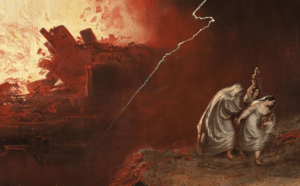
In this posting I will present a running overview of Genesis 19 relative to the sin and judgment of Sodom and Gomorrah.

Gen. 19:1a
the two angels
In Genesis 18:2 three men (i.e., angels) appeared to Abraham, one of them being the angel of the Lord, God himself (18:1, 13, 17). Two of them headed to Sodom (18:22), while the Lord departed from Abraham (18:33). Here in v. 1 the two angels come to investigate Sodom in anticipation of its destruction (v. 13; cp. 18:20–26).

Gen. 19:1b
Lot was sitting in the gate of Sodom
Peter declares three times that Lot is “righteous” (2 Pet. 2:7–8). Genesis only hints at this by noting that God would spare men for righteousness (18:22–33) then sparing Lot (v. 29). But Lot is a tragic example of a believer (declared righteous; cp. Genesis 15:6) who frequently fails: he chooses a land outside of the Promised Land based on its luxury even though the residents were “wicked exceedingly” (13:8–13); offers his daughters to the abusive Sodomites (vv. 5, 8); hesitates in leaving Sodom though directed by the angels (v. 16); and allows his daughters to get him drunk so as to commit incest (vv. 35–36). Peter tells us that he was oppressed and tormented by Sodom’s sensual conduct day by day, though he continued to live among them (2 Pet. 2:7–8). Christians must be concerned with their surroundings and avoid evil company (Psa. 1:1; 26:4–5; Prov. 4:14–15; 13:20; 1 Cor. 15:33). Lot lost his sons-in-law because of his remaining in an evil environment (19:14b).
Continue reading