Category Archives: Church

OUR CHURCH MEMBERSHIP OBLIGATION

PMW 2025-065 by Kenneth L. Gentry, Jr.cjir

I see so many Christians in America who have disassociated themselves from particular church membership. They do not see any reason for or value in joining a local congregation. So what is the biblical argument for formal church membership? Though there are many arguments, here are four that should encourage us in seeking church membership.

First, Scripture teaches that believers are to associate themselves together in worship.

In Hebrews the writer is discouraging Jews who have professed faith in Christ not to leave the church and return to the synagogue: “not forsaking our own assembling together, as is the habit of some, but encouraging one another” (Heb 10:25). In fact, in the earliest appearance of Christianity we see the disciples doing just that: “They were continually devoting themselves to the apostles’ teaching and to fellowship, to the breaking of bread and to prayer” (Acts 2:42). Continue reading
PROPER COMMUNION (5)

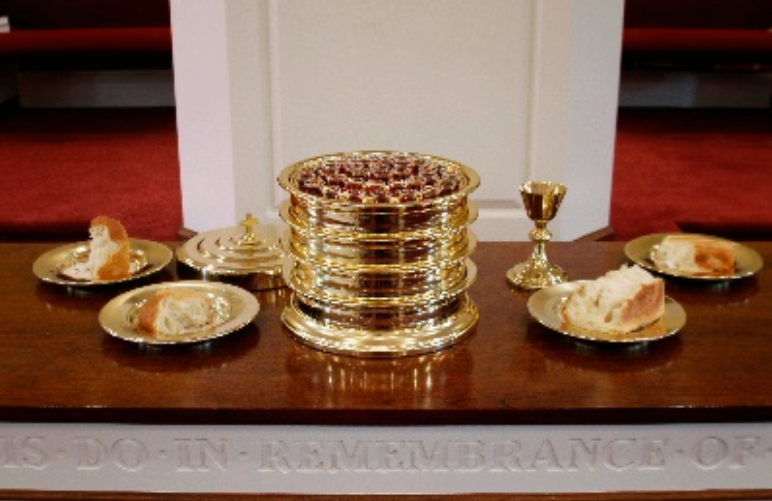
Communion 5PMW 2024-085 by Kenneth L. Gentry, Jr.

THE NECESSITY AND BENEFITS OF CAREFUL FENCING

In this five-part series, which I am concluding, we have studied the biblical argument for proper fencing of the Lord’s Table. In highlighting that argument we have noted its significance for the integrity of the church as the kingdom of Christ and as a means of establishing the church’s governmental authority. As we reflect upon the matter further we may note the necessity of careful fencing from other angles.

First, the failure to properly fence the Table encourages sin

If we allow Christians who refuse to join a church to partake of the Lord’s Supper we are encouraging them in their sin against Christ and his church. Christ established his church, gave it officers, and appointed (through his apostles) election and ordination as the means for securing its officers. And this can only be done by formal members in a church: electing church officers is surely not open to visitors. And intentionally remaining outside of membership in a local church makes it impossible for believers to “obey your leaders, and submit to them” so that they might “keep watch over souls” (Heb 13:17). Again, as Paul states: he has no authority over those outside (1 Cor 5:12). Obviously Christ intended that his followers formally commit to a church through membership. Continue reading

PROPER COMMUNION (4)

Communion 4PMW 2024-084 by Kenneth L. Gentry, Jr.

In my previous article on fencing the table I laid the foundations for considering the question before us. I introduced the idea of sacramental foundations their implications for fencing the table. Then I focused on the relationship of the sacraments to church government. Now we are finally ready to deal with the specific matter of partaking Communion.

SACRAMENTAL PARTAKING

Now I will draw out some biblical principles and directives regarding the careful fencing and partaking of the Lord’s Table.

First, the Lord’s Supper is intrinsically corporate

Although personal responsibilities fall upon the individual partakers of the Lord’s Supper (see next point below), we see clear and fundamental community overtones in it. Note the following:

(1) As I begin with these observations, we must remember that the first Lord’s Supper was established in the context of the Passover and took the place of a communal meal. Communion was designed to take the Passover’s place within the new Israel of God, the Church of Jesus Christ. This fact provides helpful background insights into the corporate setting and obligations of the sacrament. Continue reading

PROPER COMMUNION (3)

Communion 3PMW 2024-083 by Kenneth L. Gentry, Jr.

This is the third in a five-part series. The reader should read the first two articles to understand what I am getting at in this one. So, in this one, let us consider:

COMMUNION AND CHURCH GOVERNMENT

Several questions arise as we consider this issue:

• To whom was the Lord’s Supper originally given?
• In what context may it be offered?
• Who may administer it?

Answering these inter-related questions will take us a long way toward demonstrating the third and fourth elements in our fencing statement. Those elements require that a participant be a member in good standing (i.e., not under discipline) of an evangelical church and that they must have been formally admitted to the Lord’s Table by ordained church officers from an evangelical church (they may not be baptized infants who have not given a credible profession of faith, nor may baptized children approach the Table solely on their own decision without being formally approved by church officers). Let us see how this is so. Continue reading

PROPER COMMUNION (2)

Communion 2PMW 2024-082 by Kenneth L. Gentry, Jr.

In my previous posting, I introduced a new, five-part series on the proper administration of the Lord’s Supper. This article continues the study (which requires your reading the first article for a proper orientation). I am offering this study series due to my concern that the church in America has become too palsy-walsy and superficial. And I believe this is especially dangerous in regard to the sacrament of communion, which is a holy ordinance that distinguishes Christians from the world. So let us continue.

GENERAL ARGUMENT FOR FENCING

As we engage our inquiry into the biblical warrant for fencing the Table, we must begin with an irrefutable observation: the New Testament provides strong evidence that some form of fencing is required in inviting people to partake of the Lord’s Supper. Once this is recognized we have laid the essential, basic, foundational cornerstone for fencing as a general truth in Scripture. This then will open the more specific evidence for our particular form of fencing. We would argue on the basis of the following evidence that “open communion” without any fencing whatsoever is not only unbiblical but anti-biblical and dangerous. Continue reading

PROPER COMMUNION (1)

PMW 2024-081 by Kenneth L. Gentry, Jr.

INTRODUCTIONCommuinion 1

For the postmillennial hope to progress in this fallen world, the church needs to get her act together. We need a new Reformation. Contemporary worship has declined to such a deplorable level that her offering cheap entertainment rather than devout worship has diminished her influence in God’s world. One area (among many) wherein the church needs to return to her biblical standards is in the partaking of communion, i.e., the Lord’s Supper.

I will be offering a five-part study of the matter of “Proper Communion” as my contribution to this area of much need reformation. I hope you will follow me through this important study.

When I was pastoring and we celebrated the Lord’s Supper I made the following formal statement, which along with the minister’s personal call for participants to examine themselves, represented our method of fencing the Lord’s Table in the exercise of communion:

“We invite to the Lord’s Supper all who are believers in Christ, who are baptized members in good standing of an evangelical church, and who have been formally approved by church officers of an evangelical church to take communion.”

Continue reading

NEW COVENANT CHURCH & OLD ISRAEL

New Covenant IsraelPMW 2021-039 by Kenneth L. Gentry, Jr.

As noted on various occasions, I do try to answer questions sent in by my readers. I hope that these answers will be be helpful not only for the individuals who asked them, but for anyone who is interested in studying biblical eschatology. So, here goes today’s question:

Reader’s question:

Dispensationalists point out that God promises the new covenant to Israel only. The Jeremiah 31 text clearly mentions only “the house of Israel and the house of Judah.” How can we say that the new covenant finds fulfillment in the Church?

My response:

Thanks for your question. I hope the following brief answer will be helpful. First, please note that Jesus and Paul both apply the new covenant to the Church. Continue reading