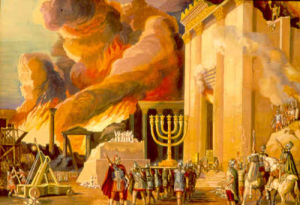
Category Archives: AD 70

POSTMILLENNIALISM AND APOLOGETICS (4)

PMT 2017-048 By Mike Warren (Christian Civilization Blog)

Point 4:
Postmillennialism is the biblical anecdote to failed predictions of Christ’s Second Coming.

Postmillennialism, with a preterist view of the Great Tribulation, refutes the numerous failed predictions, which have undermined the credibility of the modern evangelical church, that Jesus is coming soon to rapture Christians out of the world. Continue reading

POSTMILLENNIALISM AND APOLOGETICS (3)

PMT 2017-047 by Mike Warren (Christian Civilization Blog)

Point 3:
Postmillennialism refutes the skeptics’ claim that Jesus broke His promise to return.

Postmillennialism, with a preterist view of the Great Tribulation, refutes the claim of skeptics that Jesus was a false prophet because He did not return to earth within a generation as He predicted and as His apostles expected. Continue reading

POSTMILLENNIALISM AND APOLOGETICS (2)

Point 2:
Postmillennialism validates the resurrection and the truth of Jesus’ messag
e.

Postmillennialism, with a preterist view of the Great Tribulation, points to empirical evidence still visible in our own day that a major prophecy by Jesus came true, which validates Jesus as a true prophet from God (Deut. 18:21-22), and that validates Jesus’ message, such as His statements about being God and about His resurrection.[1] (“Preterist” means “past” and means here that the Great Tribulation occurred in the past, namely the first century A.D.) Continue reading

THE SIGN OF THE SON OF MAN (2)

sign-of-son-of-man-2PMT 2016-085 by Kenneth L. Gentry, Jr.

In my preceding article I began answering a reader regarding my interpretation of Matt. 24:30. I believe that the events of AD 70 are the sign of Jesus’s enthronement in heaven. That article should be read before entering into this one. Now I continue my defense of my interpretation (which is not mine, but one that is held by a number of scholars).

Hagner (“Matthew” in Word Biblical Commentary 2:714) points out the LXX backdrop to Matt. 24:30 which is found in Zech. 12:10–14. He notes that in Zech. 12:10–14 “the phrase pansai hai phulai, “all the tribes,” as well as he ge, here meant as ‘the land [of Israel].’” But then he argues that “in keeping with Matthew’s universal perspective, the tribes of the earth, which in the OT originally meant the tribes of Israel, are to be understood all the nations of the earth.” Nolland (“Matthew,” New Intl. Greek Comm., 984) agrees. How can this be said in light of the context? Continue reading

THE SIGN OF THE SON OF MAN (1)

sign-of-son-of-man-1PMT 2016-084 by Kenneth L. Gentry, Jr.

Reader’s question

I have been challenged on my view of Matt. 24:29-30 by someone who knows the Greek well. He stated that the passage does not mean what the preterist claims. He went as far as to say that the people I read and trust on this subject are wrong. Can you offer a Greek study/explanation as to why verse 30 can be read with the meaning being that “then will appear the sign of the Son of Man in heaven?” Continue reading

DEBATING HYPERPRETERISTS

Brick wallEvery few years I will get a request such as this. I thought it might be helpful to answer it publicly so that in the next few years when I get another one, I can simply point to this article.

Dr. Gentry:

I have a friend who has pointed out problems he has with some of your response to HyperPreterism. He asked me these questions about you: Why do you not publicly debate HyperPreterists? And: In your chapter in Mathison’s book against HyperPreterism, you focus solely on the creedal argument. Does creedalism preclude exegesis?
LFR (North Carolina)

Continue reading

REV 11:2 AND ISRAEL CAST OUT (4)

jer 3-8 divorce 2PMT 2016-017 by Kenneth L. Gentry, Jr.

This is the final installment in a four-part series discussing the significance of John’s imagery in Rev 11:2. To get the context of this study, please begin at the first one.

Ekballō and Spousal Divorce

Scripture employs the term ekballō of divorcing one’s wife by sending her out of the house. “As a [technical term] of the LXX for expulsion of a wife, ekballō appears in the citation of Gen 21:10 in Gal 4:30” where Paul refers to the expulsion of Hagar from Abraham’s house (EDNT). In that the judicial backdrop of Rev is God’s divorce decree against Jerusalem/Israel, this fits perfectly with John’s theme stated in Rev 1:7. The excommunication concept (discussed in my previous point) fits nicely also with God’s casting Israel out of his house as a divorced wife, as we shall see. Continue reading