Category Archives: AD 70

MATTHEW 24:28 “EAGLES” OR “VULTURES”?

PMW 2018-073 by Kenneth L. Gentry, Jr.

In the opening section of the Olivet Discourse (Matt. 24–25), Jesus deals initially and significantly with the approaching AD 70 destruction of Jerusalem by Roman imperial forces (vv. 4–34). We may easily surmise this from the local context. After all, the Discourse is introduced by Jesus’ prophesying the destruction of the temple (Matt. 24:2), then linking his prophecy to the temple locale (“the holy place,” v. 15), warning the local residents to flee from the area (Jerusalem is in Judea, v. 16), and informing them generally when it will occur (in “this generation,” v. 34). [1]

The Roman eagle

Matt. 24:28 is an interesting verse embedded in this context. But its frequent mistranslation dulls the cutting edge of Jesus’ warning about the Roman invasion. Continue reading

MATTHEW’S OUTLINE; JESUS’ IDENTITY

PMW 2018-070 by Kenneth L. Gentry, Jr.

I am currently working on a commentary on Matthew 21–25. In this commentary I will be focusing on the Olivet Discourse in its contextual setting. I will be demonstrating this fifth and final major discourse of Jesus (Matt. 5–7; 10; 13; 18; 24–25) not only prophesies the destruction of the temple and God’s judgment on Israel in AD 70, but also the Final Judgment upon all the nations at the end of history.

Jesus’ teaching in this section dramatically declares his universal lordship over both Israel (e.g., Matt. 24:2, 16, 34) and all men and nations (Matt. 25:31–46). Earlier (and uniquely!) in Matthew’s Gospel, Jesus specifically limited his mission to Israel (Matt. 10:5–6; 15:24). But now as the narrative of his life unfolds to its climax, he expands his mission to “all the nations” (Matt. 28:19). Thus, in this section he will begin repeatedly emphasizing the inclusion of the Gentiles in his program (e.g., Matt. 21:43; 22:8–10; 24:14, 31; 31–46). Continue reading

OLIVET’S TRANSITION VERSE RE-VISITED

PMW 2018-059 by R. T. France

Gentry introductory note:
As I am researching my commentary on Matthew 21–25 (the contextual unit in which the Olivet Discourse appears in Matthew), I have stumbled across a helpful older work by R. T. France: Jesus and the Old Testament. (By the way, I literally stumbled over this work: I already owned, it was in my library, and it fell out when I reached for another book.)

In the Appendix to his study, he gives a brief exegesis of Mark 13, which argues for a transition from AD 70 to the Final Judgment (just as I argue in my work on Matt. 24

He puts the matter well, so I will share it with my readers.

So now, let us hear R. T. France on Mark 13 and the transition from Jesus’ prophecy regarding AD 70 to his prophecy of the Final Judgment. The following is taken from Jesus and the Old Testament  (p. 232): Continue reading

OLIVET REVISITED

PMW 2018-058 by Kenneth L. Gentry, Jr.

The Olivet Discourse is a key eschatological passage in the New Testament (which appears in Matthew, Mark, and Luke). In Matthew, it is not only Jesus’ last discourse, but the largest (Matt. 24:3–25:46). Matthew, therefore, sets it as the climax of Jesus’ teaching, which underscores its significance.

I have a special interest in Olivet. This can be seen in that I have written several works dealing with Olivet: Continue reading

THE TEMPLE’S FAILURE AND DECLINE (3)

PMW 2018-045 by Kenneth L. Gentry, Jr.

As we conclude our focus on Israel’s temple (see previous article), we must note that Jesus prophesies the temple’s destruction so clearly (Jn 2:19-20; Mt 24:1ff) that the Jews mock him on the cross regarding the matter (Mt 27:40//). Later they recall this statement against his disciples (Ac 6:14). After cursing the fig tree as representing Israel (Mt 21:19) he declares that the temple mount will be cast into the sea (Mt 21:21//) (Morna Hooker The Gospel according to Mark 269). His trials specifically recall his statements about the temple’s destruction (Mk 14:58; Mt 26:61), though falsely claiming he said he would personally destroy it. Late in his ministry he presents a major discourse on the temple’s coming destruction (Mt 24:2ff //). Continue reading

GENTRY COMMENTARIES

PMW 2018-033 by Kenneth L. Gentry, Jr.

Gentry Commentary on Revelation

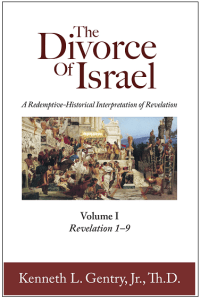
I have just received notice from the publisher that my commentary on Revelation will be released this Summer. It’s title is: The Divorce of Israel: A Redemptive-Historical Interpretation of Revelation. It will be around 1800 pages in two volumes.

I am excited that the long wait for it may be over. A day waiting for one’s book to be published is like a 1000 years. Only more so. I never thought I would interpret a 1000 years so literally!

But what does a used Revelation commentator do in his spare time, such as it is? He gets started on Revelation’s best friend, the Olivet Discourse. After all, Revelation opens with “the Revelation of Jesus Christ” (Rev. 1:1), and has four key passages from Christ that greatly impact its drama, each one taken from the Olivet Discourse. Continue reading

ORTHODOX PRETERISM AND LUKE 17

PMW 2017-126 by Kenneth L. Gentry, Jr.

From time-to-time I receive inquiries regarding the relationship of Luke 17 and Matthew 24. This is generally prompted by orthodox Christians who have been challenged by Hyper-preterists. Thus, it is important for the protection and promotion of evangelical orthodoxy to return to this question when needed.

I argue in several places in my writings, that Matthew 24 is answering two questions from the disciples. They assume the destruction of the temple means the destruction of the world (Matt 24:1–3). But Jesus separates the destruction of the temple from the second coming and the end of history. We see him drawing a line between the two events between verses 34 and 36 in Matt 24. Continue reading