
PMW 2026-018 by Charles Hodge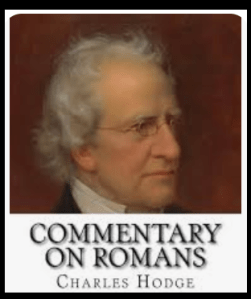
Romans 11:25–26 is a passage that is helpful for supporting the postmillennial hope. Perhaps the best exposition is that by John Murray in his commentary on Romans. In this article, however, I will post Charles Hodge’s view, which comports well with Murray’s.
I will alter Hodge’s passages in only four minor ways: (1) I will break up his statements in a more modern style, making it more easily accessible. I will, however, maintain Hodge’s words as they appear in the text. (2) I will transliterate his Greek into English. (3) I will change his punctuation to a more modern style. For example, he sometimes puts commas and semi-colons within a parenthesis, whereas today they are properly placed outside of it. (4) I will replace Roman numerals with Arabic numerals. I do this because there are II kinds of people in the world: those who understand Roman numerals and those who don’t. I want to minister to all people by this change!
Let’s get started with Hodge’s argument. All that follows is Hodge’s own presentation.
Romans 11:25
“For I would not, brethren, have you ignorant of this mystery, lest ye should be wise in your own conceits, that blindness in part has happened unto Israel, until the fullness of the Gentiles be come in.”
Although the interpretations given of this and the following verses are very numerous, they are all modifications of one or the other of the two following general views of the passage.
1. Many understand the apostle as not predicting any remarkable future conversion of the Jewish nation, but merely declaring that the hardening or blinding of the nation, was not such as to prevent many Jews entering the Christian church, as long as the Gentiles continued to come in. Thus all the true Israel, embracing Jews as well as Gentiles, should ultimately be saved.
He Shall Have Dominion
(paperback by Kenneth Gentry)
A classic, thorough explanation and defense of postmillennialism (600+ pages). Complete with several chapters answering specific objections.
See more study materials at: www.KennethGentry.com
2. The second general view supposes the apostle, on the contrary, to predict a great and general conversion of the Jewish people, which should take place when the fullness of the Gentiles had been brought in, and that then, and not till then, those prophecies should be fully accomplished which speak of the salvation of Israel.
The former of these views was presented, in different forms, by the great body of the authors who lived about the time of the Reformation; who were led by the extravagancies of the Millennarians, who built much on this passage, to explain away its prophetic character almost entirely. Olshausen, in order to show the hostile feeling entertained by the Reformers towards the Jews, quotes a passage from Luther, which does not admit of translation: “Ein jüdisch Herz ist so stoch-stein-eisen-teufelhart, das mit keiner Weise zu bewegen ist; — es sind junge Teufel zur Hölle verdammt, diese Tellfelskinder zu bekehren ist unmöglich, wie etliche solchen Wahn schöpfen aus der Epistel an die Römer.” [1]
The second view has been the one generally received in every age of the church, with the exception of the period just referred to. That it is the correct interpretation, appears evident for the following reasons:
1. The whole context and drift of the apostle’s discourse is in its favor. In the preceding part of the chapter, Paul, in the plainest terms, had taught that the conversion of the Jews was a probable event, and that it would be in the highest degree beneficial and glorious for the whole world. This idea is presented in various forms; and practical lessons are deduced from it in such a way as to show that he contemplated something more than merely the silent addition of a few Israelites to the church during successive ages.
2. It is evident that Paul meant to say, that the Jews were to be restored in the sense in which they were then rejected. They were then rejected not merely as individuals, but as a community, and therefore are to be restored as a community; see Romans 11:11, Romans 11:15. How can the latter passage (Romans 11:15), especially, be understood of the conversion of the small number of Jews which, from age to age, have joined the Christian Church? This surely has not been as “life from the dead,” for the whole world.
 The Book of Revelation and Postmillennialism (Lectures by Ken Gentry)
In the first of these three 50-minute lectures Gentry explains Revelation’s judgments to show they do not contradict postmillennialism. In the next two lectures he shows how the Millennium and the New Creation themes strongly support the gospel victory hope found in postmillennialism.
See more study materials at: www.KennethGentry.com
3. It is plain from this and other parts of the discourse, that Paul refers to a great event; something which should attract universal attention.
4. In accordance with this idea, is the manner of introducing this verse, I would not have you ignorant, brethren; see 1 Corinthians 10:1; 1 Corinthians 12:1, and elsewhere. Paul uses this form of address when he wishes to rouse the attention of his readers to something specially important.
5. The gradual conversion of a few Jews is no mystery, in the scriptural sense of the word. The word musterion, secret, is not generally used, in the New Testament, in the sense of the word mystery. It means simply, what is hidden, or unknown; whether because it is an unrevealed purpose of God; or because it is future; or because it is covered up in parables or symbols, (as the mystery of the seven candlesticks, Revelation 1:20); or because it lies beyond the reach of the human mind, Ephesians 5:32. It is only in the last mentioned case that musterion answers to our word mystery.
Whatever needs an apokalupsis, to become an object of knowledge, is a musterion. It is therefore used in reference to all the doctrines of the gospel which are not the truths of reason, but matters of divine revelation; Romans 16:25; 1 Corinthians 2:7; 1 Corinthians 4:1; Ephesians 6:19, etc. Hence ministers are called stewards of the mysteries (i.e., of the revelations) of God. It is also used of some one doctrine, considered as previously unknown and undiscoverable by human reason, however simple and intelligible in its own nature. Thus, the fact that the Gentiles should be admitted into the church of God, Paul calls a mystery, Ephesians 1:9; Ephesians 3:4. Any future event, therefore, which could be known only by divine revelation, is a mystery. The fact that all should not die, though all should be changed, was a mystery, 1 Corinthians 15:51. In like manner, here, when Paul says, “I would not, brethren, have you ignorant of this mystery,” he means to say, that the event to which he referred, was one which, depending on no secondary cause, but on the divine purpose, could be known only by divine revelation. This description is certainly far more suitable to the annunciation of a prophecy, than to the statement of a fact which might have been confidently inferred from what God had already revealed.
6. The words, all Israel, in the next verse, cannot, as the first interpretation mentioned above would require, be understood of the spiritual Israel; because the word is just before used in a different sense, “blindness in part has happened unto Israel.” This blindness is to continue until a certain time, when it is to be removed, and then all Israel is to be saved. It is plain, that Israel in these cases must be understood as referring to the same class of persons. This is also clear from the opposition between the terms Israel and Gentile.
The Divorce of Israel: A Redemptive-Historical Interpretation of Revelation
By Ken Gentry
This commentary is an 1800 page, two-volume deeply exegetical, academic commentary on the Bible’s most mysterious book. It takes an orthodox preterist approach, giving serious attention to the details of John’s many visions.
Click: The Divorce of Israel
See more study materials at: www.KennethGentry.com
7. The words (achris hou), correctly rendered in our version, until, cannot, so consistently with usage, be translated, as long as, or so that, followed as they are here by the aorist subjunctive; see Revelation 15:8; Revelation 17:17; compare Hebrews 3:13.
8. The following verses seem to require this interpretation. The result contemplated is one which shall be a full accomplishment of those prophecies which predicted the salvation of the Jews. The reason given in Romans 11:28, Romans 11:29, for the event to which Paul refers, is the unchangeableness of God’s purposes and covenant. Having once taken the Jews into special connection with himself, he never intended to cast them off for ever. The apostle sums up his discourse by saying, ‘As the Gentiles were formerly unbelieving, and yet obtained mercy, so the Jews who now disbelieve, shall hereafter be brought in; and thus God will have mercy on all, both Jews and Gentiles.’
From all these considerations, it seems obvious that Paul intended here to predict that the time would come when the Jews, as a body, should be converted unto the Lord; compare 2 Corinthians 3:16. The prediction contained in this verse is to be explained by the context. The rejection of the Jews at the time of Christ, did not involve the perdition of every individual of that nation. Thousands, and even myriads, believed and were saved. So the restoration here foretold is not to be understood as including every individual of the Jewish people, but simply that there is to be a national restoration.
“Lest ye should be wise in your own conceits.” This is given as the reason why the apostle wished the Gentiles to know and consider the event which he was about to announce. This clause may mean either, ‘Lest ye proudly imagine that your own ideas of the destiny of the Jews are correct;’ or, ‘Lest ye be proud and elated, as though you were better and more highly favored than the Jews.’ The former is perhaps most in accordance with the literal meaning of the words (en heautois phronimoi) see Proverbs 3:7.
Blindness in part, i.e. partial blindness; partial as to its extent and continuance. Because not all the Jews were thus blinded, nor was the nation to remain blind for ever. The words apo merous not to be connected with porosis nor with to Israel, but with gegonen. ‘Blindness has partially happened to Israel.’ The reference, however, is not to the degree, but to the continuance of this blindness. It is not final and hopeless; it is only for a time. The word (porosis) rendered blindness, is more correctly rendered, in Mark 3:5, hardness; compare Ephesians 4:18; see Romans 11:7, and Romans 9:18.
Israel in the Bible and History (9 mp3 lectures)
by Ken Gentry
The people of Israel are the people of God. But the modern church is divided over the nature, call and identity of Israel. This lecture series covers key issues for understanding the biblical concept of Israel.
See more study materials at: www.KennethGentry.com
Until the fullness of the Gentiles be come in. Until achris ou, marks the terminus ad quem. This blindness of Israel is to continue until something else happened. There were to be, and have been numerous conversions to Christianity from among the Jews, in every age since the advent; but their national conversion is not to occur until the heathen are converted.
What, however, is definitely meant by the pleroma ton ethnon, it is not easy to determine. The question is not to be decided by the mere signification of the words. In whatever way they may be explained, the general idea is the same. The pleroma of the Gentiles may mean, that which makes the Gentiles, as to number, full. Or, according to others, the Gentiles themselves are the pleroma, i.e. the complement; they make full the vacancy left by the rejection of the Jews. Or, as is commonly assumed, pleroma is to be taken in a secondary sense, for multitude. Compare Genesis 48:19: “Multitude (literally fullness) of nations;” and Isaiah 31:4, “Multitude (fullness) of shepherds.”
This does not mean the totality of the Gentiles. It is not Paul’s doctrine, that all Gentiles who ever lived are to be introduced into the kingdom of Christ. Nor does it mean, that all the Gentiles who may be alive when the Jews are converted, shall be true Christians. All that can be safely inferred from this language is, that the Gentiles, as a body, the mass of the Gentile world, will be converted before the restoration of the Jews, as a nation. Much will remain to be accomplished after that event; and in the accomplishment of what shall then remain to be done, the Jews are to have a prominent agency. Their conversion will be as life from the dead to the church. We must remember that Paul is here speaking as a prophet, en apokalupsei, 1 Corinthians 14:6, and therefore his language must be interpreted by the rules of prophetic interpretation. Prophecy is not proleptic history. It is not designed to give us the knowledge of the future which history gives us of the past. Great events are foretold; but the mode of their occurrence, their details, and their consequences, can only be learned by the event. It is in the retrospect that the foreshadowing of the future is seen to be miraculous and divine.
Romans 11:26
And so all Israel shall be saved, as it is written. Israel, here, from the context, must mean the Jewish people, and all Israel, the whole nation. The Jews, as a people, are now rejected; as a people, they are to be restored. As their rejection, although national, did not include the rejection of every individual; so their restoration, although in like manner national, need not be assumed to include the salvation of every individual Jew. Pas Israel is not therefore to be here understood to mean, all the true people of God, as Augustine, Calvin, and many others explain it; nor all the elect Jews, i.e. all that part of the nation which constitute “the remnant according to the election of grace;” but the whole nation, as a nation.
 “Jesus, Matthew, and the Rejection of Israel” (downloadable mp3)
by Ken Gentry
Surveys the Gospel of Matthew and highlights the numerous references — direct and indirect — that suggest that Matthew’s Gospel was written (at least in part) to demonstrate that God was rejecting Israel. A great many passages in Matthew are surveyed and briefly elaborated upon.
See more study materials at: http://www.KennethGentry.com
In support of what he had said, the apostle appeals to the Old Testament prophecies. It is probable that here, as elsewhere, he does not intend to refer exclusively to any one prediction, but to give the general sense of many specific declarations of the ancient prophets. Isaiah 59:20, Isaiah 59:21; Isaiah 27:9; Jeremiah 31:31–34; Psalms 14:7, are the passages which seem to have been immediately before the apostle’s mind, and to have given color to his language.
In Isaiah 49:20, it is said, “The Redeemer shall come to Zion, and unto them that turn from transgression in Jacob.” Instead of ek Zion, out of Zion. the LXX has eneken Zion, for the sake of Zion, the English version, to Zion. In Psalm 14:7, it is out of Zion. The latter part of the verse, as given by Paul, does not agree with the Hebrew, which is correctly rendered in our version, “To such as turn from transgression (literally, to the converts of transgression) in Jacob.” Paul follows the LXX, kai apostrepsei asesbeias apo Iakob, and shall turn iniquity from Jacob.
In Isaiah 27:9, the phrase is, “the iniquity of Jacob shall be purged.” The general idea expressed in these passages is, “The God, the deliverer, shall come for the salvation of Jacob,” i.e., of the Jews. And this is all that Paul desired to establish by these ancient prophecies. The apostle teaches, that the deliverance promised of old, and to which the prophet Isaiah referred in the passage above cited, included much more than the conversion of the comparatively few Jews who believed in Christ at the advent. The full accomplishment of the promise, that he should turn away ungodliness from Jacob, contemplated the conversion of the whole nation, as such, to the Lord. We are, of course, bound to receive the apostle’s interpretation as correct; and there is the less difficulty in this, as there is nothing in the original passage at all incompatible with it, and as it accords with the nature of God’s covenant with his ancient people.
Note
1. The translation of Luther’s anti-Semitic statement is: “A Jewish heart is so stubbornly hard, like stone and iron, that it cannot be moved in any way; — they are young devils condemned to hell, it is impossible to convert these children of the devil, as some derive this delusion from the Epistle to the Romans.” Luther pulled no punches!
Click on the following images for more information on these studies:
 |
 |
 |



 Postmillennial Worldview
Leave a comment