
PMW 2025-100 by Kenneth L. Gentry, Jr.
In my last article I began to suggest an effective strategy for presenting a preterist approach to Revelation to any dispensational friend you might have (and if you are in America and have Christians friends, they are almost certainly dispensational). Unfortunately, after I began that article I quickly strayed off the path and ended up following a few rabbit trails. Now I have found my way back and will present the promised article.
Remembering what has been stated
Though much was written in jest (i.e., jest in time, you might say) in my last article, there are a few things you must bear in mind as you attempt to introduce preterism to any associates. I noted the following two matters: (1) To make your introductory presentation manageable, I recommend concentrating on one key passage rather than ranging over dizzying array of several. And (2) you should begin at Revelation’s opening rather than jumping into some of the more exciting and familiar portions of the book. So, let me map at a battle plan for you.
Begin at the beginning
How, then, should you begin the challenging task of opening the small, closed mind of your confused Rapturist associate? I believe that you must begin with John’s own opening words that introduce the rest of Revelation to follow. It is always important to read and understand a writer’s own introduction. He is writing it for an important communicative reason. Don’t overlook it.
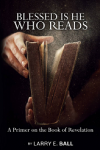
Blessed Is He Who Reads: A Primer on the Book of Revelation
By Larry E. Ball
A basic survey of Revelation from an orthodox, evangelical, and Reformed preterist perspective. Ball understands John to be focusing on the destruction of Jerusalem and the temple in AD 70. Insightful. Easy to read.
For more Christian studies see: www.KennethGentry.com
This is true even in reading poetry. For instance, in introducing one of the world’s most famous poems you will find it necessary to engage the poem’s introduction. Thus, you cannot simply open with “Sugar is sweet / And so are you.” This does not provide enough context to let your audience know what you are speaking about. [1] You must begin with the all-important, introductory set-up: “Roses are red / Violets are blue.” Then, and only then, will your acquaintance understand your poetic sentiment. (And don’t slip up and say, “Roses are read,” for that will really confuse your listener.)
So, in introducing Revelation you must open with John’s own introductory words, which are his first three verses, Revelation 1:1–3:
[1] “The Revelation of Jesus Christ, which God gave Him to show to His bond-servants, the things which must soon take place; and He sent and communicated it by His angel to His bond-servant John, [2] who testified to the word of God and to the testimony of Jesus Christ, even to all that he saw. [3] Blessed is he who reads and those who hear the words of the prophecy, and heed the things which are written in it; for the time is near.”
Now we have John’s own clearly stated explanation about what he will be writing in Revelation. He does not cross-reference the laborious, in-depth, academic exegetical work found in Hal Lindsey’s densely written Late Great Planet Earth or offer celestial documentation from John Hagee’s careful, meticulous research from astrophysics provided in his remarkable tome: Four Blood Moons: Something is About to Change.
Rather, John pointedly asserts — twice! — in his opening words found in his first three verses that “the Revelation of Jesus Christ” will be dealing with “things which must soon take place.” And that his original audience (the seven churches of Asia, Rev. 1:11; 2:1–3:22) must “hear the words of the prophecy, and heed the things which are written in it; for the time is near” (Rev. 1:3).
And just to nail shut your opening argument, you might want to cross-reference the exact parallels in Revelation 22:6, 10, as John reminds his audience when he begins closing his prophecy:
[22:6] “These words are faithful and true”; and the Lord, the God of the spirits of the prophets, sent His angel to show to His bond-servants the things which must soon take place…. [10] Do not seal up the words of the prophecy of this book, for the time is near.”
Thus, the clear bulk of Revelation must be dealing with what John opens and closes his prophecy announcing: events that must soon take place because the time is near. Of course, most written works will allow a flash forward or a flash back (but seldom a flash sideways). So, a few of the prophecies can be dealing with events in the distant future without contradicting John’s overall near-term focus.
 The Book of Revelation and Postmillennialism (Lectures by Ken Gentry)
In the first of these three 50-minute lectures Gentry explains Revelation’s judgments to show they do not contradict postmillennialism. In the next two lectures he shows how the Millennium and the New Creation themes strongly support the gospel victory hope found in postmillennialism.
See more study materials at: www.KennethGentry.com
Read as intended
A second point to make in introducing Revelation’s true meaning is to take to heart another major point stated in John’s opening three verses. But in this case you will have to realize the Greek backdrop to that important statement.
In Revelation 1:1 reads (again, but with a different focus):
“The Revelation of Jesus Christ, which God gave Him to show to His bond-servants, the things which must soon take place; and He sent and communicated it by His angel to His bond-servant John.”
Here the word “communicated” is esemanen, from the root verb semaino. This word means “signified,” i.e., to show by signs, images, or symbols. If you have the New American Standard Bible (or some other Bible with good center column notes) you will read footnote 1 explaining that the word translated “communicated” can mean “signified.” That is, sign-ified, shown by signs or symbols. This is why John’s interpretive angel “shows” [deiknumi] him his prophecies: they are symbols, not literal observations. The words deiknumi and semaino function together to emphasize symbolism is involved. Thus, John will soon be commanded to “write in a book what you see [blepo]” (Rev. 1:11).
This opening comment by John should discourage anyone from attempting to interpret Revelation literalistically, as dispensationalists vehemently argue. And to help flesh out this point of symbolic interpretation, you may have to wander quickly through several of Revelation’s symbolic images. And they are legion. For instance, who would interpret these matters literally?
In Revelation 1:12–20, he records his first vision, a vision of Christ walking among lampstands. On the literalist assumption, the vision should be teaching that the Lord walks among candles in heaven. However, John will not allow that. In verse 20, Jesus interprets the vision for us:
“As for the mystery of the seven stars which you saw in My right hand, and the seven golden lampstands: the seven stars are the angels of the seven churches, and the seven lampstands are the seven churches.” (Rev. 1:20)
In Revelation 5, John sees a lamb with seven eyes. Even the most naive literalist recognizes this lamb represents Christ the Lord, for he is called (not literally!) “the Lion that is from the tribe of Judah, the Root of David” (Rev. 5:5). After all, the angels of heaven sing his praise as the Redeemer of God’s people (5:9–10) and as glorious because of his work (5:12). In the next verse, he is praised equally with God the Father (5:13). In Revelation 14, the Lamb’s name is associated with God’s name on the elect of God (14:1).
Four Views on the Book of Revelation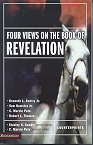
(ed. by Marvin Pate)
Helpful presentation of four approaches to Revelation. Ken Gentry writes the chapter on the preterist approach to Revelation, which provides a 50 page survey of Revelation .
See more study materials at: www.KennethGentry.com
John also provides interpretive directives on one of the more unusual features of the vision of the Lamb. He explains the “seven eyes”: “And I saw between the throne (with the four living creatures) and the elders a Lamb standing, as if slain, having seven horns and seven eyes, which are the seven Spirits of God, sent out into all the earth” (Rev. 5:6). The vision’s seven eyes do not mean that the Lamb literally has seven eyeballs in his head, i.e., the firm, mobile, spherical structures enclosed by the sclera and the cornea. John tells us so himself.
Despite John’s speaking of “incense” in the angelic bowls in heaven, he re-directs our understanding. He clearly states that the incense John saw really represented the “prayers of the saints”:
“And when He had taken the book, the four living creatures and the twenty-four elders fell down before the Lamb, having each one a harp, and golden bowls full of incense, which are the prayers of the saints.” (Rev. 5:8)
In Revelation 17:7, 9–10, the interpreting angel clears John’s confusion by noting that one image really represents two altogether different realities:
“And the angel said to me, ‘Why do you wonder? I shall tell you the mystery of the woman and of the beast that carries her, which has the seven heads and the ten horns. . . . Here is the mind which has wisdom. The seven heads are seven mountains on which the woman sits, and they are seven kings; five have fallen, one is, the other has not yet come; and when he comes, he must remain a little while.” (Rev. 17:9–10)
So then, not only do the seven heads not portray seven literal heads on one actual beast, thus referring to the upper part of the body in humans and animals, containing the brain, eyes, ears, nose, and mouth. Rather they symbolize two other, wholly unrelated realities: seven mountains and seven kings.
And what shall we say of the horns on the beast? They are not horns at all—even though certain mammals do actually possess horns made up of a bony core covered with a sheath of keratinous material. The interpreting angel interprets this for John and for us: “And the ten horns which you saw are ten kings, who have not yet received a kingdom, but they receive authority as kings with the beast for one hour” (Rev. 17:12).
And there are numerous other examples of the absurdity of literalism which can be seen in Revelation. What about four living creatures, covered with eyes (Rev. 4:6)? Or the slain lamb who has seven horns and seven eyes (5:6)? Or people washing their robes in blood to make them white (7:14)? Or locusts with crowns and the faces of men (9:7)? Or horses with the heads of lions (9:17)? Or the multi-headed dragon pulling down the stars of heaven (12:3–4)? Or a woman with two wings and a serpent that spews out a river (12:14–15)? Or a beast that is a compound of a leopard, bear, and lion (13:2)? Etc., etc., ad infinitum?
Reformed Eschatology in the Writings of Geerhardus Vos
Ed. by Ken Gentry and Bill Boney
This is a collection of several key eschatological studies by the renowned Reformed theologian Geehardus Vos. We have modernized Vos’ grammar and syntax and updated his layout style according to modern publishing conventions (shorter sentences and paragraphs). We did this without changing any of Vos’ arguments.
For more information on this new Vos work or to order it, see:
https://www.kennethgentry.com/reformed-eschatology-in-the-writings-of-geerhardus-vos/
Conclusion
Thus, in introducing the preterist interpretation of Revelation to the average American evangelical Christian, you should try these tactics. (1) Begin at Revelation’s beginning (Rev. 1:1–3), rather than leaping into the midst of the action in later chapters. (2) Limit your focus to the key passage for understanding Revelation (Rev. 1:1–3), which is John’s introduction to the book. And (3) avoid trying to interpret Revelation literalistically, in heeding John’s own statements and avoiding the absurdities which would follow.
Note
1. Please do not chastise me for ending a sentence with a preposition. I agree with Winston Churchill whose editor challenged him for doing such. He complained: “This it the kind of errant pedantry up with which I will not put.”
Three Views on the Millennium and Beyond
(ed. by Darrell Bock)
Presents three views on the millennium: progressive dispensationalist, amillennialist, and reconstructionist postmillennialist viewpoints. Includes separate responses to each view. Ken Gentry provides the postmillennial contribution.
See more study materials at: www.KennethGentry.com



 Postmillennial Worldview
Leave a comment