
PMW 2025-094 by Richard B. Gaffin, Jr.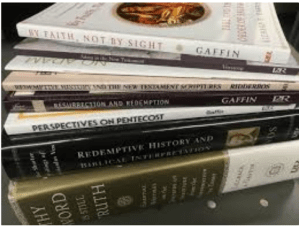
Gentry reminder:
This article continues the one in my previous posting. It continues citing a lengthy excerpt from Richard B. Gaffin, Jr.’s excellent book, Resurrection and Redemption (Phillipsburg, N.J.: Presbyterian and Reformed, 1978), pp. 78-92. This is a compelling study of Paul’s confusing statement regarding Christ being a “life-giving Spirit” (1 Cor. 15:45).And again, I have only included Gaffin’s main text, not his footnotes. You can order this book here: https://www.prpbooks.com/book/resurrection-and-redemption
Now for the conclusion of Gaffin’s material.
The following is all Gaffin who writes:
With this preparatory spadework completed we can now concentrate on the description of Christ as life-giving pneuma in verse 45c. (1) What is the specific reference of pneuma? (2) When did he become life-giving pneuma?
(1) The first question is answered in the light of the correlation between pneuma and the adjective “spiritual” (pneumatikon, vv. 44b, 46), an especially close correlation in view of the overall structure of the passage and the function of verse 45 in providing proof for verse 44b. In Paul’s usage, with the exception of Ephesians 6:12, pneumatikos always has specific reference to the activity of the Holy Spirit (e.g., Rom. 1:11; 7:14; I Cor. 12:1; 14:1; Gal. 6:1; Eph. 1:3; 5:19; Col. 1:9). This is particularly apparent in 1 Corinthians 2:13-15, the only other place where Paul contrasts pneumatikos with psuchikos. The main emphasis of the immediate context (vv. 10ff.) is the Spirit’s function in revelation (cf. v. 4), and repeated reference is made to his person (v. 10 [twice]; vv. 11, 12, 13, 14). The contrast then, underscores the indispensability of the Spirit’s activity. The phrase at the end of verse 13 (pneumatikois pneumatkia sugkrinontes), whatever its precise meaning, refers to those things and that activity distinguishing the teaching ministry of the Spirit. Accordingly, the “natural man” (psuchikos anthropos) is unable to receive “the things of the Spirit of God” because he lacks the corresponding facility of discerning “spiritually” (pneumatikos) requisite for understanding them (v. 14). In contrast, “the spiritual man” (ho pneumatikos), since he is qualified by the Spirit, possesses such discernment (v. 15; cf. v. 12). All four occurrences in verses 13-15 of “spiritual(ly)” plainly refer to the activity of the Holy Spirit.
Paul’s usage elsewhere, then, favors taking “spiritual” in verses 44 and 46 as a reference to the work of the Holy Spirit. This conclusion is supported in the context by its use in verse 44 to describe the resurrection body. As such it sums up the predicates in verses 42f.: incorruption, glory, and power. These according to Paul are always elements in the closely-knit conceptual network whose core is “Spirit.” They are only found where the Holy Spirit is at work.

Perspectives on Pentecost (Richard Gaffin)
A careful examination of the New Testament teaching on the gifts of the Spirit. Makes a case for the cessation of tongues at the close of the apostolic era. Gaffin is professor emeritus of biblical and systematic theology at Westminster Theological Seminary, Philadelphia.
See more study materials at: www.KennethGentry.com
A combination of factors outside verse 45 inevitably points to pneuma as a specific reference to the person the Holy Spirit. This conclusion is confirmed by the attributive qualifier “life-giving” (zoopoioun). Without reintroducing what has already been said about the inseparable bond between the Spirit and life, uses of this verb (zoopoieo) elsewhere show unquestionably that the Spirit is in view here. God will “give life” to the mortal bodies of believers “through his Spirit” (Rom. 8:11). Even more decisively, II Corinthians 3:6 asserts, with the ring of a general principle: “The Spirit gives life” (cf. John 6:63; I Peter 3:18).
Verse 45c, then, teaches that Christ became life-giving Spirit. From the context where Paul’s perspective, although broad, remains entirely within the sphere of the historical, this identification is plainly not ontological, as if he were here obliterating the personal distinction between Christ and the Spirit. Such a view would be a too-flagrant contradiction of his uniform teaching elsewhere. Rather, the oneness expressed has in view a conjunction between Christ (as the last Adam) and the Spirit dating from a point still to be determined. Christ (as incarnate) experiences a spiritual qualification and transformation so thorough and an endowment with the Spirit so complete that as a result they can now be equated. This unprecedented possession of the Spirit and the accompanying change in Christ result in a unity so close that not only can it be said simply that the Spirit makes alive, but also that Christ as Spirit makes alive. Specifically, this identity is economic or functional, in terms of their activity, and there is no need to discover “more” than this.
(2) If Christ became life-giving Spirit, when did that take place? One may be inclined to say that the overall emphasis of the chapter makes it apparent that the answer is Christ’s resurrection. However, representative Reformed exegesis favors the incarnation, and so an effort must be made to settle the issue.
This can be done most easily by referring to verses 20-22. The close affinity of verse 22 with verse 45 is obvious: both contain not only the same explicit contrast between Adam and Christ but also on the christological side the same verbal idea — “making alive.” Earlier we noted the sequence of amplification in these verses: Verse 21 expands on verse 20 and verse 22, in turn, on verse 21. Consequently, the “making alive” of all in Christ (the resurrection of the dead through him, v. 21) is here grounded specifically in his resurrection and, by inference, what he is by virtue of that resurrection (v. 20). An integral connection exists between Christ as firstfruits and Christ as life-giving Spirit. In fact, because Christ’s resurrection is the indispensable foundation for others to share in resurrection life, he functions as life-giving Spirit only on the basis of his resurrection, only in his resurrected state. Specifically the resurrected Christ is the life-giving Christ. The plain implication, then, is that the last Adam became life-giving Spirit at his resurrection.
This conclusion is reinforced by the functioning of the “firstfruits” principle in the immediate context of verse 45. As already noted, verse 45 at the very least introduces Christ, the last Adam, as the model spiritual man. His fuller significance as life-giving inevitably involves that he is the primary exemplification of the spiritual existence which he communicates to the rest of the harvest. Now since the (bodily) spiritual existence of believers begins at their resurrection (v. 44), in view of the solidarity involved, Christ’s spiritual existence, his becoming life-giving Spirit, dates from the resurrection.
Navigating the Book of Revelation (by Ken Gentry)
Technical studies on key issues in Revelation, including the seven-sealed scroll, the cast out temple, Jewish persecution of Christianity, the Babylonian Harlot, and more.
See more study materials at: www.KennethGentry.com
To argue this point at length only serves to obscure it. It is neither by virtue of his preexistence or because of his incarnation that the last Adam is life-giving Spirit. The final word in this connection has been spoken by Deissner:
“As a matter of fact, it would have made no sense to construct the argumentation in chapter 15 on the resurrection of Christ, if Christ were already qualified as the giver of life by virtue of his
origin or by virtue of his capacity as preexistent heavenly man.”
Conclusions. (1) At his resurrection the personal mode of Jesus’ existence as the last Adam was so decisively transformed by the Holy Spirit that Paul says he has become life-giving Spirit. The Spirit, who raised him up as the firstfruits, indwells him so completely and in such a fashion that in their functioning he is the Spirit who will be instrumental in the resurrection of the full harvest. Further, (a) the life-giving activity predicated of the resurrected Christ, is not predicated directly; the Spirit is an absolutely indispensable factor. Only by virtue of the functional identity of the Spirit and Christ, effected redemptive-historically in his resurrection, is Christ the communicator of life. No principle in Paul’s soteriology is more fundamental. (b) The change in Christ’s person at his resurrection is as real as and commensurate with the transformation to be experienced by the rest of the harvest.
(2) The resurrection of Jesus has more than personal significance. Verse 45 in its immediate context brings into view not only an organic connection with the resurrection of believers but also considerations cosmic in scope. Resurrection is here nothing less than the counterpart of creation. The resurrection of Christ is the beginning of the new and final world-order, an order described as spiritual and heavenly. It is the dawn of the new creation, the start of the eschatological age. In terms of the conceptual framework with which Paul views the whole of history, it is the commencement of the “age-to-come.”
Such a broad perspective has far-reaching implications: (a) In this passage “spiritual,” “last,” and “heavenly” are clearly correlative. Verse 46 in particular expresses the essential tie between the Spirit and the eschatological, heavenly world (cf. Eph. 1:3). The final order is a specifically pneumatic order. Its atmosphere, as it were, is spiritual. So far as individual eschatological existence is concerned, the Spirit is not only active in its inception but completely dominates the resultant state. In fact, Paul’s thought appears to move from the Spirit’s constitutive place in the resurrected life to his role in the act of resurrection, rather than the reverse. Because he so thoroughly conditions the former, he is appropriately instrumental in the latter.

Perilous Times: A Study in Eschatological Evil (by Ken Gentry)
Technical studies on Daniel’s Seventy Weeks, the great tribulation, Paul’s Man of Sin, and John’s Revelation.
See more study materials at: www.KennethGentry.com
(b) Perhaps the most distinctive mark of Paul’s conception of the Spirit and his activity is its eschatological aspect, dominant in this passage. Yet it is often overlooked. Few misunderstandings of Paul are more widespread than the tendency to consider his teaching on the Spirit, particularly the Spirit’s present sanctifying work in the believer, without reference to his eschatology. This tendency seems in large part chargeable to the loci method of dogmatics in confining the locus of eschatology to dealing with the “last things,” understood as all that dates from the second coming of Christ (the lone exception being the intermediate state, treated in individual eschatology). According to this passage, however, “eschatology” dates from Christ’s resurrection. The issue here it not merely semantic. Traditional dogmatics by its very structure obscures the structure and important perspectives of Paul’s theology. It masks the outlook basic not only to Paul but the entire New Testament that the Messiah’s coming is one (eschatological) coming which unfolds in two episodes, one already and one still to come, that the “age-to-come” is not only future but present. It veils the organic connection between the resurrection of Christ (in which, according to this passage, the redemptive-historical significance of the first coming is concentrated) and the bodily resurrection of believers (=second coming). Further, the conventional dogmatic outlook eclipses the eschatological quality of the believer’s present soteriological experience, the integral bond between present and future in the life of those joined to the resurrected Christ.
(3) This passage sheds light on the way Paul relates Christ’s resurrection to his ascension (and heavenly session). Clearly he views them as separate occurrences. In Romans 8:34 being at the right hand of God is distinguished from being raised. The act of ascension as distinct from the act of resurrection is the plain presupposition. The same observation applies in Ephesians 1:20 and 2:6 where being raised and being seated in the heavenlies are distinguished. Accordingly, the same distinction is implicit in Philippians 2:9 where exaltation (without mention of resurrection) is set over against obedience unto death (v. 8).
The resurrection, however, has a more than temporal priority. Verse 45 together with verses 47-49 makes it unavoidably clear that Christ’s resurrection is integral to his subsequent mode of existence. What Christ is and continues to be he became at the resurrection and at no other point. The exalted, pneumatic, heavenly existence of the second Adam is specifically his existence as life-giving Spirit. Ascension and heavenly session are exponential of resurrection. Certainly Paul gives no indication that the former effected changes in Christ’s exalted person not experienced at the latter.
Click on the following images for more information on these studies:
 |
 |
 |



 Postmillennial Worldview
hello, I’m new to the post mil camp and came from a dispy background at my church growing up. I’m learning all new things and had 2 questions regarding post mil- for the verses about “thief in the night” how do you look at that regarding post mil? From my view growing up it was always about rapture/final coming?
for the verse Isaiah 65 What would you say about that one about the old man dies young at 100? Is that a future way of saying people won’t be getting as old? How would the pre mil and amill argue against this view?
The thief motif emphasizes the unknowability of an event. For instance, we cannot know when Christ will return (Matt. 24:36). Isaiah 65 speaks in poetic terms of the effect of the gospel on the world, but at the same time points ahead to an ultimate new creation. Scripture teaches a now/not yet polarity, which says in some sense our ultimate glory is already present (e.g., we are currently sanctified by Christ) but we are awaiting a full and perfect sanctification at the End. Likewise our being new creations now, anticipates our ultimate transformation at the end of history.