
PMW 2025-093 by Richard B. Gaffin, Jr.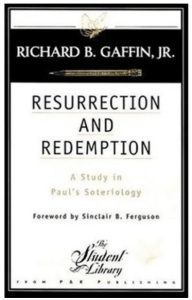
Gentry note:
This and the article that will follow it in a couple of days are excerpts from Richard B. Gaffin, Jr.’s excellent book, Resurrection and Redemption (Phillipsburg, N.J.: Presbyterian and Reformed, 1978), pp. 78-92. This is a compelling study of Paul’s confusing statement regarding Christ being a “life-giving Spirit” (1 Cor. 15:45). As Peter wrote, Paul could say some things difficult to be understood (2 Pet. 3:16). Stumbling over this text can lead one into various heresies, not the least of which is Hyperpreterism. So, understanding Paul properly is an important issue in today’s evangelical culture.I have only included Gaffin’s main text, not his footnotes. I highly recommend your getting, reading, and studying this book — with its significant footnotes. I not only desire to offer insightful articles on my site, but also to encourage the reading of important and relevant literature from various theologians.
You can order this book here:
https://www.prpbooks.com/book/resurrection-and-redemption
Now for Gaffin’s material (the following is all Gaffin):
I Corinthians 15:45
Our interest in this verse is the description of Christ as the last Adam, as “lifegiving pneuma” (pneuma zopoioun). However, nowhere in the whole of Paul is a statement more inextricably embedded in both its narrower and broader contexts. In verses 45-49 together with verse 22, “Paul provides us with what is one of the most striking and significant rubrics in all of Scripture.” Compact modes of expression and the density of thought also make it, along with verses 42-44, one of the most difficult Some consideration, then, needs to be given to this contextual factor.
In verse 35 Paul takes up the questions of the mode of the resurrection and the nature of the resurrection body. These questions appear to have been posed by the opponents, probably in a derisive fashion. Paul, however, treats them seriously, making of them a single, compound question which structures his discussion to the end of the chapter. Within this section, the unit of verses 42-49 contains the heart of the argument.
An essential mark of this unit is its carefully implemented antithetical structure. The semantic function of particular clauses or phrases or even words is decisively controlled by their place in the central contrast running through verses 42-49. All too frequently the history of interpretation has failed to recognize this Remembering, then, that our final objective is not the solution of all exegetical difficulties but the explanation verse 45c, what are the central features in the development of the argument?
Postmillennialism Made Easy (by Ken Gentry)
Basic introduction to postmillennialism. Presents the essence of the postmillennial argument and answers the leading objections. And all in a succinct, introductory fashion.
See more study materials at: www.KennethGentry.com
The contrast as begun in verses 42f. is between the dead body of the believer and his resurrection body and his resurrection body. Although, strictly speaking, the corpse of the believer is in view (the four-fold repetition of ‘it is sown’ [speiretai] makes this clear), implicitly present as well is the somatic condition of the believer prior to physical death. For Paul elsewhere refers believers to their mortal bodies (Rom. 6:12, 8:10f.; II Cor. 4:10f.; cf. here esp. vv. 53f.) and speaks of his own body at the time of writing as a “body of death” (Rom. 7:24). Even at the outset, then, the scope of the contrast is broadened by implication. At any rate, the one body is characterized by perishability, dishonor, and weakness, the other by imperishability, glory, and power. The prepositional phrases indicate circumstances or qualities of the subject rather than the manner in which the action of the verb takes place. Even at these subordinate points of contrast the balanced, antithetical parallelism is carefully maintained. perish/imperish, etc.
Verse 44a summarizes what precedes. The single terms used to describe in a comprehensive and distinguishing fashion the bodies being contrasted are “natural,” “psychical” (psuchikon) and “spiritual,” respectively.
Careful attention to grammar discloses an important turn in the argument at verse 44b. The contrast up to this point carried out by a series of contraposed main clauses is continued instead by joining an apodosis to a protasis (“If there is a psychical body, there is also a spiritual body”). In other words, verse 44b is itself an argument. Without destroying the balanced parallelism, the rigid and pointed antithesis of verses 42-44a is suddenly softened. Paul now reasons directly from the psychical body to the spiritual body. The former is made the condition for the latter; the latter is postulated on the basis of the former.
Verse 45 supports verse 44b by an appeal to Scripture. “Thus it is written” makes this clear. The particular use of Scripture is itself one of the striking features of this verse, for Paul in citing Genesis 2:7 which mentions only the creation of (the first) Adam, finds there also a reference to the becoming of the last Adam. Two considerations show this: (1) Verse 45 functions to establish the argument in verse 44b. This it can do only as the appeal to Scripture covers the entire proposition, not just the protasis. (2) The syntax of verse 45 shows the close bond between 45b and 45c. The two clauses are joined asyndetically, their respective structures are closely parallel, and “become” (egeneto, from the quotation) in the former is plainly to be read in the latter.
How Paul arrived at this formulation is difficult to say. Although a certain similarity exists with the paraphrases of the Targums, there is no evidence of borrowing. Original with him, it is best understood as an annotation of Scripture equated with Scripture itself.
As verse 45 grounds the argument of verse 44b, then, the references to the first Adam as “living soul” (psuche zosa) and the last Adam (Christ) as “life-giving pneuma” (pneuma zoopoioun) serve to establish a frame of reference for understanding “psychical” (psuchikon) and “spiritual” (pneumatikon), respectively. Whatever else may be in view, the two are representatives or primary exemplifications. Adam is ho psuchikos, Christ ho penumatikos par excellence.
He Shall Have Dominion
(paperback by Kenneth Gentry)
A classic, thorough explanation and defense of postmillennialism (600+ pages). Complete with several chapters answering specific objections.
See more study materials at: www.KennethGentry.com
The trend of Paul’s argument and his broadened perspectives on the resurrection of the body now begin to emerge. The contrast initiated between bodies has been expanded to include whole, living persons, persons who represent others. Moreover, on the one side, where the corpse of the believer was the point of departure, the scope has been expanded to include the person of Adam by virtue of creation.
Recognizing this expansion facilitates understanding verse 44b as an argument. At first glance, Paul’s reasoning is apparently a fortiori: if there is a psychical body characterized by corruption, dishonor, weakness, then all the more must there be a spiritual-powerful, glorified, incorruptible-body. A major difficulty with this view, however, is that death and the qualities of the psychical body in verses 42f. are for Paul always the result of sin (Rom. 5:12; 6:16, 21, 23; cf. Rom. 1:32; 8:6, 13; I Cor. 15:56; Gal. 6:8); and when he argues a fortiori from sin and condemnation to grace and salvation the form he regularly employs is: “if … much more….” (ei … pollo mallon …, Rom. 5:15, 17; cf. II Cor. 3:7f., 9, 11). Moreover, apparently all a fortiori arguments in Paul involving a protasis with ei have this form (or its equivalent) in the apodosis (cf. Rom. 5:10; 11:12). Paul’s usage elsewhere, then, favors taking verse 44b as not containing a disqualifying element in the protasis and so as reasoning directly from the psychical body to the spiritual body.
This conclusion, however, is apparently faced with an insuperable difficulty of its own. How can Paul say that the resurrection body with its attributes may be predicated on the basis of the body placed in the tomb with its attributes? Is Paul saying that death and life are so related synthetically that the latter can be directly inferred from the former? Such a notion is in flat contradiction with Paul’s uniform teaching elsewhere. Romans 5:12-21 demonstrates clearly that life and death are no more capable of being positively correlated and postulated from each other than are righteousness and sin (cf. Rom. 6:20-23; 8:2, 6; II Cor. 2:15f.).
The Divorce of Israel: A Redemptive-Historical Interpretation of Revelation
This long-awaited commentary has now been published. It is an 1800 page, two-volume deeply exegetical, academic commentary on the Bible’s most mysterious book.
Click: https://www.kennethgentry.com/the-divorce-of-israel-2-vols-by-gentry-pre-publication-offer/
See more study materials at: www.KennethGentry.com
A way out of this dilemma, which at the same time does justice to the requirements of the text, is to recognize that “psychical” in verse 44b has a significantly broader reference than in verse 44a. The psychical body of verse 44b is the prefall, creation body, to which the characteristics (corruption, dishonor, weakness) of the psychical body of verse 44a do (not belong). This inference is supported by Paul’s appeal in verse 45 to the creation of Adam. In fact, these two factors — the argument of force the view that the psychical body of verse 44b is the 44b and the use of Genesis 2:7 in verse 45 — together enforce the view that the psychical body of verse 44b is the prefall body.
Why does Paul, when asked about the nature of the resurrection body and after beginning to contrast the believer’s dead body with his resurrection body, suddenly expand the comparison to include the creation body? Apparently his interest is to show that from the beginning, prior to the fall, a higher or different kind of body than the body of Adam, the psychical body, is in view. Adam, by virtue of creation (not because of sin), anticipates and points to another, higher form of somatic existence. The principle of typology enunciated in Romans 5:14 is present here, albeit somewhat differently: the creation body of Adam is “a type of the one to come.” This suggestion of typology helps to illumine the use of Genesis 2:7 in verse 45, especially the addition in 45c.
If at verse 45 the contrast has been expanded to include the persons of Adam (prior to the fall) and Christ as representative of others, then its scope is really even broader; it includes the environments of which Adam and Christ in their respective (bodily) existences are necessarily exponential. That Paul actually introduces such an extended horizon emerges in verse 46. Whatever may be the reason that Paul here momentarily departs from his parallel structure, the contrast is not blunted but continued in significantly more general terms, and “psychical” and “spiritual” now describe two comprehensive states of affairs, two orders of existence contrasted temporally. The one follows upon the other and together they encompass the whole of history. Verse 46 is a compressed overview of history. As the era of the first Adam, the psychical order is the preeschatological aeon, the incomplete, transitory, and provisional world-age. As the era of the last Adam, the pneumatic order is the eschatological aeon, the complete, definitive, and final world-age. “to pneumatikon and to psuchikon in verse 46 are generalizing expressions, after which it would be a mistake to supply soma; they designate the successive reign of two comprehensive principles in history, two successive world-orders, a first and a second creation, beginning each with an Adam of its own.” The perspective from which Paul views the believer’s resurrection, then, is nothing less than cosmic.

As It Is Written: The Genesis Account Literal or Literary?
Book by Ken Gentry
Presents the exegetical evidence for Six-day Creation and against the Framework Hypothesis. Strong presentation and rebuttal to the Framework Hypothesis, while demonstrating and defending the Six-day Creation interpretation.
See more study materials at: www.KennethGentry.com
While verses 47-49 resume the balanced, antithetical parallelism, the contrast, up to this point expressed by psuche and pneuma, with their adjectives, is continued instead by the pair “earth-heaven” (ge-ouranos) and related adjectives. Although these two sets of terms are not synonymous, they are plainly correlative here and have the same frame of reference. This introduction of expressly cosmological language makes explicit the comprehensive dimensions of the contrast.
Verse 47 closely parallels verse 45 by contrasting Adam and Christ, the difference being that now the one is “from earth, earthly,” the other “from heaven.” These prepositional phrases (ek ges, ex ouranou) are predicates and have qualitative force. The latter no more refers to the coming of Christ out of the state of preexistence at his incarnation than the former means that preexistent Adam “came” out of the earth at creation. Besides, such notion applied to Christ would contradict the principle just laid down in verse 46: not first the pneumatic, but first the psychical then the pneumatic. The parallelism also excludes the notion that “from heaven” refers to the second coming. This qualitative interpretation is confirmed in verses 48 and 49 by the application of the adjective “heavenly” (arising from the use of the prepositional phrase) to believers as well as Christ. It can hardly mean that the former have come out of heaven. Verses 45 and 47 describe states resulting from a becoming that for Adam took place at his creation, for Christ at a point yet to be determined. Whether or in what condition Christ existed prior to that point is here outside Paul’s scope.
Verses 48 and 49 make plain that Adam and Christ are being compared not simply as individuals. Associated with Adam as the earthly one (ho choikos) are those of the earthly order; associated with Christ as the heavenly one (ho epouranios) are those of the heavenly order. Moreover, not only their representative capacity but also the constitutive nature of their primacy is prominent here. “The earthly ones” are such only as they in solidarity with “the earthly one” bear his image; “the heavenly ones” are such only as they in union with “the heavenly one” bear his image. Verse 49b both brings to a climax the contrast begun in verse 42 and expresses the focal consideration in answer to the questions in verse 35: the mode of the resurrection and the nature of the resurrection body are to be explained in terms of union with Christ, the last Adam, as the heavenly one, the life-giving pneuma.

Perspectives on Pentecost (Richard Gaffin)
A careful examination of the New Testament teaching on the gifts of the Spirit. Makes a case for the cessation of tongues at the close of the apostolic era. Gaffin is professor emeritus of biblical and systematic theology at Westminster Theological Seminary, Philadelphia.
See more study materials at: www.KennethGentry.com
Our findings to this point may be summarized as follows: The contrast between Adam and Christ as living soul and life-giving pneuma, respectively, is not only pointed but also comprehensive and exclusive. They are in view not only as individuals but primarily as heads representing and constituting the existence of others, and hence as representatives of two contrasting orders of life, two aeons, two world-periods, in a word, two creations — the one psychical and earthly, the other, pneumatic and heavenly. Moreover, as the one follows the other, they together span the flow of time. The order of Adam is first (cf. protos, v. 45); there is none before him. The order of Christ is second (cf. deuteros, v. 47); there is none between Adam and Christ. The order of Christ is last (cf. eschatos, v. 45); there is none after Christ. He is the eschatological man; his is the eschatological order.
Gentry note: To be continued!



 Postmillennial Worldview
Leave a comment