
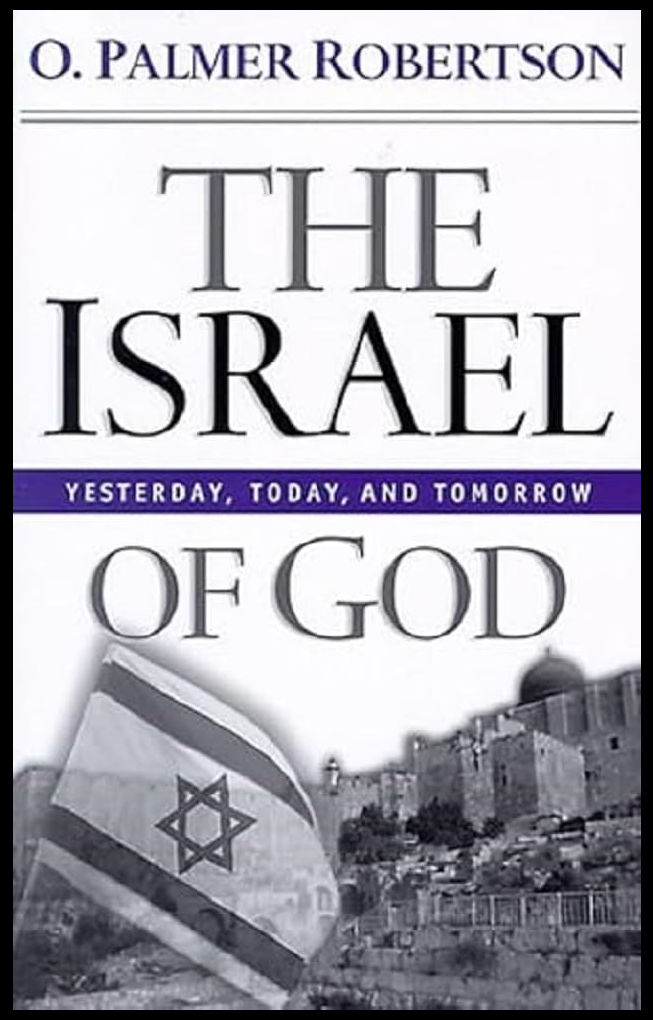
 PMW 2025-011 by O. Palmer Robertson
It has been rightly observed that the idea of the “land” as a theological concept has been largely overlooked by both Judaism and Christianity. Except for eschatological speculations concerning the return of Israel to the land, the whole concept of the land as presented in Scripture has been generally neglected. The reasons for this neglect might be variously evaluated.¹ But unquestionably the significance of the land as a theological idea needs fuller exploration.²
The concept of a land that belongs to God’s people originated in Paradise. This simple fact, so often overlooked, plays a critical role in evaluating the significance of the land throughout redemptive history and in its consummate fulfillment.³ Land did not begin to be theologically significant with the promise given to Abraham. Instead, the patriarch’s hope of possessing a land arose out of the concept of restoration to the original state from which man had fallen. The original idea of land as paradise significantly shaped the expectations associated with redemption. As the place of blessedness arising from unbroken fellowship and communion with God, the land of paradise became the goal toward which redeemed humanity was returning.
In speaking of Israel’s land under the old covenant, it is necessary to think in categories of shadow, type, and prophecy, in contrast to reality, substance, and fulfillment under the new covenant. These contrasting categories come to expression in various ways in the writings of the New Testament. Throughout Matthew’s gospel, significant events in the life of Jesus are explained as having occurred so that old covenant anticipations might be fulfilled (Matt. 2:15, 17, 23; 13:14, 35; 26:54, 56; 27:9). John declares that God now “tabernacles” with his people in a way that far surpasses his dwelling with Israel in the days of their wilderness wandering (John 1:14), that the angels of God now ascend and descend on the Son of Man rather than on Jacob’s visionary ladder (John 1:51), that the lifting up of the Son of God supersedes the lifting up of the serpent in the wilderness (John 3:14), and that the manna from heaven given by Moses has been transformed into “living bread” given by Christ (John 6:49–51). Paul speaks of the religious festivals of the old covenant as “a shadow of the things that were to come” (Col. 2:17), and the events of Israel’s redemptive history as “types” for believers during the new covenant age (1 Cor. 10:6). All these authors of new covenant documents develop a significant aspect of their theology by contrasting old covenant shadows with new covenant realities.
The Divorce of Israel: A Redemptive-Historical Interpretation of Revelation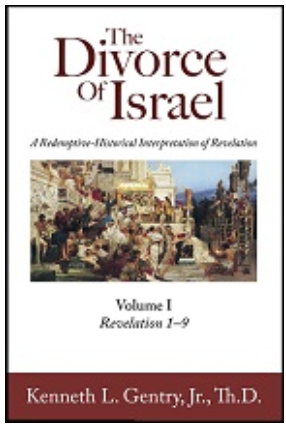
This long-awaited commentary has now been published. It is an 1800 page, two-volume deeply exegetical, academic commentary on the Bible’s most mysterious book.
Click: https://www.kennethgentry.com/the-divorce-of-israel-2-vols-by-gentry-pre-publication-offer/
See more study materials at: www.KennethGentry.com
It is particularly in the epistle to the Hebrews that this contrast between anticipation and realization, between shadow and reality, finds its fullest and most distinctive expression. According to the writer to the Hebrews, the administration of redemption under the law of the old covenant was “only a shadow” of the good things that were coming (Heb. 10:1). These shadowy images of redemptive reality did not originate merely in the context of old covenant experiences. Instead, these prophetic shadows originated in the abiding realities of heaven itself. Because Melchizedek the priest-king was made “like” the Son of God in his eternal relationship to the Father, he could anticipate the priestly role of Jesus (Heb. 7:1, 3). Similarly, only because the tabernacle in the wilderness was constructed precisely “according to the pattern” shown to Moses on the mount, could its pattern of worship provide insight into the realities of a proper approach to God under the provisions of the new covenant (Heb. 8:5).
According to all these different documents of the new covenant, the administration of redemption under the old covenant was prophetically typological, anticipating the realities of the new covenant. Other examples may be cited to substantiate the same principle. The sacrifice of animals and foodstuffs anticipated the offering of the body of Jesus under the new covenant. A temporary priesthood anticipated the permanent priesthood of Christ. The mobile tabernacle foreshadowed the abiding presence of God’s glory in the person of Jesus. As the Israelites journeyed through the desert, God provided them with manna from heaven, water from the rock, and a serpent on a pole. All these images found their new covenant fulfillment, not in more manna and water, or in a larger serpent on a taller pole, but in the redemptive realities that these old covenant forms foreshadowed (see, e.g., John 3:14; 6:51; 7:37; Rom. 15:16). The very nature of the old covenant provisions requires that they be viewed as prophetic shadows, not as permanent realities.
This principle has great significance when it is applied to the idea of land as experienced by Israel under the administration of the old covenant. The promise of land also originated in the heavenly realities and not merely in the temporal experiences of Israel. According to the writer to the Hebrews, Abraham and the patriarchs longed for “a better country—a heavenly one” (Heb. 11:16). They understood, though only dimly, that the land promised to them actually had its origins in the heavenly, eternal reality that yet remained before them. The possession of a particular tract of land would have significance from a number of perspectives with respect to God’s redemptive working in the world. But the land also served as a shadow, a type, a prophecy, anticipating the future working of God with his people.
This relation of prophetic shadow to substantial fulfillment becomes increasingly evident as the theme of the land is traced throughout Scripture—first in the history of Israel, then in the Psalms and Prophets, and finally in the documents of the new covenant itself. In reviewing this material, it would be helpful to note that the idea of land in Scripture centers particularly on two basic concepts, one broad and one narrow: (1) the totality of the area known as the land of the Bible, and (2) the city of Jerusalem with its center at Mount Zion. Both of these concepts are significantly related to the idea of God’s intent to redeem a people to himself. In this regard, the following topics may be considered:
A. The land in the experience of God’s people under the old covenant
B. The land in the Psalms and the Prophets
C. The land from a new covenant perspective
Israel in the Bible and History (9 mp3 lectures)
by Ken Gentry
The people of Israel are the people of God. But the modern church is divided over the nature, call and identity of Israel. This lecture series covers key issues for understanding the biblical concept of Israel.
See more study materials at: www.KennethGentry.com
A. The Land in the Experience of God’s People Under the Old Covenant
Land began with Paradise, but the paradisical nature of land was lost in the Fall. Sinful humanity was expelled from this land of blessing. But the idea of paradise was renewed in the promise of land made by God in his covenant to redeem a people from his fallen condition. As Adam and Eve had known God’s blessing in Eden, so God would bless his people in a new land. This idea of restoration to paradise provides the proper biblical context for understanding God’s promise to give land to Abraham (Gen. 12:1). This promise to the patriarch became the basis for all subsequent understanding of the role of the land in the unfolding history of redemption.
This divine promise was restated to Moses in terms of “a land flowing with milk and honey” (Ex. 3:8, 17; 13:5; 33:3; Lev. 20:24; Num. 13:27; etc.). As the significance of this land was revealed to Moses, three striking concepts emerged:
1. This land belongs to the Lord of the covenant. According to the legislation in Leviticus, the land was not to be sold, since, as the Covenant Lord declared, “The land is mine, and you are strangers and my tenants” (Lev. 25:23*). This is the only verse in the Pentateuch in which the land is specifically declared to belong to the Lord, although a number of other ideas support this concept. It is declared that (1) the land was to be divided by lot, allowing God to determine its distribution (cf. Num. 26:55); (2) the law of the tithe indicated that the Lord owned the land and had a right to demand his portion (cf. Deut. 14:22; 26:9–15); (3) the law of the sabbath rest was applied to the land, indicating that it was the Lord’s possession, just as were people and cattle (Lev. 25:2, 4).
But the concept that this particular land belonged to the Lord can be understood correctly only if the Lord’s claim to the whole earth is recognized. This idea finds expression in the record of God’s creation of all things, as well as in a number of subsequent passages:
[Moses promises to stop the hail that has been destroying Pharaoh’s crops] so you may know that the earth belongs to the Covenant Lord. (Ex. 9:29*)
[The Lord declares to the Israelite people as he confirms his covenant at Sinai:] Although the whole earth is mine, you will be for me a kingdom of priests and a holy nation. (Ex. 19:5)
To the Covenant Lord your God belong the heavens, even the highest heavens, the earth and everything in it [yet this great God has set his affection on Israel’s forefathers and has chosen this nation above all the nations]. (Deut. 10:14–15)
No idea of a deity restricted to a particular territory may be found in these passages. God’s selection of one portion of the earth in which to do a special work of redemption naturally leads to the expectation that through this one people all the nations of the earth will be blessed.
 “Jesus, Matthew, and the Rejection of Israel” (downloadable mp3)
by Ken Gentry
Surveys the Gospel of Matthew and highlights the numerous references — direct and indirect — that suggest that Matthew’s Gospel was written (at least in part) to demonstrate that God was rejecting Israel. A great many passages in Matthew are surveyed and briefly elaborated upon.
See more study materials at: http://www.KennethGentry.com
Under the new covenant, this principle that the Lord possesses the whole of heaven and earth has practical application. Writing to the Christians in Corinth, Paul explains that they should have no qualms about eating things offered to idols, “for the earth is the Lord’s, and everything in it” (1 Cor. 10:26). Since the one true God is Lord of the whole earth, an idol has no claim over any portion of it.
In a similar vein, the covenant promise of land made to Abraham takes on a much greater significance when it is viewed from the perspective of fulfillment in the age of the new covenant. Now the patriarch’s promise is understood to imply that he is the heir of the cosmos, not merely the land of the Bible (Rom. 4:13). Because God is the Lord of the whole universe, he will fulfill his covenant promise of redemption by reconstituting the cosmos. In this way, paradise will be restored in all its glory. The blessing of land that humanity first experienced will finally be graciously given back to him.
2. All blessings flowing from the land come ultimately from the hand of the Lord. From an alternative perspective, it may be said that the land is specifically “the place where Yahweh abundantly gave material gifts of all kinds to his people.” One should not suppose that Israel derived this concept from the Canaanite culture that surrounded it. The universal reign of the Lord of the covenant makes it plain that he is not restricted to blessing only within the land of promise. As he departed from Egypt, Abraham was loaded with the blessings of prosperity, even though he had earned the disgust of the heathen pharaoh on whom he had brought a curse because of his deceit concerning his wife Sarah (Gen. 12:18–13:2).
The fact that the Lord alone could give blessing in the land was underscored even before Israel entered it. This land would not be like Egypt, watered regularly by the flooding Nile. Instead, in this land God would show his special care by sending the rains in their various seasons. Apart from this blessing, the land would become a curse to the people. Yet they could trust the Covenant Lord’s good intentions. As Moses told them, “It is a land the Lord your God cares for; the eyes of the Lord your God are continually on it from the beginning of the year to its end” (Deut. 11:12). For this reason and this reason alone, the people could be assured of the blessings of the Lord. It was his land, the place of his special concern.
House Divided: The Break-up of Dispensational Theology By Greg Bahnsen and Ken Gentry
This book presents and defends Christian Reconstruction theology, particularly theonomic ethics and postmillennial eschatology. It does to by responding to dispensationalism’s social and exegetical theology.
For more educational materials: www. KennethGentry.com
Yet with all the emphasis on the distinctiveness of this land in comparison with all other lands, the reason for its selection must not be overlooked. . . .
To finish reading, including footnotes and the important section “The Land from a New Covenant Perspective,” go to: https://www.reformation.blog/p/the-israel-of-god-the-land. I recommend suscribing to this important site.
Tagged: Jesus



 Postmillennial Worldview
Excellent article! The link to rest of the article isn’t working.
Sorry. For some reasons the hotness of the hot link doesn’t work! However, if you cut and paste it, you will find the article.