
 PMW 2025-006 by Kenneth L. Gentry, Jr.
I am continuing a study on Revelation 20 and the “millennium.” This passage is radically misinterpreted virtually throughout contemporary discussions. So, here I continue my thoughts from my last posting.
The Explanation Offered
My three changes appear in two places in the text. Though seemingly small, they carry radical implications. In my view, the eschatological debate (the “millennial” views) does not need to come to Revelation 20 at all. It is better waged elsewhere in Scripture — almost everywhere else in Scripture (hence the size of my He Shall Have Dominion: A Postmillennial Eschatology, which builds up the postmillennial eschatology from a wide range of Old Testament and New Testament Scriptures). Postmillennialism and amillennialism certainly do not depend on Revelation 20, though dispensationalism and premillennialism absolutely do. In fact, Revelation 20, though serving as the foundational passage for premillennialism and dispensationalism, actually creates irresoluble problems that undermine those systems.
The Two Shall Be One
John writes in Rev 20:4b: “I saw the souls of those who had been beheaded because of the testimony of Jesus and because of the word of God, and those who had not worshiped the beast or his image, and had not received the mark upon their forehead and upon their hand.” Previously I held that this presents two separate groups, martyrs and confessors, which themselves represent all Christians in history, dead or living. As such I originally thought these groups portray the whole Christian Church throughout the Christian era.
 The Truth about Salvation By Ken Gentry
A study guide for personal or small group Bible study. Deals with the Christian doctrine of salvation from a Reformed theological perspective. It opens with a study of God as loving Creator, the shows how the first man fell into sin. Shows God’s righteousness requires that sin be dealt with. Presents Jesus as both God and man so that he can be man’s Savior. Includes review questions and questions for further study.Twelve chapters are ideal for one quarter of Sunday School.
See more study materials at: www.KennethGentry.com
I now believe that John envisions only one group: deceased martyrs who did not worship the beast. The phrase “and those” in the Greek is: kai oitines. This is a relative pronoun clause: kai = “and” and hostis derives from the root of hoitines (“which, who”). This relative pronoun clause can go either way: It can sometimes separate two ideas; at other times it can further explicate one idea. That is, grammatically it can refer either to one group or to two. Which is it here? Scholars are divided.
I believe it functions as an analeptic interpolation (a back reference) referring to the preceding group, while adding some additional explanatory information. That is, it is epexegetical, providing significant expansion for the preceding. I began to notice that everywhere else in Revelation, John uses hostis to further explain the preceding. For instance, in Revelation 1:12 he turns to see the voice, the one which (hetis) was speaking with him. In Revelation 11:8 the bodies of the two prophets lie in the great city, the city which (hetis) is mystically called Sodom and Egypt. In Revelation 12:13 the dragon persecutes the woman, the one who (hetis) gives birth to the child. In Revelation 19:2 God judges the great harlot, the one who (hetis) is corrupting the Land.
Then I realized that after stating that he “saw thrones, and they sat upon them, and judgment was given to them” (Rev 20:4a), then “he saw the souls of those who had been beheaded.” Since he saw souls on the thrones, and since he specifically mentions beheaded persons, and since in the context “they came to life,” he seems quite clearly to be referring only to deceased believers in heaven. But this is not all.
Amillennialism v. Postmillennialism Debate (DVD by Gentry and Gaffin)
Formal, public debate between Dr. Richard Gaffin (Westminster Theological Seminary) and Kenneth Gentry at the Van Til Conference in Maryland. The debate focuses on whether the church is called to perpetually suffer in history.
See more study materials at: www.KennethGentry.com
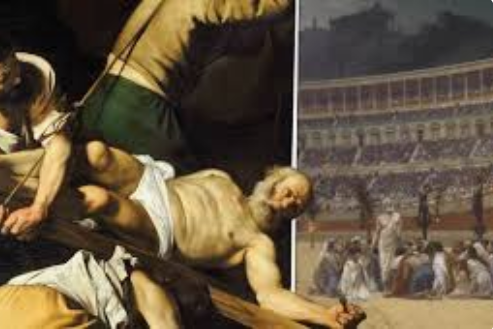
Not only are these enthroned ones deceased, but they are deceased under specific circumstances. They have been judicially killed: “beheaded” is a standard form of capital punishment well-known in the Roman Empire (cf. Mt 14:10). These did not die from plantar faciitis (very few people do!) or old age. Furthermore, this imagery fits all the preceding story of Revelation, where the Jewish aristocracy is drunk on the blood of the saints (Rev 17:6), as is the Roman beast (Rev 13:7). This further confirms my redemptive-historical preterism and continues John’s concern for his audience, which is facing the very real prospect of death for their faith.
What is more, I now realize that structurally Revelation 20:4 is really the answer to the prayer of Revelation 6:9–11. In fact, it clearly repeats some of the same thoughts and words. Revelation 6:9–11 speaks of “the souls of those who had been slain.” These did not just fall over and die; they were slaughtered (esphagmenōn, Rev 6:9). They are crying out for God to avenge [ekdikeis] their blood on those who “dwell in the Land [tēs gēs]” (Rev 6:10). Revelation 20:4 and 6:9 are doublets, based on replicated wording and strong parallels. Note:
Revelation 20:4
And I saw the souls of those who had been beheaded because of the testimony of Jesus and because of the word of God.
Revelation 6:9
I saw underneath the altar the soiuls of those who had been slain because of the word of God, and because of the testimony which they had maintained.
Exact wording parallels include eidon (“I saw”), tas psuchas (“the souls”), and dia (“because”). Additionally, the clear allusions are: ton esphagmenōn (“of those slain”) / ton pepelekismenōn (“of those beheaded”) and ton logon tou theou (“the word of God”) / tēn marturian (“the witness” or “testimony”).
I would argue that these two passages represent promise and fulfillment. In Revelation 6:9 the souls are beneath heaven’s altar praying for vindication and receiving the promise of such in due time. But in Revelation 20:4 they actually receive their vindication by being given the right to sit in judgment over their enemies (cp. Rev 19:2). To those caught up in the earthly terror, the martyrs would seem to be tragically destroyed and altogether lost in the struggle (cp. Rev 11:9–10; 13:7, 15). It would also seem to the world round about that the martyrs have lost the battle and that the living persecutors have won the victory. But John characteristically provides a heavenly insight, showing that these are actually living and enthroned with Christ. These are the “blessed” ones who are dead (hoi nekroi, Rev 14:13).
The Beast of Revelation
by Ken Gentry
A popularly compiled presentation that serves as an antidote to dispensational sensationalism and newspaper exegesis. Convincing biblical and historical evidence showing that the Beast was the Roman Emperor Nero Caesar, the first civil persecutor of the Church. The second half of the book shows Revelation’s date of writing, proving its composition as prior to the Fall of Jerusalem in A.D. 70. A thought-provoking treatment of a fascinating and confusing topic.
For more study materials, go to: KennethGentry.com
The “souls” at the altar in Revelation 6:11 are told to “rest for a little while longer,” until others join them in a martyr’s death, being “killed even as they had been.” Since Christ’s judgment-coming against Israel in Revelation 19:11ff (cp. Rev 6:12–17) results in the glory of Revelation 20:1–4, John appears to be stating that by A.D. 70 the martyrs will be vindicated within the promised time frame of “a little while” (chronon mikron, Rev 6:11; cp. Lk 18:7–8). Thus, their “coming to life” as fulfillment of the promise given to them (which is given to them while they already are in heaven, Rev 6:11), appears to be an image of their vindication in the death of their opponents in A.D. 70 rather than at the very moment of their entering heaven. This is unique to John — whose work is unique in many respects.
In the New Testament John is the only writer to use chronon mikron (Jn 7:33; 12:35; Rev 6:11; 20:3), and in both instances in the Gospel, it covers a very short period — less than three years. As Jesus (elsewhere) explains to those who will be caught up in the war that leads to the temple’s destruction: “the one who endures to the end, he shall be saved” (Mt 24:13). This, of course, fits well with Revelation’s overarching theme (Rev 1:7), within its specific time frame (“shortly” and “near”; Rev 1:1, 3; 22:6, 10), and with its recurring concern for judging the slayers of the saints (Rev 12:10–11; 13:7–10; 14:9–13; 15:2–4; 16:5–7; 17:1–6, 14; 18:20, 24; 19:2).
We must remember the alignment of the Roman beast with the Jewish high-priestly aristocracy (“We have no king but Caesar. Crucify him”). This vision fulfills the promise that Christ “will cause those of the synagogue of Satan, who say that they are Jews, and are not, but lie — behold, I will make them to come and bow down at your feet, and to know that I have loved you” (Rev 3:9). That fulfillment was “about to come [mellouses erchesthai]” soon in the first century experience, for he is “coming quickly” to judge (Rev 3:10, 11). And though they initially must wait that “little while” (Rev 6:11) for vindication, the consequences of their soon-coming vindication will span an enormous period of time: “the thousand years” (Rev 20:4) The events transpiring during the Jewish War (from A.D. 67–70), especially the destruction of the temple, represent “their reward” (Rev 11:18; cp. 18:20; 19:1–3), as their enemies are destroyed and their long-lasting, triumphant reign begins in earnest.
Before Jerusalem Fell Lecture
DVD by Ken Gentry
A summary of the evidence for Revelation’s early date. Helpful, succinct introduction to Revelation’s pre-AD 70 composition.
See more study materials at: www.KennethGentry.com
Now all of this means that those who are on the thrones in the millennium are not living Christians. Nor are they simply deceased Christians. Nor are they Christians from all ages. They are deceased Christians in heaven, who are martyred in the first century. This is John’s point: Keep the faith! Withstand your oppressors! You will be greatly rewarded in heaven even if you die! Indeed, that is effectively how he introduces his book: “I, John, your brother and fellow partaker in the tribulation and kingdom and perseverance which are in Jesus” (Rev 1:9).
Of course, heavenly reward awaits all Christians in all ages. But that is not John’s point here. We learn this extended truth from other Scriptures. Here in Revelation 20 he is speaking from a particular context in completing a long-running call to accept martyrdom rather than succumbing to the beast or the false prophet. Remember how Hebrews warns Jewish converts to Christ not to apostatize — especially since the old covenant is “obsolete and growing old” and “ready to disappear” (Heb 8:13)? John is doing the same in Revelation, only more dramatically.
So then, my first two changes in my understanding of Revelation 20 are: I now see only one group in the vision; and that one group involves only the first century martyrs. Revelation 20:4–6 does not speak of the reign of the Church in history, nor does it prophesy a still-future political reign on earth. Though again: I do believe the Church reigns in history (1Co 3:21–23; Eph 1:19–23), and that we are seated with Christ in heavenly places (e.g., Eph 2:6; Col 3:1). But John is writing an occasional epistle dealing with specific historical matters. We may take principles from Revelation and apply them in other contexts (just as we apply, for instance, principles from Paul’s congregation-specific directives to the church at Corinth). But John’s express teaching regards the first century persecuted Church and her two persecutors, Rome and Israel.
Click on the following images for more information on these studies:
 |
 |
 |



 Postmillennial Worldview
Exactly where in Old Testament does it speak of a “Millennial View”?
Daniel 12 explains that the resurrection happens immediately after tribulation. Wasn’t Daniel 12 played out in history from 66-70AD? When they stopped the emperors daily sacrifice? All of Daniels prophecies end in the sanctuary being destroyed. Christ also tells us in His Olivet Discourse to go to Daniel for understanding of the temple being destroyed. How does one look for a future resurrection like in revelation… when OT prophecy points to the resurrection happening after the temple is destroyed. Daniel was clearly speaking of the second temple and not a future temple. All NT writes were also speaking of the temple they saw in their generation. Please explain how John the apostle injects a “Millennial Reign” when Christ Himself told them why and how the temple would mark the end of the old covenant law age and judgment would come and the start of the resurrection of the saints would happen just as Daniel 7,9 & 12 state.
I must apologize to you. I wrote a couple of days ago about your “divorce of Israel” commentary and thought that it would be a good idea to have the references back to the rest of scripture to help in my study. However, I noticed that the index has most of that information, of course. Thank you once again for your excellent work and knowledgeable insight. I feel certain that the Holy Spirit will continue to teach me about this very difficult book in scripture, and how the rest of scripture ties together with this perspective. I am thankful to our Lord for graciously allowing me to read and understand your redemptive – historical perspective on this marvelous apocalypse. Mike Tschoepe
You are spot on. These are the ones of the first resurrection who reign with Christ for a thousand years, still reigning today. Also known as the 144,000 they are the ones who came out of the great tribulation (which happened during Nero’s reign) the first fruits to God and the Lamb. We are not part of the first resurrection, only those slaughtered in the first century were, we are of the resurrection on the last day as Jesus said and was spoken of by Martha in John 6 and john 11. Not resurrected to heaven, as the bible does not teach this, but to Earth as the Bible teaches, a new creation. with bodies like Christ has after his resurrection.
If you go along with others who stretch and deform the scriptures by saying first resurrection is symbolic and applies to all Christians today when they become Christians as you referenced Eph 2:6; Col 3:1. It not what the scripture is saying, unless you twist it to make it fit with preconceived ideas. Then that will throw you off track in understanding the first resurrection as did applying two groups when it only applied to one in the first century namely those who had been slain.
What is are your thoughts on the reference to Babylon in 1 Peter 5:13? If Babylon is a reference to Jerusalem in the Revelation, why not here?
Sent from Proton Mail for iOS
I am inclined in that direction.
There is only one place that mentions a “millennium.” In Rev. 20. It is John’s symbolic expression speaking of Christ’s kingdom rule.