
 PMW 2024-078 by Kenneth L. Gentry, Jr.
This is my final installment in a series analyzing the leading Scriptures that are deemed to prohibit alcohol consumption. I will start with:
Isaiah 5:21–22
Woe to those who are wise in their own eyes,
And clever in their own sight!
Woe to those who are heroes in drinking wine,
And valiant men in mixing strong drink.
This passage calls down woes upon “heroes in drinking wine.” And rightly so. But clearly this does not universally condemn all wine drinking. This should be evident for a number of reasons:
First, as we have seen, abundant evidence from Scripture shows that wine may be consumed in a righteous manner and by righteous men — including even the Son of God. And Scripture does not contradict Scripture.
Second, we find these verses set in a larger judgment context, where the prophet condemns other normally acceptable practices. For instance, verse 8 calls down woe upon those who “join house to house.” Is multiplying real estate holdings always sinful? In verse 12 we learn that the Jews are attending banquets where music is produced “by lyre and harp, tambourine and flute.” Are public festivities involving music necessarily evil?
Third, the immediate context already suggests the moderationist’s interpretation:
“Woe to those who rise early in the morning that they may pursue strong drink;
Who stay up late in the evening that wine may inflame them!” (Isa. 5:11)
Note that these “rise early” to “pursue strong drink”; they “stay up late in the evening” so that “wine may inflame them.” These men are not moderate drinkers! In fact, Isaiah condemns them because they “drag iniquity with the cords of falsehood” (v. 18) and “call evil good and good evil” (v. 19). These men are “wise in their own eyes” (v. 20) and “justify the wicked for a bribe” (v. 23). Immediately before the condemnation of those who justify the wicked by accepting bribes (v. 23) we read our verse about “heroes in drinking wine” (vv. 21-22). What could be more clear?
Consequently, verses 21 and 22 refer to an immoderate abuse of wine by judges (v. 23). J. A. Alexander notes that “the tone of this verse is sarcastic, from its using terms which express not only strength but courage and heroic spirit, in application to exploits of drunkenness.”
Jeremiah 35:6
But they said, “We will not drink wine, for Jonadab, the son of Rechab, our father, commanded us, saying, ‘You shall not drink wine, you or your sons, forever.’”
From time to time those who forbid wine drinking will point to this episode in Scripture as a noble example of a fitting testimony to abstinence. Once again, though, this does not stand as a universal, divine obligation to abstinence.
Reformed Eschatology in the Writings of Geerhardus Vos
Ed. by Ken Gentry and Bill Boney
This is a collection of several key eschatological studies by the renowned Reformed theologian Geehardus Vos. We have modernized Vos’ grammar and syntax and updated his layout style according to modern publishing conventions (shorter sentences and paragraphs). We did this without changing any of Vos’ arguments.
For information on the upcoming Geerhardus Vos work or to pre-order it, see:
https://axeheadpress.com/pages/coming-soon-vos
First, note that this is a human command which Jonadab gives to his sons (vv. 5, 6, 8). This testimonial carries with it no “thus saith the Lord.” Rather it is a family practice that passes down by human authority through the line of this singular family. We must not universalize noble testimonies of individual families, otherwise we would all dedicate our children to temple service (as did Samuel’s mother, 1 Sam. 1:11, 20-22) and commit our children to Naziritic holiness (as did Samson’s mother, Jdgs. 13:5).
Second, it also forbids the owning of a house (vv. 7, 9). Obviously, owning a home is not sinful. In fact, the Lord Jesus Christ himself promises blessings of houses to his faithful followers: “Jesus said, ‘Truly I say to you, there is no one who has left house or brothers or sisters or mother or father or children or farms, for My sake and for the gospel’s sake, but that he shall receive a hundred times as much now in the present age, houses and brothers and sisters and mothers and children and farms, along with persecutions; and in the age to come, eternal life’” (Mark 10:29-30).
Third, the context of this command implies that this was a form of prophetic theater. That is, this obligation serves as a prophecy acted out against sinful conditions. For instance, Hosea lives out prophetic theater when God commands him to marry a harlot (Hos. 1:2; 3:1) as a symbolic portrayal of God’s love for unfaithful, idolatrous Israel (Hos. 1:2, 4-11). Here in Jeremiah 35 the sons of Jonadab portray a spiritual truth by keeping this vow. By obeying this obviously unnecessary and unreasonable command of their father, they serve as a testimony against faithless Israel for her refusal to obey God’s good and reasonable law (Jer. 35:12-19).
Hosea 7:5
On the day of our king, the princes became sick with the heat of wine;
He stretched out his hand with scoffers.
Reynolds uses this passage to forcefully illustrate the dangerous nature of alcoholic wine. In fact, his chapter title is: “Hosea 7:5 and the Question of the Poisonous Nature of Wine When It Is Alcoholic.” He attempts an interesting lexical argument to prove that the word translated “heat” (NASB, NAB, NRSV) should better be translated “poison”:
The question still remains whether chamath is properly to be translated heat, anger, or poison. Chemah from which it is derived may have any one of these meanings, the context being used to determine which meaning is correct in any particular case.
Here the reader must choose between — the heat of wine make sick, the anger or wrath of wine makes sick, or the poison of wine makes sick. Poison regularly makes the one who takes it sick. Heat and anger may sometimes make the person who is affected by them sick, but not regularly. Therefore poison is to be preferred.
We must notice that the Bible does not say that this poison is something other than alcohol which malicious people have added to the king’s wine. It is the poison of wine, that is the poison of alcohol, the poison in grape juice which has fermented.
We already have a reference in Proverbs 23:32 to alcoholic wine’s being like the bite of a poisonous snake. When adequately translated, Hosea 7:5 is a second reference to the poison of (alcoholic) wine.
In response, note that though Reynolds prefers the translation “poison,” no modern translation committee does. And for good reason: The context all around it crackles with flames. Consider the surrounding context and note how nicely “heat” fits in 7:5 (emphases mine):
They are all adulterers
Like an oven heated by the baker,
Who ceases to stir up the fire
From the kneading of the dough until it is leavened.
On the day of our king, the princes became sick with the heat of wine;
He stretched out his hand with scoffers,
For their hearts are like an oven
As they approach their plotting;
Their anger smolders all night,
In the morning it burns like a flaming fire.
All of them are hot like an oven,
And they consume their rulers;
All their kings have fallen.
None of them calls on Me. (Hos. 7:4-7)
Furthermore, the imagery Hosea presents is of kings who are drunk on wine. They are “sick with . . . wine,” which is a familiar problem with those who drink too much of it (Isa. 19:14; 28:8; Jer. 25:27; 48:26). This abuse of wine by men in positions of authority is a common problem that the prophets confront (and which explains Prov. 31:4-5), as we may discern from a several references (Isa. 5:22-23; 19:14; 28:7; 56:12).
That’s all folks! Thanks for reading.
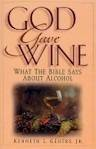
God Gave Wine (by Ken Gentry)
A biblical defense of moderate alcohol consumption. Considers all key biblical passages and engages the leading objections.
See more study materials at: www.KennethGentry.com
Tagged: alcohol consumption, wine drinking



 Postmillennial Worldview
I believe you rightly divide the Word on this subject. While originally being abstentionists, after joining a Presbyterian church in the South that taught as you do, we experienced the blessing of enjoying all that God has given to us when received with thankfulness, including moderate drinking of wine.