
 PMW 2024-057 by Patrick Fairbairn
Gentry reader asks:
Thanks so much for all your resources. I’ve been slowly studying the postmil eschatology for about a year now and it has been eye opening. I have a question regarding Ezekiel chapter 37. How does the postmil Eschatology respond to the details of the unification of Israel as a nation and the land promises that seem to be so literal? Thank you! (Z.K.)
Gentry lets Fairbairn respond:
The commentary on Ezekiel by Patrick Fairbairn (1805-1874) is an extremely helpful analysis of this great prophet. I will simply post the relevant portion of his commentary to full answer your question. I am citing from pages 408–412. I will only edit it in terms of more paragraph breaks. Older writers did not believe in paragraph breaks for their weary readers.
“And My servant David will be king over them, and they will all have one shepherd; and they will walk in My judgments and keep My statutes and do them. They will inhabit the land that I gave to Jacob My servant, which your fathers inhabited; and they will inhabit it, they, and their sons and their sons’ sons, forever; and David My servant will be their prince forever. And I will cut a covenant of peace with them; it will be an everlasting covenant with them. And I will give them the land and multiply them and will set My sanctuary in their midst forever. My dwelling place also will be with them; and I will be their God, and they will be My people. And the nations will know that I am Yahweh who sanctifies Israel, when My sanctuary is in their midst forever.”’
House Divided: The Break-up of Dispensational Theology
 By Greg Bahnsen and Ken Gentry
This book presents and defends Christian Reconstruction theology, particularly theonomic ethics and postmillennial eschatology. It does to by responding to dispensationalism’s social and exegetical theology.
For more educational materials: www. KennethGentry.com
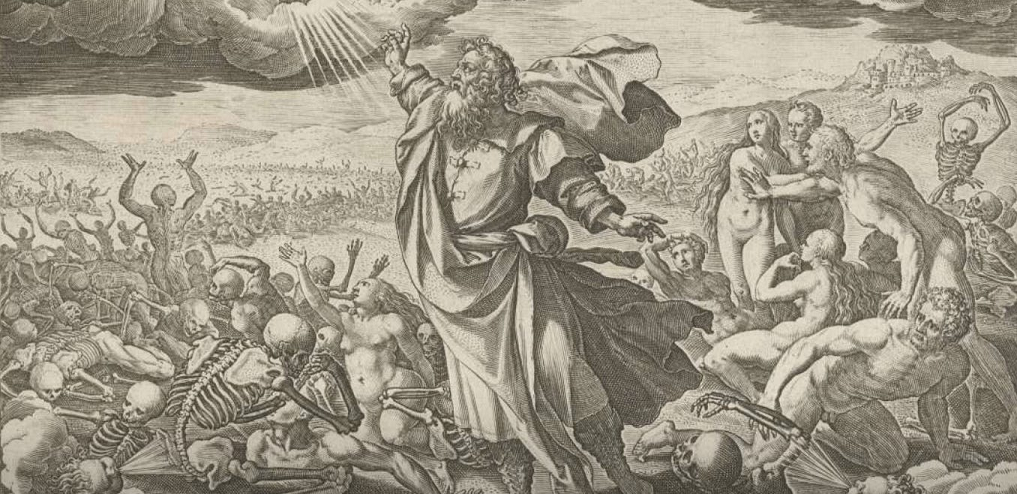
Here, precisely as in the resurrection-scene of the earlier part, the action with the rods, first writing on them the names of the two ancient divisions of the covenant-people, and then pressing them together into one, is employed merely as a symbol of what was to take place with the people themselves,—a prophecy in action to give distinctness and credibility to the immediately following prophecy in word. And for the direct import of the communication, the close and brotherly union among the members of the covenant, that forms the substance of it, is here presented to our view as an immediate and certain effect of the manifestation of God’s power to revive and bless them, and as the necessary condition to their complete and final establishment.
The whole people of Israel had been represented as participating in the regenerating efficacy of the spirit of life, which was to be given from above: and, as the direct result of this was to unite them to God, so its secondary operation could not fail to be, to unite them in brotherly concord with each other. For the true covenant-people must form but one body, as they can only have one Head; and hence, as the necessary shell for preserving this great truth, it was so strictly enjoined of old, that they should have but one temple, one high-priest, one king, and one commonwealth.
The breaking up of this united brotherhood by the revolt of the ten tribes under Jeroboam, however needful at the time as a salutary chastisement to the house of David, is constantly represented as a sad dismemberment of the church of God, and the source, to a large extent, of the more overwhelming tide of evils which thenceforth set in upon the land, and at last laid it desolate. As soon, therefore, as there might be produced a revived and healthful condition among the covenant- people, there must be a return to brotherly union, and that in connection with the house of David; for to this house had been committed, by an irrevocable decree, the right to rule over the heritage of God, and to abide in separation from it was to continue in rebellion against Heaven.
Nay, not only must the brotherly union find its centre in the house of David, but David himself must again preside over the united brotherhood; since he is pre-eminently that servant of God, whose grand end in ruling was to do the will of God, and promote the ends of his righteous government. This God-honouring king must reign for ever; his rule shall be perpetuated through all generations; that the covenant of peace also may be perpetual, and that God’s sanctuary may constantly abide among the people, and his name be magnified through their pure and prosperous condition. Thus, the order of God being re-established and made sure, there should be nothing any more to interrupt the flow of the Divine blessing; God would be most really present with his people, and the inheritance of good promised in the covenant, hitherto found only in part, be fully and for ever realised.
There is nothing absolutely new in the prophecy; it is substantially a fresh exhibition of the prospect already unfolded in chaps, xxxiv. and xxxvi.; but rendering prominent what was there implied rather than broadly asserted, the formal union of the covenant-people, along with their sanctification and blessedness, under the presidency of David. That there has been no adequate fulfilment of the prophecy in what may be called the literal sense of its terms, is too plain to require any lengthened proof. Some advances were of old made towards it,—that is all that can be said.

Dispensational Distortions
Three Lectures by Kenneth Gentry. Reformed introduction to classic dispensationalism, with analysis of leading flaws regarding the Church, kingdom, redemptive history, and Christ. Helpful for demonstrating errors to dispensationalists.
See more study materials at: www.KennethGentry.com
There was a return, to some extent, of the covenant-people, chiefly indeed of the house of Judah, though not without representatives from the other tribes; a visible display of union among such as did return, a partial repossession of the land of the covenant, and an external reconstruction of the temple and its worship—enough to show that God had not forgotten his word, and that he was ready to bless to the full, if his people had been willing to seek to him for the blessing. But still all, not excepting even the things connected with the temple (see on chap. xxi. 26), were found in a very imperfect and mutilated condition, not after the bright pattern furnished here by the hand of the prophet.
And the most characteristic part of the description—the cementing, strengthening, benignant rule of David—had not even the appearance of a literal fulfilment in the post-Babylonish history of Israel. The prophecy, therefore, has not been accomplished according to the letter in the past; and, with so strong and prominent a feature of an ideal sort as the eternal presidency of David, it seems amazing that any one should expect it to be realised after that manner in the ages to come. For to that end it were indispensable that the literal David should be raised from the dead, and again set over the heritage of God, vested there even with perpetual sovereignty; notwithstanding that Christ has expressly received, by Divine appointment, the throne of his father David.
The Reformed Eschatology of Geerhardus Vos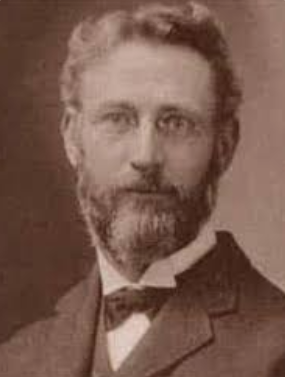
Ed. by Ken Gentry and Bill Boney
This collection of several key eschatological studies by the renowned theologian Geehardus Vos will be published in late Summer or early Fall 2024. We have modernized Vos’ grammar and syntax and updated his publications according to modern style conventions (shorter sentences and paragraphs).
For information on the upcoming Geerhardus Vos work, see:
https://axeheadpress.com/pages/coming-soon-vos
The prophecy is a detailed picture of coming good, drawn, as such a picture must have been, under the form of the old covenant relations. It exhibits the prospective good, as a revival of Israel’s best periods, freed from their still remaining defects and oft-intermingling judgments; and a picture that could be realised only in part, while the old covenant stood, both from its own inherent imperfections, and from the wilful neglect and obstinacy of its people. Not till the new covenant enters does the comparatively perfect begin to develop itself. For with the coming of Messiah, the head and centre of the new, as David was of the old, everything connected with God’s kingdom takes a loftier flight and a wider range; the shadows vanish away, being supplanted by the substance; and that which before was partial and restricted, presents now the aspect of an expansive freedom and a universal adaptation. The whole earth is as much Christ’s rightful heritage as the territory and people of Canaan were David’s; and only when it becomes his actual possession, can the prophecy respecting him, as the New Testament David, reach its destined accomplishment.
So that to speak now of the prophecy still requiring for its fulfilment a literal Israel, a literal Canaan, a literal tabernacle, with the many outward and fleshly conditions therewith connected, and that too in the face of the palpable incongruity in the heart of the prophecy of a non-literal David, is as if one were to reduce the lofty tree again to the puny dimensions of the plant, or send the man of full-grown stature back to his cradle,—as if, in short, against all the experience of the past, which is ever moving on to something higher and better, we should expect the chariot-wheels of God’s providence to return to their former courses, and keep within the ancient landmarks.
The Divorce of Israel: A Redemptive-Historical Interpretation of Revelation
This long-awaited commentary has now been published. It is an 1800 page, two-volume deeply exegetical, academic commentary on the Bible’s most mysterious book.
Click: https://www.kennethgentry.com/the-divorce-of-israel-2-vols-by-gentry-pre-publication-offer/
See more study materials at: www.KennethGentry.com
It was the peerless glory of Israel as a nation, to give to the world the new David, who was to be for humanity the one child of hope, and to furnish to his hand the first builders of that spiritual house, which was to be formed of renewed souls, and reared on the foundation of his perfected redemption. But there their distinctive honour ceases—not as if their real privileges and blessings were lost, but because these must henceforth be shared in common by the household of faith. The very mother that bore Jesus, and his nearest kindred, could attain to no peculiar place in his kingdom by reason of their earthly connection with him: not these, he said, but every one that heareth the word, and doeth the will of my Father in heaven, is my mother and sister and brother. Thus the fleshly bond was broken at the centre, and it must vanish to the farthest circumference; everything founded on natural relationships and genealogical descent was, with the handwriting of ordinances, nailed to the cross of Christ, and buried in his grave, as a part of that bondage to the elements of the world, from which the church had at length escaped, and which should never more be heard of in her borders.
The one relationship to be accounted of is union to Christ, which renders all who possess it children of Abraham, and heirs according to the promise—heirs, that is, of all that was given to Abraham in promise; more even, if more could be, for they are heirs of God and joint heirs with Christ himself. Therefore, it is folly to speak of robbing the Jew by putting him on a level with the believer in Christ; for to put him there is to raise him to the highest standing that a child of humanity can enjoy, and give him a share in that, which being large enough for all, is not diminished, but rather enhanced by the numbers who partake in it.
And for the church herself, seeing that her exalted Head is now at the right hand of the Majesty on high, with power and authority to make the whole earth his possession, instead of seeking to revive the old distinctions, which have served their day, or hanging her hopes on effete outward arrangements, it is alike her wisdom and her duty to press forward the spiritual conquest of the world,—plying with unwearied diligence the means of its regeneration, and withal waiting and praying for the time when, nature itself being regenerated, the earth shall become the fit abode of manifested Deity, and all shall be full of the knowledge, and resplendent with the glory of the Lord. Then in the fullest sense shall the vision of our prophet be realised; for then the entire territory of the new covenant shall be reclaimed for righteousness, and the tabernacle of the Lord most truly be with men.
Israel in the Bible and History (9 mp3 lectures)
by Ken Gentry
The people of Israel are the people of God. But the modern church is divided over the nature, call and identity of Israel. This lecture series covers key issues for understanding the biblical concept of Israel.
See more study materials at: www.KennethGentry.com



 Postmillennial Worldview
Leave a comment