
PMW 2023-098 by Kenneth L. Gentry, Jr.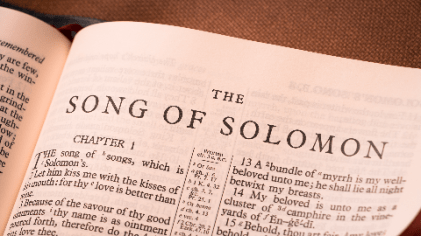
In today’s posting I will focus on the opening verses of the Song of Solomon. The text regarding Solomon’s black bride-to-be is usually misinterpreted — along with the rest of the book.
Song is perhaps the most difficult book in the Old Testament to interpret, rivaling even Revelation in the New Testament. Interpretations include its being an allegory (either of God’s love for Israel or for Christ and the Church), a drama (an actual romantic play), a cultic celebration (i.e., speaking of a fertility cult), a funeral cult ritual (cf. 8:6), an actual wedding ceremony text, or a love song (either of an historical event or a purely poetic exercise). Yet, sufficient evidence suggests that it is a love poem celebrating the sexual relationship between a bride-to-be and her husband-to-be. It is not a love story presented as a formal drama, per some interpreters (e.g., the famed Franz Delitzsch), for it offers little character development and virtually no plot line.
The poem’s imagery speaks directly to its message regarding true love. The images do not stand for various theological truths, political issues, or philosophical matters. Rather, the work is a lyrical love poem presented largely through dramatic dialogue exchanged between a young man (cf. Song 2:3, 9, 17; 8:14) and a maiden who is beautiful both physically (1:8–11, 15; 2:10, 14, 13; 5:9; 6:1; 7:1–6) and morally (6:3, 9; 7:10; see 3:1–5 Ext. Note; 8:10 Note).
It basically functions as a poetically-framed parable celebrating the purity, dignity, depth, and joy of true, romantic, sensual love. It pictures the devoted, rapturous love of a young man for a maiden. Despite some interpretations, it does not include a third party (usually seen as Solomon), who attempts to separate a country girl from her true love in order to bed her down. It is a beautiful, warm, moving, and emotional love song, not a story of a lustful attempt at seduction and manipulation.
Although not certain, it probably is based on a temporary experience from Solomon’s early adult life. If so, it would picture the true, monogamous love he shared in his first marriage to a Shulamite bride (6:13) while he was a young king. If not based on his own experience, however, it could be his poetically idealized presentation of true love.
Openness Unhindered (by Rosaria Butterfield)
Dr. Butterfield goes to great lengths to clarify some of today’s key controversies. She also traces their history and defines the terms that have become second nature today-even going back to God’s original design for marriage and sexuality as found in the Bible. She cuts to the heart of the problems and points the way to the solution.
See more study materials at: www.KennethGentry.com
Let’s consider the first few verses to get us off on the right track.
Song 1:2–4a
This stanza opens the poem and announces its romantic theme. The text does not indicate who is speaking, but it is obviously not the male lover. Rather, it is his true love, a young woman, his bride-to-be. She will be the dominant speaker throughout the poem, for regarding those verses which we can determine with certainty who is speaking, she speaks in fifty-six of them, compared to the man’s thirty-six.
Song 1:2
May he kiss me with the kisses of his mouth
The poem opens with this fundamental act of affection: an intimate kiss on the lips (not a peck on the cheek). By stating that the man’s love is better than wine, the young woman is declaring that it is both enjoyable (Psa. 104:15; Eccl. 10:19; Zech. 10:7) and intoxicating (Gen. 9:21; 1 Sam. 1:14; Eph. 5:18). These first words set the tone for the whole romantic story. Later these words will be returned to her by her lover (4:10).
Song 1:4a
The king has brought me into his chambers
The bride-to-be is excited and desires to run away with her lover (“let us run together,” v. 4a), a theme that will frequently arise (cp. 2:10, 13; 4:8; 7:11, 12). She then exhorts him to take her into his bed chamber, i.e., the wedding chamber (v. 4b). This verb is a cohortative (an exhortation) rather than a past tense, and reads better as: “Let the king bring me into his chambers” (NIV). She wants to be married now.
Song 1:4b
We will rejoice in you
Though the chorus is not properly introduced, the plural references (“we will rejoice” / “we will extol”) clearly shift from the singular (“kiss me” / “draw me, vv. 2, 4). The chorus is composed of the “daughters of Jerusalem,” to which the bride-to-be will soon speak (v. 5). They rejoice in and praise her love for the king. Earlier the girl praised her lover the king by noting “the maidens love you” (v. 3c); now the chorus of maidens commends him by declaring that this is right: “rightly do they love you.”
Covenantal Theonomy
(by Ken Gentry)
A defense of theonomic ethics against a leading Reformed critic. Engages many of the leading objections to theonomy.
See more study materials at: www.KennethGentry.com
Song 1:5–6
I am black but lovely
Solomon’s lover declares she is “black” (v. 5) or better, “dark.” This has nothing to do with her race; she is a Jew (from the tribe of Issachar, see 6:13), not an Ethiopian. This statement betrays her social status as a field-laborer. Her statement that “I am dark but” is defensive, suggesting social prejudice against her peasant status (see v. 6a). This is despite her love for “the king” (v. 4), who would normally seek out a beautiful woman (e.g., 1 Kgs. 1:3–4; Est. 2:2–3). The “but” shows that although she is darkened by laboring in the sun, she is nevertheless, “lovely,” i.e., beautiful in bodily shape and facial features. Thus, this is a defensive statement regarding her field appearance.
The word shachor, which is translated “black,” should be rendered “dark” (v. 5; see NIV, ESV) for several reasons: (1) The actual word covers a range of shades from dark to raven black (cp. 5:11). Thus, “dark” is a lexical option. (2) She declares that her dark skin is like the heavy “tents of Kedar,” which were made of gray or black goat hair in which bedouin shepherds lived (Isa. 60:7; Jer. 49:28–29; Eze. 27:21). (3) The root of the word “dark” is qadar, which means “to be dark, darken, grow dark,” like dark rain clouds (Jer. 4:28) or the moon in a shadowed eclipse (Joel 2:10).
(4) She claims she is “swarthy,” shecharchoreth (v. 6a). This is the diminutive of “black” (shachor), suggesting she is not fully black, but less black, blackish, i.e., dark. (5) Contextually, her skin is dark because “the sun has burned me” (v. 6b), i.e., tanned. Thus, her darkness is not natural the Ethiopian (Jer. 13:23). (5) She has been forced to take care of her brothers’s several vineyards (v. 1:6d; see 1:6 Note), which would require much time outside in the sun (cf. Lev. 25:3; Jdg. 9:27; Matt. 21:1, 28). She did not even have time to take care of her own vineyard (1:6e).
That she says “I am dark but lovely” suggests social prejudice from the upper class. This upper class could well be reflected in “the daughters of Jerusalem.” They dwell in a finer urban setting in the confines of the capital city rather than laboring out in the fields with the field hands. Notice her plea for them not to stare at her (v. 6a) and their later criticism of her beloved (5:9).
Yet she is nevertheless “lovely” in appearance. Though her skin may be like dark bedouin tents, her overall loveliness is like the “curtains [Heb., yeriah] of Solomon.” This probably refers to the beautiful curtains [yeriah]of the tabernacle (Exo. 26:1–13; 36:8–17) that would have been replicated in Solomon’s temple.
This is introducing a love song; not a typology of Christ and his church.



 Postmillennial Worldview
I have used the verses in this book with my wife more times than I can count. Very profitable.
I think you are right about the nature of the Song of Songs. The allegorical approach has suggested to my mind a kind of prudery on the part of the interpreter, or perhaps a prejudice against anything in Scripture that does not seem to them “spiritual”.
My idea is that one purpose of it is to teach us how to view and speak to each other about sexual matters without clinical language on the one hand, or crude vulgarity on the other. Bashful brides and nervous grooms need help with this. The awkwardness is increased if they don’t know how to say what they are thinking and feeling. They should not learn this from filthy video or the often tasteless language of their friends.