FOUR DISCIPLES; TWO QUESTIONS

two fingersPMW 2024-015 by Kenneth L. Gentry, Jr.

An Important Question
A reader of my blog wrote and asked an important question:

“Hello, and thanks for the interesting blog posts!

I have a question concerning the amount of the questions Jesus’ disciples asked him in Matthew’s version of the Olivet Discourse.

Those who reject the preteristic interpretation of the discourse, argue that disciples asked three questions:

1) when will these things be (the destruction of the temple, which they admit that Jesus talks a bit)

2) what will be the sign of your coming (the second advent)

3) what will be the sign of the end of age (the end of the present world order we all are living)

My question: Is there any grammatical or other structural arguments for two and not three questions?
Continue reading

THE CONFUSED, STUMBLING DISCIPLES

PMW 2024-014 by Kenneth L. Gentry, Jr.Tripping man

I am researching an expansion of my The Olivet Discourse Made Easy book. My expansion is so far-reaching in scope and large in size that I may have to rename it. Perhaps, The Olivet Discourse Made Hard. [1]

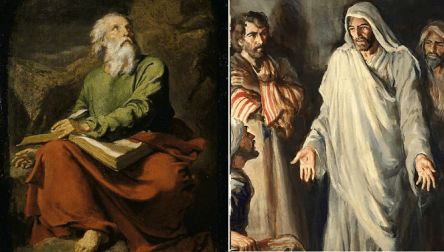
In my research I have a large section showing how confused and stumbling were Jesus’ twelve disciples — despite having the best teacher possible! Their confusion plays a large role in their misunderstanding Jesus’ prophecy of the destruction of the temple (Matt. 24:2). They ask two questions of him, the second of which shows their confusion. They ask when shall these things be, then they ask what shall be the sign of your parousia and of the end of the age (Matt. 24:3). As per much first century Jewish and apocalyptic expectations, they believed the temple could not be destroyed without history ending and that the Messiah would wage war against pagans.
Continue reading

ABRAHAMIC COVENANT & THE LAND

Israel and the worldPMW 2024-013 by Kenneth L. Gentry, Jr.

A quick summation of Genesis 12 and 13 regarding the precovenantal promise of God to Abraham.

Gen. 12:1a
Now the LORD said to Abram
At this point the Genesis narrative moves out of primeval history and into patriarchal history toward which it has been heading since Gen. 1:1. Like Adam and Noah before him, Abraham initiates a new beginning in advancing God’s plan in history. Although the Abrahamic Covenant will not be established until a little later (15:17–21), here we have the pre-covenantal promise that leads to it. God speaks to Abraham through direct, objective revelation (cp. Gen. 12:7; 17:1; 18:1; Acts 7:2).
Continue reading

ISRAEL AND GOD’S PEOPLE (4)

Jew and GentileThis is my final installment on a brief series of the role of Israel in the Bible and theology. I am responding to the Judeo-centric theology of dispensationalism. Please read the three preceding articles to understand the flow of my argument. I now move on to note that:

9. The new covenant church is actually called “Israel”

Dispensationalists strongly resist the application of “Israel” to the church, asserting that “the Scriptures never use the term Israel to refer to any but the natural descendants of Jacob” [1] But if according to the New Scofield Reference Bible Abraham can have Gentiles as his “spiritual seed,” [2] why may we not envision a spiritual Israel?

In fact, Paul applies the name “Israel” to Christians when he writes: “And as many as walk according to this rule, peace and mercy be upon them, and upon the Israel of God” (Gal 6:16). Here he is referring to Christians as “the Israel of God.” In the Greek the “and “preceding “the Israel of God,” functions epexegetically. That is, we should translate the verse “peace and mercy upon them, that is, upon the Israel of God.” Thus, according to Paul “as many as walk according to this rule [Christian faith]” are the “Israel of God.”

Dispensationalists see Galatians 6:16 as applying to Jewish converts to Christ, “who would not oppose the apostle’s glorious message of salvation.” [3] But such is surely not the case, for the following reasons. The entire epistle of Galatians opposes any claim to a special Jewish status or distinction: “For you are all sons of God through faith in Christ Jesus. For as many of you as were baptized into Christ have put on Christ. There is neither Jew nor Greek, there is neither slave nor free, there is neither male nor female; for you are all one in Christ Jesus” (Gal 3:26–28).
Continue reading

ISRAEL AND GOD’S PEOPLE (3)

Isaiah and jesusPMW 2024-012 by Kenneth L. Gentry, Jr.

I have offered two articles on Israel in my two previous installments of this study. I am currently rebutting the dispensational view of Scripture and theology, which presents a Judeo-centric focus. I will continue with my critique.

4. The new covenant church is not a mystery wholly unrevealed

Based on Ephesians 3, dispensationalist argue that the new covenant era, international church was a mystery that is “completely unrevealed in the Old Testament.” Certainly the clarity of the revelation of God’s expanding people increases in the New Testament. But that revelation was, in fact, given in the Old Testament.

Let’s look at dispensationalism’s key passage for this concept. Ephesians 3:5–6 reads: “which in other generations was not made known to the sons of men, as it has now been revealed to His holy apostles and prophets in the Spirit; to be specific, that the Gentiles are fellow heirs and fellow members of the body, and fellow partakers of the promise in Christ Jesus through the gospel.” We have already seen that the Old Testament anticipated this. Now we must note that Ryrie and the dispensationalists misread Paul’s statement. Consider the following.

To begin with, we must discern for whom the revelation was a mystery. Ephesians 3:3–6 reads: “By revelation he made known unto me the mystery . . . which in other ages was not made known unto the sons of men.” Thus, the “mystery” now revealed was not previously made known to the “sons of men,” that is, the Gentiles. It was made known to the “sons of Israel” through their prophets. The phrase “sons of Israel” appears often in the Old Testament (e.g., Exo 3:3, 14–15; 4:31; 5:14–15; 6:5; etc.), setting them over against the rest of the world, the Gentiles, the “sons of men.” When God speaks to Ananias he distinguishes between “the Gentiles” and “the sons of Israel” (Acts 9:15; cp. Luke 2:32; Acts 4:27).
Continue reading

ISRAEL AND GOD’S PEOPLE (2)

Church and IsraelPMW 2024-011 by Kenneth L. Gentry, Jr.

In my opening installment of this four-part series on Israel, I highlighted the wildly popular dispensational view of Israel, which has a Judeo-centric eschatology. My reader should consult my preceding article in order to understand what I am arguing.

Continuing the idea of the previous article, I would note that though “replacement theology” is a popular charge against non-dispensational, evangelical theology, a better term would be: “fulfillment theology.” Let me demonstrate the biblical warrant for this “fulfillment theology” view.

1. The OT anticipates the expansion of God’s people

The Old Testament writers foresee a time in which God will expand his people by bringing blessings on the Gentiles and including them within Israel. This hope is established early in Israel’s formative history when God establishes his covenant with Abraham: “As for Me, behold, My covenant is with you, / And you shall be the father of a multitude of nations” (Gen 17:4).

Continue reading

ISRAEL AND GOD’S PEOPLE (1)

Israel and the churchPMW 2024-010 by Kenneth L. Gentry, Jr.

Because of the prominence of dispensationalism and the Left Behind phenomenon in evangelical circles, it is important for us to reflect on a fundamental emphasis in contemporary prophecy discussions: Israel. This is also important in that Israel does ver clearly play a prominent role in Scripture. In this brief series I will provide a brief study of the Scripture’s view of Israel from a Reformed perspective both exegetically and theologically

As all Christians know, throughout most of the Old Testament Israel is God’s special people — beginning in seed form with the calling of Abraham in Genesis 12. She is God’s elect nation (Deut 7:7–8 ; 10:15; Zech 2:8; Rom 3:1–3; 11:1) and the focal point of his redemptive mercies in history (Deut 4:7–8; Psa 147:19–20; Amos 3:2; Rom 9:4). Because of her commanding presence in old covenant history and her central role in Old Testament prophecy she becomes a crucial issue in understanding the Bible.


Israel in the Bible and History (9 mp3 lectures)235 Israel in Bible and History 2
by Ken Gentry
The people of Israel are the people of God. But the modern church is divided over the nature, call and identity of Israel. This lecture series covers key issues for understanding the biblical concept of Israel.

See more study materials at: www.KennethGentry.com


Continue reading