
HOPE IN THE FUTURE

Hope 3PMW 2024-027 by Kenneth L. Gentry, Jr., Th.D..

In his letter to the troubled Corinthian church, Paul lists three Christians virtues while exhorting them to a closer walk with Christ: faith, hope, and love (1 Cor. 13:13). This three-fold cord of holy values provides a strong bond of commitment for the Christian, and has tied the Church of Jesus Christ together throughout the ages.

Faith and love are not only beautiful threads knitting together the fabric of the Christian life, but are easily recognized as such. They weave a strong carpet for the Christian walk; they serve as dual strands tugging us forward in our holy calling. And though hope is certainly not a detached thread from the Christian garment, it has been snagged loose and at best is only partially visible to the eye of faith today.

Certainly all Christians are united in recognizing our ultimate, glorious resurrection hope in our heavenly home. We know that the present fallen order is not all that we may expect in our experience of God’s grace. The beatific vision in Scripture encourages us to keep a hopeful eye on heaven above even as we watch our steps in the earth below. And though eternal life in the presence of God is the ultimate hope of the Christian and the abiding consequence of the gospel, it does not exhaust the full significance of biblical hope. Continue reading

TOLERANCE, AND SOCIAL MORALITY

DiversityPMW 2024-026 by Kenneth L. Gentry, Jr., Th. D.
I live in the deep south, and right in the middle of the Bible belt. Unfortunately, we have gotten a taste of the homosexual revolution in our area. Awhile back recent news items, editorials, and letters to the editor debated the question of homosexuality. Tragically, the conservative South and Christian dominated cities are not immune to the moral decline and degradation of our culture.

Unfortunately, the whole controversy is a study in muddled ethical thinking, contradictory assertions, sloganeering, and outlandish charges. The local resistance to homosexual culture has been ridiculed as: “a breach of the separation of church and state,” “Naziism,” “menacing authority,” “an atrocity,” “right-wing extremism,” “poisonous,” “ayatollah-like,” “warped,” “a return to the dark ages,” “frightening,” “appalling,” “a witch hunt,” and more. Consequently, the dispute exposes our inability to think through moral issues. But public socio-political discourse is not the place for such moral confusion.
Continue reading

DIVORCE OF ISRAEL TABLE OF CONTENTS

imageBy Ken Gentry

I have been asked by a number of people to see the Table of Contents of my Revelation commentary, which is due out April 15, 2024. So I will post this as an aside from my regularly scheduled blog articles.

The commentary can be pre-ordered at a discount:

https://www.kennethgentry.com/the-divorce-of-israel-2-vols-by-gentry-pre-publication-offer/

TABLE OF CONTENTS

Foreword by Martin Selbrede
Preface
1. Introduction
2. Superscription And Beatitude (1:1–3)
3. Greeting and Theme (1:4–8)
4. The Commissioning Vision (1:9–20)
5. Seven Oracles (2:1—3:22)
6. The Court Scene (4:1–11)
7. The Seven-Sealed Book (5:1–14)
8. The Seals Opened: The First Six Seals (6:1–17)
9. Two Interludes (7:1–17)
10. The Seals Opened: The Seventh Seal (8:1–5)
11. The Seven Trumpet Angels: The First Six Trumpets (8:6—9:21)
12. Third Interlude: The Little Book and John’s Action (10:1–11)
13. Fourth Interlude: The Measured Temple and Two Witnesses (11:1–13)
14. The Seven Trumpet Angels: The Seventh Trumpet (11:14–19)
15. The Sun-Clothed Woman And the Red Dragon (12:1–17)
16. The Beast From the Sea (13:1–10)
17. The Beast From the Land (13:11–18)
18. Visions of Blessing and Judgment (14:1–20)
19. The Seven Last Plagues (15:1—16:21)
20. The Harlot of Babylon and the Beast (17:1–18)
21. The Fall of Babylon the Harlot (18:1—19:5)
22. The Final Victory of the Lamb (19:6–21)
23. Satan’s Ruin and Final Judgment (20:1–15)
24. The New Creation’s Coming (21:1–8)
25. The New Jerusalem Bride (21:9–27
26. New Heaven and New Earth (22:9–17)
27. Final Testimonies and Admonition (22:6–15)
28. The Final Attestation and Blessing (22:16–21)


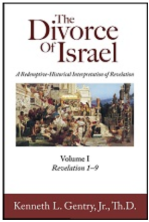
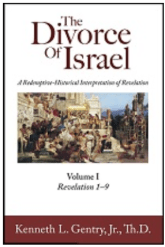
The Divorce of Israel: A Redemptive-Historical Interpretation of Revelationimage
This long-awaited commentary is now at the printer and should be available for the public in late April, 2024. It is an 1800 page, two-volume deeply exegetical, academic commentary on the Bible’s most mysterious book.

Pre-order today for a special discount. Click: https://www.kennethgentry.com/the-divorce-of-israel-2-vols-by-gentry-pre-publication-offer/

CREEDS IN SCRIPTURE?

creedsPMW 2024-025 Kenneth L. Gentry, Jr., Th.D.

Creeds are important instruments for the securing and promotion of the Christian faith. The concept of creeds arise in Scripture itself. Certainly no law in Scripture explicitly commands “Thou shalt frame creeds.” Nevertheless, the impetus and mandate for creeds derives from good and necessary inferences deduced from Scripture.

We can demonstrate this in a variety of ways, three of which will suffice for our present purpose.

First, the biblical call for a public affirmation of faith serves as the prime impetus to creedalism.
Continue reading

GENESIS 2 EXPOSITION (2)

creation of evePMW 2024-025 by Kenneth L. Gentry, Jr.

This article concludes the two-part survey of Genesis begun in the last article.

Gen. 2:16
God commanded the man
This crucial command is given directly to Adam. Eve has not yet been created (2:22). This implies man’s functional loving and protective headship (not his superiority or dominance) over his wife within the family..

Gen. 2:17
you will surely die
Adam was not created in a declining and dying condition. But he was created capable of dying — if he disobeyed God. The covenant of works has consequences; man has responsibility. Death has two components, spiritual (Eph. 2:1; Col. 2:13) and physical. On the day Adam sinned, he died spiritually, but his body would eventually return to the dust physically (Gen. 3:19b; cp. Psa. 90:3; 104:29; Eccl. 12:7). This is certain because the Hebrew phrase behind “surely die” is a pleonasm, which is a dramatic verbal form expressing certainty. It may be literally translated “to die you will die.”
Continue reading

GENESIS 2 EXPOSITION (1)

PMW 2024-024 by Kenneth L. Gentry, Jr.

Creation of adamOnce again I will offer a running overview of an important passage of Scripture. This two part series will present the creation of Adam, the planting of Eden, and the marriage of man.

Gen. 2:7a
the LORD God formed
This shows the intensely personal creation of man. Animals were created en masse by a spoken word (1:20, 24); man was created as an individual by God’s carefully forming his body and in-breathing life into him (cp. 2:21–22). This is not a poetic, anthropomorphic image of a potter at work, for: (1) neither the word “potter” nor “hand” appear (as in Jer. 18:4, 6) and (2) potters do not work with “dust” but clay (Isa. 29:16; Jer. 18:4).

Gen. 2:7b
man
The Hebrew word for “man” is adam which is related to the word “ground” (adamah). As a land creature man is closely linked with the ground from the beginning (2:5, 9, 15–16; 3:16–19a; cp. 1:29). Under God’s curse for his rebellion, he will return to the ground (3:19b).

Continue reading

COMMENTARY PRE-PUBLICATION SPECIAL

March 25, 2024

This fully orthodox preterist commentary is scheduled to be completed printing by April 15, 2024. I am hoping to have it in hand sometime between April 30 and May 10, 2024. Please note: Due to shipping and logistical issues there could be a slight delay on my receiving it for distribution.

To get pre-publication special for the two-volume set, click HERE.

If you order before April 15 I will sign your copy (if you would like for me to do so and if you specifically request it). Then I will send it to you as soon as I receive my shipment.

Thanks for your interest. And patience. And prayers! Keep them going.

Ken Gentry