Category Archives: Uncategorized

PAEDO-BAPTISM VS. PAEDO-COMMUNION

PMW 2024-053 by Purely Presbyterianbaby surprised

Gentry note: I received this article from “Purely Presbyterian” by email the other day and thought it worthy of promotion on my website (since I am a Westminster Confessionalist).

PAEDO-BAPTISM, YES; PAEDO-COMMUNION, NO

A common objection against infant baptism by credo-baptists is that if children are to be baptized, then, for the sake of consistency, they ought to also be admitted to the Lord’s Supper. In other words, the logical conclusion of infant baptism necessarily leads to the absurdity of infant communion; paedocommunion is obviously unbiblical and absurd, therefore paedobaptism must likewise be unbiblical. In like manner, paedocommunion advocates endorse the same logic, but instead of denying both infant baptism and infant communion, they affirm and practice both under the same pretense of consistency (cf. Infant Communion? By Douglas Wilson). Since paedobaptism is true, paedocommunion is likewise true, and it is inconsistent to treat them differently by giving one sacrament to infants but not the other.

But is this charge of inconsistency a valid criticism of confessional Reformed sacramentology?
Continue reading

PARABOLIC WARNINGS TO ISRAEL

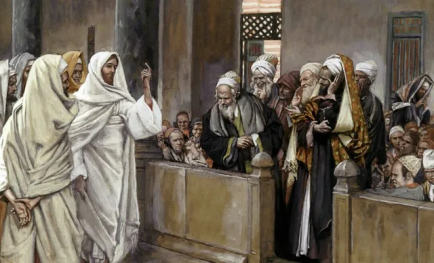
PMW 2024-048 by Kenneth L. Gentry, Jr.Preachi to sanhedrin

I am working my through Matthew showing the rejection of the Jews from God’s kingdom and the inclusion of the Gentiles. This helps us to see why the Olivet Discourse is given so late in Jesus’ ministry. He has given Israel every opportunity to believe in him, but they have refused. In the process we are seeing the gradual inclusion of the Gentiles in the biblical narrative. We are now ready to consider a few parabolic warnings to Israel, especially her leaders.

Matthew 22

In Matthew 22:1–14 Jesus presents the parable of the king (God) who gives a wedding feast for his son (Jesus). Those originally invited (the Jews, Matt. 10:5; 15:24) refuse to come (they do not accept Jesus as the Messiah, Matt. 23:37; 27:25; cp. John 1:11; cp. Acts 13:46; 18:6; 19:19)). As a consequence, “the king was enraged and sent his armies, and destroyed those murderers, and set their city on fire” (22:7).

This speaks of the Romans burning Jerusalem in AD 70, of which Josephus writes: “one would have thought that the hill itself, on which the temple stood, was seething hot, as full of fire on every part of it” (J.W. 6:5:1 §275). Of the Romans we read that: “they went in numbers into the lanes of the city with their swords drawn, they slew those whom they overtook without and set fire to the houses whither the Jews were fled, and burnt every soul in them” (J.W. 6:8:5 §404). Continue reading

HYPERPRETERISM & SLIP SLIDIN’ AWAY?

PMW 2024-059 by Kenneth L. Gentry, Jr.Black hole

An old lawyer’s maxim states: “If you can’t pound the facts, pound the table.” This loud procedure has been adopted by many Christians for spreading fear about orthodox (partial) preterism. They argue that many hyper-preterists were once partial-preterists, and thus orthodox preterism leads to heresy. Therefore, they loudly urge Christians to avoid all preterism as dangerous.

Partial preterism and hyper-preterism

Well, it is certainly true that many hyper-preterists started out as partial preterists. And they often boast about this fact. Indeed, Gary DeMar in his recent podcast about my Revelation commentary mentions this issue: Continue reading

JESUS’ GENEALOGY AND GENTILES

PMW 2024-044 by Kenneth L. Gentry, Jr.Matthew 1

Having noted the importance of narrative flow in the Gospels, we will now begin considering some of the earlier chapters of Matthew. We will notice how Matthew begins with two themes that are important for postmillennialism: (1) The decline of Israel and (2) the inclusion of the Gentiles in God’s kingdom.

JESUS AND ABRAHAM

Matthew opens his Gospel by tracing Jesus’ genealogy back to Abraham, the “father” of the Jews (Matt. 3:9). [1] As we will see, Matthew will be presenting Jesus as the new Israel, the true, continuing Israel of God (cp. Gal. 6:15–16). [2] Thus, he begins Jesus’ story by tracing his genealogy to Israel’s own historical source, Abraham. In this he differs from the Gentile Luke who takes his genealogy all the way back to Adam, the historical source of all men (Luke 3:38).

In fact, Matthew even structures his genealogy in a remarkably-intriguing and rhetorically-important way. We see this as he summarizes it in 1:17: “Therefore all the generations from Abraham to David are fourteen generations; and from David to the deportation to Babylon fourteen generations; and from the deportation to Babylon to the time of Christ fourteen generations.” Continue reading

EARLY DATE DIFFICULTIES (1)

Objections, Preterism, Revelation

Emperor worship 5

PMW 2024-037 by Kenneth L. Gentry, Jr.

Preteristic postmillennialists hold that Revelation was written prior to the destruction of Jerusalem and the temple in AD 70. We argue this on historical and exegetical grounds. We do not argue for an early date for Revelation on purely theological grounds in order to defend our long-range hope against John’s enormous judgment scenes.. I have argued the case of the early date of Revelation in several places, most especially in my doctoral dissertation published as Before Jerusalem Fell. In this brief series of articles I will respond to four leading arguments against the early date.

The modern case for the late date of Revelation concentrates upon four basic arguments. These have been ably and succinctly summarized by noted evangelical scholar and late-date advocate Leon Morris in his commentary, The Revelation of St. John (2d. ed.: Grand Rapids: Eerdmans, 1987). I choose to investigate Morris’s approach for three basic reasons.

(1) He has rightfully earned an international reputation among both evangelical and liberal scholars. (2) He has a demonstrated competence in the field of New Testament studies, having even produced an excellent commentary on Revelation itself. (3) His presentation is succinct and focused, which lends itself to blog analysis. The order of my listing of these evidences will follow Morris’s, which is based on his scholarly estimation of their priority.


Beast of Revelation

The Beast of Revelation
by Ken Gentry

A popularly written antidote to dispensational sensationalism and newspaper exegesis. Convincing biblical and historical evidence showing that the Beast was the Roman Emperor Nero Caesar, the first civil persecutor of the Church. The second half of the book shows Revelation’s date of writing, proving its composition as prior to the Fall of Jerusalem in A.D. 70. A thought-provoking treatment of a fascinating and confusing topic.

For more study materials, go to: KennethGentry.com


Morris begins with what he calls “the principal reason for dating the book during” Domitian’s reign, which is: Revelation “contains a number of indications that emperor-worship was practised, and this is thought to have become widespread in Domitian’s day” (p. 35).Earlier than Morris, James Moffatt insisted that the role of emperor worship in Revelation was virtually conclusive: “When the motive of the Apocalypse is thus found in the pressure upon the Christian conscience exerted by Domitian’s emphasis on the imperial cultus, especially as that was felt in Asia Minor, any earlier date for the book becomes almost impossible.” [1]

This argument regarding emperor worship is also held by Robert H. Mounce, R. H. Charles, H. B. Swete, Donald B. Guthrie, W. G. Kümmel, M. Eugene Boring, William Barclay, and many others. References in Revelation which seem to reflect emperor worship are found in scattered places. See especially Revelation 13:4, 8, 12, 15; 14:9, 11; 16:2; 19:20; 20:4. The most noteworthy statements re found in Revelation 13, where worship of the “beast” is compelled.

Unfortunately, for this view emperor worship dates back to Julius Caesar in the last century before Christ. And it is endorsed by Nero, the emperor who commissions Vespasian to put down the Jewish rebellion (which results in the destruction of the temple). The emperor cult had a prominent role in the political and social life of the Roman empire well before Domitian, and even before Nero.

Although it is true that historical development continued to introduce new features and requirements into the practice, nevertheless after 30 B.C. “we can observe a swift spread of the emperor cult throughout the Roman Near East.” [2] As even late-date advocate James Moffatt wrote: “The blasphemous title of dims, assumed by the emperors since Octavian (Augustus = sebastos) as a semi-sacred title, implied superhuman claims which shocked the pious feelings of Jews and Christians alike. So did theos [god] and theou huios [son of god] which, as the inscriptions prove, were freely applied to the emperors, from Augustus onwards.” [3]


Before Jerusalem Fell Tyler

Before Jerusalem Fell Lecture (DVD)
DVD by Ken Gentry

A summary of the evidence for Revelation’s early date. Helpful, succinct introduction to Revelation’s pre-AD 70 composition.

See more study materials at: www.KennethGentry.com


The appearance of emperor worship in Revelation is held by many late-date theorists as the strongest evidence for a date during the last year of the reign of Domitian (A.D. 81-96). It is true that Domitian required people to address him as “Lord and God.” Certainly the emperor cult was prominent in his reign. Yet when we scrutinize the relevant historical evidence we discover abundant testimony to emperor worship at various stages of development well before both Domitian and Nero. Indeed, such clear statements exist of so many aspects of the emperor cult, it is surprising that this argument is used at all against the early date. One wonders why it is deemed “the principal reason” (Morris) that makes it “almost impossible” (Moffatt) for the early date view to stand is wholly incredible.

Notes

  1. James Moffatt, The Revelation of St. John the Divine, vol. 5 in W. Robertson Nicoll, ed., The Expositor’s Greek Testament (Grand Rapids: Eerdmans, rep. 1980), 317.
  2. Doron Mendels, The Rise and Fall of Jewish Nationalism: Jewish and Christian Ethnicity in Ancient Palestine (Grand Rapids: Eerdmans, 1992), 278.
  3. Moffatt, Revelation, 429. See also: Aune, Revelation 1-5, lxviii; Leonard L. Thompson, The Book of Revelation: Apocalypse and Empire (New York: Oxford, 1990), 104-190.

ORTHODOXY IS NOT OPTIONAL

PMW 2024-033 by Barton J. GingerichFork in road

Gentry note: This is a helpful article on the importance of maintaining orthodoxy.

Richard John Neuhaus (1936-2009), the conservative Lutheran-turned-Catholic cleric and writer, originated what would become known as Neuhaus’ Law. Deeply aware of social dynamics and theological truth, he claimed, “Where orthodoxy is optional, orthodoxy will sooner or later be proscribed.” As our own culture continues its unsettling spiritual trajectory, Neuhaus’ Law keeps playing itself out over and over again in church bodies and other Christian institutions.
Continue reading

HOPE IN THE FUTURE

Hope 3PMW 2024-027 by Kenneth L. Gentry, Jr., Th.D..

In his letter to the troubled Corinthian church, Paul lists three Christians virtues while exhorting them to a closer walk with Christ: faith, hope, and love (1 Cor. 13:13). This three-fold cord of holy values provides a strong bond of commitment for the Christian, and has tied the Church of Jesus Christ together throughout the ages.

Faith and love are not only beautiful threads knitting together the fabric of the Christian life, but are easily recognized as such. They weave a strong carpet for the Christian walk; they serve as dual strands tugging us forward in our holy calling. And though hope is certainly not a detached thread from the Christian garment, it has been snagged loose and at best is only partially visible to the eye of faith today.

Certainly all Christians are united in recognizing our ultimate, glorious resurrection hope in our heavenly home. We know that the present fallen order is not all that we may expect in our experience of God’s grace. The beatific vision in Scripture encourages us to keep a hopeful eye on heaven above even as we watch our steps in the earth below. And though eternal life in the presence of God is the ultimate hope of the Christian and the abiding consequence of the gospel, it does not exhaust the full significance of biblical hope. Continue reading