
Category Archives: Revelation

DOES REV 3:10 SPEAK OF THE RAPTURE?

PMT 2015-132 by Kenneth L. Gentry, Jr.Romans fighting
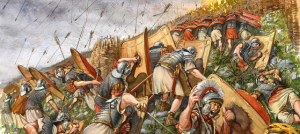
In Rev 3:10 we read of Christ’s statement the church at Philadelphia (not the church in Cleveland or Detroit!): Because you have kept the word of My perseverance, I also will keep you from the hour of testing, that hour which is about to come upon the whole world, to test those who dwell on the earth (3:10).

Because they are enduring for Christ—against all opposition, but especially from the Jews (3:9a)—he promises: “I also will keep you from the hour of testing” (3:10b). Since they kept (eteresas) his word, he will keep (tereso ) them becaus he blesses those who honor him. He will keep them from an hour of testing. Continue reading
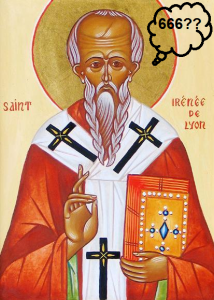
WHY DIDN’T IRENAEUS KNOW WHAT 666 MEANT?

Irenaeus 666PMT 2014-122 by Kenneth L. Gentry, Jr.

My readers’ questions keep turning to Revelation. I hope I don’t answer them all before my commentary comes out! But here is another one.

Reader’s question:

As I study your argument for 666 as a reference to Nero Caesar, these two questions arise. Could you please explain your understanding of these objections?

If Irenaeus’s statement refers to John rather than the apocalypse, the statement seems to suggest that John wasn’t telling people who the beast was during his lifetime. That seems odd if those things had already occurred.

If John did reveal to his contemporaries the identity of the beast why wouldn’t it have been common knowledge amongst the Christians and therefore Irenaeus? Continue reading

REVELATION COMMENTARY PROJECT UPDATE

Gentry with booksPMT 2015-100 by Kenneth L. Gentry, Jr.

I receive a steady flow of questions regarding my Revelation commentary’s progress towards publication. I will give my blog readers a brief report on this — don’t tell anyone about this. Let’s surprise them. 🙂

The state of the matter

I spoke with the Tolle Lege editor of my commentary this week. He will finish editing volume 1 this weekend. Then he will send the digital files to me. Once I go over it, make any necessary corrections or additions, and return it to him, he will start work on the final layout. I will be focusing on careful review of the edited manuscript beginning the moment I receive it. I am anxious to get it done! Continue reading

HIDE US FROM THE WRATH OF THE LAMB

Jerusalem cavesPMT 2015-093 by Kenneth L. Gentry, Jr.

In my last article I noted the moving mountains in Revelation and how they do not speak of a literal tectonic movements. That passage is easily applied to the Roman warfare method during the Jewish War. But similarly, the calling upon the mountains to fall also speaks of the circumstances of the Jewish War.

Rev 6:17 reads:

“They said to the mountains and to the rocks, ‘Fall on us and hide us from the presence of Him who sits on the throne, and from the wrath of the Lamb; for the great day of their wrath has come, and who is able to stand?’”

Men hiding in caves is easy enough to understand in a literal fashion. But we need to realize how important a feature this becomes in the Jewish War. Its appearance in Revelation is not a simple matter of local color; it was an issue of great significance. Continue reading

THE SEVEN “LAST” PLAGUES?

Seven bowlsPMT 2015-082 by Kenneth L. Gentry, Jr.

Rev 15:1 opens a scene in heaven which introduces the seven plagues. John’s opening statement is: “Then I saw another sign in heaven, great and marvelous, seven angels who had seven plagues, which are the last, because in them the wrath of God is finished” (Rev 15:1).

His statement that these are “the last” because “the wrath of God is finished” leads some commentators — especially futurists — to see these as occurring in our distant future, at the end of history. While I believe history does have an end, I don’t believe that John’s vision looks to that consummate end. Rather something else is going on here. Continue reading

THE HEAVENS FLEE AWAY

PMT 2015-081 by Kenneth L. Gentry, Jr.

In Revelation 20 we have the one section of Revelation that extends beyond the near-time indicators. John speaks of the “thousand years” in which Christ reigns with his martyred saints (Rev 20:4–7). In 20:11 we read of the Great White Throne of God. John informs us that “the heaven and earth fled away” at the setting of the judgment scene.

But what does the fleeing away of the heaven and earth mean? This is the question I will answer in this blog article.

In Rev 20:11 John adds a description regarding the enthroned one. He states that he is the one “from whose presence earth and heaven fled away, and no place was found for them.” According to Scripture, the physical universe will be physically transformed through fiery cleansing to make way for the consummate new heavens and new earth (2Pe 3:10–12; cp. Ps 102:25–27; Isa 51:6; Mt 5:18; 24:35). Continue reading

PRETERISTS WHO ADOPT A LATE-DATE

Past DuePMT 2015-080 by Kenneth L. Gentry, Jr.

Milton Terry underscores the significance of the question of compositional date when interpreting Rev: “The great importance of ascertaining the historical standpoint of an author is notably illustrated by the controversy over the date of the Apocalypse of John. If that prophetical book was written before the destruction of Jerusalem, a number of its particular allusions must most naturally be understood as referring to that city and its fall. If, however, it was written at the end of the reign of Domitian (about A.D. 96), as many have believed, another system of interpretation is necessary to explain the historical allusions.”

“Preterism,” as you well know, is the view that Rev deals with events that are in the near future — when John writes, but now lie in our distant past. Admittedly most preterists who see a large focus on the destruction of Jerusalem and the temple in AD 70 generally tend to adopt the early date. In fact, this becomes an integral part of the argument in that they prefer internal evidence over external.

However, despite common suspicions and confident complaints, such a commitment to the early date is not absolutely necessary for a preterist analysis. Continue reading