Category Archives: Resurrection

RESURRECTION “FROM THE DEAD”?

PMW 2025-095 by Kenneth L. Gentry, Jr.

Hyper-preterists often attempt to reinterpret verses dealing with “the resurrection of the body” (e.g., 1 Cor 15:42). They strive to draw a contrast between “the resurrection of the dead” and “the resurrection of the flesh.” This strained attempt to undermine the historic Christian belief in a physical resurrection is not helpful to their cause. Indeed, such is greatly mistaken.

The New Testament often speaks of actual physical resurrections of deceased people as being a resurrection of “the dead.” It can do so using various expressions for resurrection, while clearly speaking of a dead physical body’s arising to life again in this physical world. Note the following verses that speak of “the dead” without reference to “the flesh.” Yet these verses are clearly speaking of a body’s physical resurrection, which the historic, corporate, public, universal, systematic Christian faith has held for 2000 years to be a firm eschatological truth preparing us for our eternal consummate condition. Tragically the resurrection is being rejected today by hyper-preterism’s neo-Gnostic heresy. [1]

But now let us survey a number of verses affirming resurrection as being a physical resurrection of deceased people arising from the dead. Continue reading

CHRIST AS LIFE-GIVING SPIRIT (2)

PMW 2025-094 by Richard B. Gaffin, Jr.

Gentry reminder:
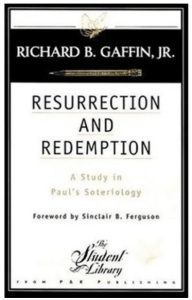
This article continues the one in my previous posting. It continues citing a lengthy excerpt from Richard B. Gaffin, Jr.’s excellent book, Resurrection and Redemption (Phillipsburg, N.J.: Presbyterian and Reformed, 1978), pp. 78-92. This is a compelling study of Paul’s confusing statement regarding Christ being a “life-giving Spirit” (1 Cor. 15:45).

And again, I have only included Gaffin’s main text, not his footnotes. You can order this book here: https://www.prpbooks.com/book/resurrection-and-redemption

Now for the conclusion of Gaffin’s material.

The following is all Gaffin who writes:

With this preparatory spadework completed we can now concentrate on the description of Christ as life-giving pneuma in verse 45c. (1) What is the specific reference of pneuma? (2) When did he become life-giving pneuma?

(1) The first question is answered in the light of the correlation between pneuma and the adjective “spiritual” (pneumatikon, vv. 44b, 46), an especially close correlation in view of the overall structure of the passage and the function of verse 45 in providing proof for verse 44b. In Paul’s usage, with the exception of Ephesians 6:12, pneumatikos always has specific reference to the activity of the Holy Spirit (e.g., Rom. 1:11; 7:14; I Cor. 12:1; 14:1; Gal. 6:1; Eph. 1:3; 5:19; Col. 1:9). This is particularly apparent in 1 Corinthians 2:13-15, the only other place where Paul contrasts pneumatikos with psuchikos. The main emphasis of the immediate context (vv. 10ff.) is the Spirit’s function in revelation (cf. v. 4), and repeated reference is made to his person (v. 10 [twice]; vv. 11, 12, 13, 14). The contrast then, underscores the indispensability of the Spirit’s activity. The phrase at the end of verse 13 (pneumatikois pneumatkia sugkrinontes), whatever its precise meaning, refers to those things and that activity distinguishing the teaching ministry of the Spirit. Accordingly, the “natural man” (psuchikos anthropos) is unable to receive “the things of the Spirit of God” because he lacks the corresponding facility of discerning “spiritually” (pneumatikos) requisite for understanding them (v. 14). In contrast, “the spiritual man” (ho pneumatikos), since he is qualified by the Spirit, possesses such discernment (v. 15; cf. v. 12). All four occurrences in verses 13-15 of “spiritual(ly)” plainly refer to the activity of the Holy Spirit. Continue reading

CHRIST AS LIFE-GIVING SPIRIT (1)

PMW 2025-093 by Richard B. Gaffin, Jr.

Gentry note:
This and the article that will follow it in a couple of days are excerpts from Richard B. Gaffin, Jr.’s excellent book, Resurrection and Redemption (Phillipsburg, N.J.: Presbyterian and Reformed, 1978), pp. 78-92. This is a compelling study of Paul’s confusing statement regarding Christ being a “life-giving Spirit” (1 Cor. 15:45). As Peter wrote, Paul could say some things difficult to be understood (2 Pet. 3:16). Stumbling over this text can lead one into various heresies, not the least of which is Hyperpreterism. So, understanding Paul properly is an important issue in today’s evangelical culture.

I have only included Gaffin’s main text, not his footnotes. I highly recommend your getting, reading, and studying this book — with its significant footnotes. I not only desire to offer insightful articles on my site, but also to encourage the reading of important and relevant literature from various theologians.

You can order this book here:
https://www.prpbooks.com/book/resurrection-and-redemption

Now for Gaffin’s material (the following is all Gaffin):

I Corinthians 15:45
Our interest in this verse is the description of Christ as the last Adam, as “lifegiving pneuma” (pneuma zopoioun). However, nowhere in the whole of Paul is a statement more inextricably embedded in both its narrower and broader contexts. In verses 45-49 together with verse 22, “Paul provides us with what is one of the most striking and significant rubrics in all of Scripture.” Compact modes of expression and the density of thought also make it, along with verses 42-44, one of the most difficult Some consideration, then, needs to be given to this contextual factor. Continue reading

ENDURING THE HYPERPRETERIST CONTAGION

PMW 2025-092 by Kenneth L. Gentry, Jr.

Along with many evangelical Christian leaders, I am deeply concerned with the small, but growing number of people defecting from the orthodox Christian faith by adopting Hyperpreterism. Simultaneously though, I am greatly encouraged by the number of emails and personal contacts I receive from folks who say my writings had helped them escape the addiction of Hyperpreterism.

THE SAD PROBLEM

I often receive worried emails from family members having to endure the Hyperpreterism addiction in a loved one. One recent email lamented their spouse’s attraction to Hyperpreterism. The writer asked how they might best be able to respond to their spouse’s theological error. Continue reading

THE EMBODIED PERSON

PMW 2025-091 by Gregg Allison

Gentry note:
This article is found on the “Christ Over All” website. It is a helpful study of Christian anthropology and the importance of the material body in defining human life and countering the neo-Gnosticism of Hyper-preterism. Allison is professor of Christian theology at The Southern Baptist Theological Seminary. He is secretary of the Evangelical Theological Society.

Gregg Allison article:
The Embodied Person: Why I Am My Body, Not Just My Soul

Theological anthropology focuses on the doctrine of humanity and explores such topics as the nature and origin of human beings and the image of God. Historically, much discussion has been dedicated to the soul, or immaterial aspect of human nature, with little or no attention given to the body, or material aspect.[1] This essay proposes that the proper state of human beings is embodiment and seeks to rectify some of the historical and (even) contemporary oversight of embodiment. It will pursue this thesis—which I will call the “embodied person” view—by some close interaction with a contemporary theologian, Joshua Farris, and his fine work An Introduction to Theological Anthropology.[2] Both of us hold that humans are composed of soul and body but we emphasize different aspects of that dualist human constitution: Farris, the immaterial; I, the material. Continue reading

“THE FINAL TRIUMPH OF GOD” REVIEW

PMW 2025-062 by Kenneth L. Gentry, Jr.

James P. Ware’s The Final Triumph of God: Jesus, the Eyewitnesses, and the Resurrection of the Body in 1 Corinthians 15 (Eerdmans, 2006) is one of the most compelling and insightful books I have read in many years. It is absolutely spell-binding in its careful exegetical observations regarding the physical resurrection of the body in 1 Corinthians 15. And in our day of the arising of a new neo-Gnosticism (!) it is a “must have” book. I highly recommend this book to anyone interested in Christ’s physical, bodily resurrection or our own. And to any who might want to witness to hyper-preterists (or liberals who hold the views). This might be a good tract to  give them.

Instead of my own personal review, I will simply cite most of the Foreword by A. Andrew Das. He focuses on the essence of the book and the importance of Ware’s own triumph! Continue reading

HYPERPRETERISM VS. THE GOSPEL (3)

PMW 2025-060 by Kenneth L. Gentry, Jr.

Introduction
This is my third and final article in a short series on 1 Corinthians. I am showing that Paul is warning the Corinthians that denying the physical resurrection ends up denying the gospel. Thus, 1 Corinthians should serve as a warning to any Christians being tempted by hyper-preterism and its neo-Gnostic spiritual resurrection of the body. Sadly, hyper-preterists who teach a “spiritual” resurrection instead of a “bodily” resurrection are adopting humanism over biblicism.

The wisdom of the world
Once again, I am beginning with Paul’s first major section opening the main body of his epistle: 1 Cor. 1–4. In this section, which is the foundation for the whole epistle, Paul is warning against the wisdom of the world (i.e., that of fallen man) as he sets it over against the wisdom of God, which is found in Paul’s preaching. In 1 Cor. 3:18 he expresses concern about some “among” the Corinthians who are teaching the wisdom of the world in the church there [1]:

“Let no man deceive himself. If any man among you [en humin] thinks that he is wise in this age [sophosen to aioni touto], he must become foolish, so that he may become wise. For the wisdom of this world [sophia tou kosmou toutou] is foolishness before God. For it is written, ‘He is the one who catches the wise in their craftiness’; and again, ‘The Lord knows the reasonings of the wise, that they are useless.’ So then let no one boast in men.” Continue reading