 PMT 2014-128 by Kenneth L. Gentry, Jr.
An interview of me made recently for an introduction to a conference engagement.
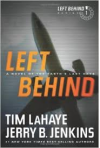
1. People now days are fascinated with “the end times.” And with the reboot of the Left Behind series, discussions about the end times will continue to increase. No doubt, we will hear more talk about things like the 7-yr tribulation, the rapture, the mark of the beast, etc. These are key parts to the theology that undergirds the Left Behind books and movie. But what most people don’t realize is that this theology, known as Dispensationalism, is actually a relatively new way to read Scripture. That is, up until only about 150 years ago, no Christian on record ever believed some of things that is depicted in the Left Behind series. Could you comment more on this fact?
Dispensationalism arose in the 1830s in England, about the same time as Mormonism was arising in America, and not long before the Jehovah’s Witnesses. It was a time of much prophetic speculation and expectation. John N. Darby created dispensationalism as a prophetic outlook that eventually became a whole theology. He fully expected the Lord’s return in his lifetime, which ended 130 years ago (in 1882). It has constantly been frustrated with wrong predictions of the Rapture, such as Hal Lindsey’s 1980 book “The 1980s: Countdown to Armageddon” and his 1996 book: “Planet Earth 2000: Will Mankind Survive.” Continue reading →

 PMT 2014-146 by Kenneth L. Gentry, Jr.
 PMT 2014-129 by Kenneth L. Gentry, Jr.
 The Antichrist is a popular and dreaded eschatological figure. This has been the case for centuries. But in our day of a dispensational hegemony in evangelicalism, this is particularly significant.
 This is my fourth and final installment (for the time being!) on Paul’s Man of Lawlessness. Though it is a difficult passage, it serves as a foundation stone to peculiar dispensational beliefs involving the rebuilt temple and the re-institution of animal sacrifices. I have been showing, however, that this passage is dealing with first century concerns, not last century ones. We will see this further in today’s installment.
 In this blog article I will provide my third installment of my study on Paul’s Man of Lawlessness. In this study I will show the case for the Man of Lawlessness being . . . Nero Caesar.
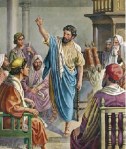 In my previous blog I began a brief analysis of one of Paul’s most difficult passage. I noted widespread statements by church fathers and contemporary scholars confessing its difficulty. Then I noted that despite this, dispensationalism employs this passage as one of its foundations for its distinctive temple-theology. A theology built on difficult passages is not a stable system.
 Postmillennial Worldview
Recent comments