Category Archives: Objections

POSTMILLENNIALISM AND THE DAYS OF NOAH (1)

PMW 2020-023 by Kenneth L. Gentry, Jr.

A reader sent me a question regarding postmillennialism’s glorious hope in light of Jesus’ statement in Matthew 24:37–39. Jesus’ statement reads:

“For the coming of the Son of Man will be just like the days of Noah. For as in those days before the flood they were eating and drinking, marrying and giving in marriage, until the day that Noah entered the ark, and they did not understand until the flood came and took them all away; so will the coming of the Son of Man be.” (Matt. 24:37–39)

The problem we face

This statement appears to undermine postmillennial expectations for the improvement of world conditions under the spread of the gospel. In fact, it seems actually to teach the opposite: that history will descend into wholesale corruption equivalent to the worldwide debasement experienced in the days of Noah. Continue reading

AL MOHLER DISSES POSTMILLENNIALISM

PMW 2019-081 by Gary DeMar (American Vision)
Al Mohler has written “Evolving Standards of Decency? How Progressivism Reshapes Society.” My question: “Where were Christians when the Supreme Court codified “evolving standards of decency”? Mohler writes that we share with progressives a belief “in a linear view of history…. We also believe that history doesn’t go forward and backward in time. But we do not believe as Christians that the world is always getting better and better. That’s actually a deformation of Christian doctrine. The reality is that the biblical worldview is so honest about the power of sin that we come to understand that societies do move forward in some terms economically, politically, certainly technologically, but they don’t move forward uniformly certainly when it comes to morality.” Continue reading

REV 17 AND THE BEAST AS “AN EIGHTH” (2)

PMW 2018-009 by Kenneth L. Gentry, Jr.

In my previous article I began focusing on Rev. 17:11 which reads:

“The beast which was and is not, is himself also an eighth and is one of the seven, and he goes to destruction.”

I pointed out that the idea of the “eighth” pictures a resurrection, a new beginning. But now we must ask: Who is this “eighth,” this resurrection of the beast?

In Rev. 17:9–10 we read:

“Here is the mind which has wisdom. The seven heads are seven mountains on which the woman sits, and they are seven kings; five have fallen, one is, the other has not yet come; and when he comes, he must remain a little while.”

Continue reading

REV 17 AND THE BEAST AS AN EIGHTH (1)

PMW 2017-008 by Kenneth L. Gentry, Jr.

This is the second in a three-part study of the confusing verses in Revelation 17. I now move on to consider Rev. 17:11 and:

The eighth among seven?

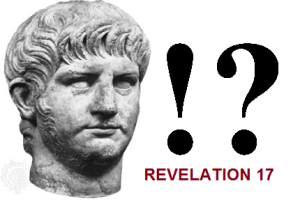
In previous studies I argued that Nero is the personification of the beast. The evidence is quite clear and most compelling. But in Revelation 17:11 we read a statement which causes some difficulties with this interpretation. In fact, it “presents all interpreters with a real difficulty.” [1]

And the beast which was and is not, is himself also an eighth, and is one of the seven, and he goes to destruction. (Rev 17:11)

Of course, the main difficulties have been solved for I show above what he means by “the beast which was and is not” (cf. Rev 17:8). But now who is this “eighth”? How can there be an eighth in a series of seven? And how is he “one of the seven”? Continue reading

REV 17 AND THE BEAST THAT “WAS, IS, AND IS NOT”

PMW 2018-007 Kenneth L. Gentry, Jr.

In previous studies I presented evidence that the sixth head of the seven-headed beast of Revelation was Nero Caesar, the sixth emperor of Rome. Thus, in Revelation the sixth head of the beast represents the then reigning sixth head/king of Rome. But now we must deal with a passage that seems to contradict this identification. In Revelation 17 the interpreting angel states that:

“The beast that you saw was, and is not, and is about to come up out of the abyss and go to destruction. . . . The beast which was and is not, is himself also an eighth and is one of the seven, and he goes to destruction.” (Rev. 17:8, 11)

As we focus on these statements, two important questions arise: (1) What is the significance of the beast being the one who “was and is not, and is about to come”? Is this one of the many instances of the beast’s divine pretensions, wherein he parodies divine eternality, which is the view of most commentators? And (2) does this description undercut the early-date position and preterist approach by declaring the beast (Nero) is already dead when John writes? After all, the angel states that he “was and is not [ouk estin].” Continue reading

THE NARROW GATE AND THE POSTMILLENNIAL HOPE

narrow-gatePMT 2016-072 by Kenneth L. Gentry, Jr.

Introduction

I am frequently asked how postmillennialism can stand since Jesus speaks of the narrow gate to salvation. This is certainly a reasonable question, because it is a biblical one.

Inquirers often challenge me: I just can’t imagine this present world becoming a Christian majority at any point, especially in light of Christ’s wide and narrow gates and many being called, but few chosen, etc. I don’t see that at all. Never has the world been a friend of God and I don’t see a future scene like that at all in Scripture.

This is an important question. Let’s consider how we can resolve the theoretical problem. Continue reading

POSTMILLENNIALISM AND PERSECUTION

StrengthPMT 2015-133 by Kenneth L. Gentry, Jr.

Quite frequenty critics of postmillennialism will go to NT passages such as Matt 10:22 to discredit postmillennialism’s long-term optimism. That passage reads:

“You will be hated by all because of My name, but it is the one who has endured to the end who will be saved.”

Since postmillennialism expects a future in which Christianity reigns supreme, and in which righteousness and peace will prevail throughout the world, texts such as this one must be explained. Postmillennialism cannot be true if Christians will always be hated and the only hope we have is our bare endurance. Continue reading