Category Archives: Millennium

POSTMILLENNIALISM AND SATAN’S LOOSING

PMW 2025-088 by Kenneth L. Gentry, Jr.

Satan loosedI received this question from a reader. I think it might be helpful to other blog readers for me to answer it. Here is the question:

“As I’ve been reading your whole series on Revelation, I have come realize more and more how much we A-Mill Folks agree with you Post Mill Guys. But how does the loosing of Satan coincide with your postmillennial preterist hermeneutic? This seems to be the only area where I have a problem from the Preterist Viewpoint. Please advise where this fits.”

This is a good question that touches on an issue that seems to confront both preterism (Satan’s loosing occurs after 1000 years in a book set to transpire shortly) and to undermine the idea of the universal conquest of the gospel expected by postmillennialism. Postmillennialism is a theological construct whereas preterism is a methodology, rather than a theology. Both merge well in my understanding of postmillennialism. Let me explain. Continue reading

THE MILLENNIUM EXAGGERATED (2)

MisdirectionPMW 2025-085 by Kenneth L. Gentry, Jr.

This is the second and concluding study on the exaggerated role of the millennium in eschatological studies. It is important for you to read the preceding article before jumping into this one. I am arguing that John’s half-chapter is given too much place in prophetic discussions. This has led many Christians to misunderstand the function of the millennium in Revelation, as well as its length.

Properly understood, the thousand-year time frame in Revelation 20 represents a long and glorious era and is not limited to a literal 365,000 days. Continue reading

THE MILLENNIUM ABUSED (1)

Millennium exaggeratedPMW 2025-084 by Kenneth L. Gentry, Jr.

I am beginning a two-part series on the millennium. I will be highlighting how its significance in eschatological discussions is exaggerated. I am calling for balance on this issue.

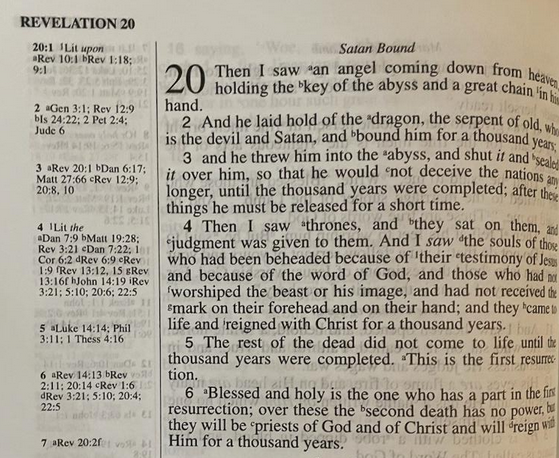
Revelation 20:1–6 present us with a time frame that plays a far greater role in the eschatological debate than it warrants. Oddly, Stanley J. Grenz asserts of “evangelical postmillennialists” that “as a millenarian viewpoint, of course, it builds its primary case from a futurist interpretation of John’s vision.” This is simply not so. Continue reading

THE END OF THE MILLENNIAL REIGN

PMW 2025-83 by Milton S. Terry (Biblical Apocalyptics)
Gentry note: In this article I am presenting some helpful postmillennial material from Milton S. Terry (1840–1914) as presented in his book, Biblical Apocalyptics. Below I will be directly citing his material, except that I will break it into smaller paragraphs (as I noted was necessary in my last article).

So here is a direct citation of Biblical Apocalyptics, pp. 453–54:

The five scenes of the millennial period thus far presented form a closely connected series and are to be thought of, not as chronologically successive, but rather as simultaneous and supplementary in their logical relations. Thus, the moving forth of the great Conqueror (19:11–16) results in the great slaughter of the numerous enemies of God (19:17,18); this involves at the same time the destruction of the beast and the false prophet (19:19–21) and the binding of Satan (20:1–3). These are different aspects of a world-wide conquest, for the Messianic King of Old Testament prophecy is to “have dominion from sea to sea and from the river unto the ends of the earth” (Psalm 72:8). Continue reading

RE-IMAGINING THE MILLENNIUM (4)

Heavenly hostPMW 2025-07 by Kenneth L. Gentry, Jr.

I am continuing a study of that pesky passage, Revelation 20, which so dominates eschatological discussions. I believe that this passage is almost totally misconstrued by the large majority of scholars and lay readers, as I have been noting. But now I am ready for my last comments on the matter as we come to John’s statement regarding:

The Rest of the Dead

Now having changed my view regarding the occupants on the thrones of Revelation 20:4, another issues arises: Who are “the rest [hoi lopoi] of the dead” (Rev 20:5) that are being set over against the enthroned ones? Since Revelation 20:1–6 is linked with Revelation 19:11–21, John’s context offers a clue to understanding “the rest of the dead” who “did not come to life until the thousand years are completed” (Rev 20:5). We should interpret this group contextually in terms of John’s literary flow and dramatic story-line. Continue reading

RE-IMAGINING THE MILLENNIUM (3)

MartyrPMW 2025-006 by Kenneth L. Gentry, Jr.

I am continuing a study on Revelation 20 and the “millennium.” This passage is radically misinterpreted virtually throughout contemporary discussions. So, here I continue my thoughts from my last posting.

The Explanation Offered

My three changes appear in two places in the text. Though seemingly small, they carry radical implications. In my view, the eschatological debate (the “millennial” views) does not need to come to Revelation 20 at all. It is better waged elsewhere in Scripture — almost everywhere else in Scripture (hence the size of my He Shall Have Dominion: A Postmillennial Eschatology, which builds up the postmillennial eschatology from a wide range of Old Testament and New Testament Scriptures). Postmillennialism and amillennialism certainly do not depend on Revelation 20, though dispensationalism and premillennialism absolutely do. In fact, Revelation 20, though serving as the foundational passage for premillennialism and dispensationalism, actually creates irresoluble problems that undermine those systems. Continue reading

RE-IMAGINING THE MILLENNIUM (2)

Revelation 20PMW 2025-005 by Kenneth L. Gentry, Jr.

I am continuing some reflection upon the millennial passage in Revelation 20. Rightly or wrongly, this text dominates the eschatological discussion. Before reading this article, you will need to read the preceding one.

The Issues Impacted

First, I originally held that two groups were in view Revelation 20:4. I held the common Augustinian view that the martyrs represent deceased Christians in heaven (the Church Triumphant) and the confessors represent living saints on the earth (the Church Militant). And together these two groups picture all Christians throughout Church history. I no longer accept this interpretation.

Second, I also previously held that the fact that they “came to life and reigned with Christ” (Rev 20:4c) portrayed the new birth experience, where the Christian arises from spiritual death to sit with Christ in heavenly places. I still believe this doctrinal position, for it is taught in various places in Scripture (see especially Eph 2). But I do not believe this is a proper exegetical position here in Revelation 20. In other words, I now believe that this view is good theology but bad exegesis — if we try to draw it from Revelation 20.
Continue reading