Category Archives: Millennial Views

POSTMILLENNIALISM AND SATAN’S LOOSING

PMW 2025-088 by Kenneth L. Gentry, Jr.

Satan loosedI received this question from a reader. I think it might be helpful to other blog readers for me to answer it. Here is the question:

“As I’ve been reading your whole series on Revelation, I have come realize more and more how much we A-Mill Folks agree with you Post Mill Guys. But how does the loosing of Satan coincide with your postmillennial preterist hermeneutic? This seems to be the only area where I have a problem from the Preterist Viewpoint. Please advise where this fits.”

This is a good question that touches on an issue that seems to confront both preterism (Satan’s loosing occurs after 1000 years in a book set to transpire shortly) and to undermine the idea of the universal conquest of the gospel expected by postmillennialism. Postmillennialism is a theological construct whereas preterism is a methodology, rather than a theology. Both merge well in my understanding of postmillennialism. Let me explain. Continue reading

A SUMMARY OF MILLENNIAL VIEWS

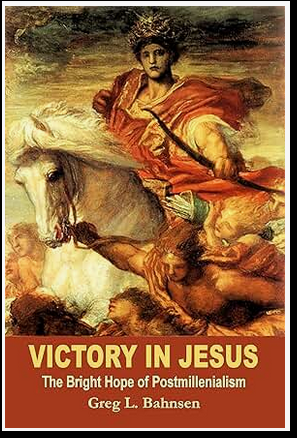
PMW 2025-028 by Greg L. BahnsenVictory in Jesus

Gentry note: The following material is taken from Greg L. Bahnsen’s valuable study, “The Prima Facie Acceptability of Postmillennialism,” which is reprinted in his posthumously published collection of articles and lectures on postmillennialism as the book: Victory in Jesus: The Bright Hope of Postmillennialism. I highly recommend this book as a brief introduction to postmillennialism. The following is by Dr. Bahnsen.

The Distinctive Essentials of the Three Positions
In the preceding section of this discussion there was occasion to note that postmillennialism had been misrepresented in its basic position. This causes us to ask, just what are the fundamental differences among premillennialism, amillennialism, and postmillennialism? That is, what is the distinctive outlook of each position, its essential and central characteristic?

Here many people are prone to be misled, becoming entangled in questions which are subsidiary and indecisive with respect to the basic dogmatical outlook of a pre-, a-, and postmillennialism. What this means is that they take important exegetical issues pertaining to the millennial question and attempt to use them to delineate the three fundamental theological positions; however, these particular exegetical issues are not decisive for the central and general claims of the school of thought. Perhaps some examples would be helpful.
Continue reading

DISPENSATIONALISM’S PROBLEM WITH REV 20

PMW 2022-083 by Kenneth L. Gentry, Jr.
Millennial cubeDispensationalists are prone to boast that Revelation 20 presents their system in clear and certain terms. They often declare that they can go to one text of Scripture and find their system. Unfortunately, this is not the case. This text actually presents them with serious problems. Consider the following.


First, the concluding period of earth history, which experiences the glorious victory of Christ, is a thousand years long, but its length appears in only one chapter of the entire Bible. Continue reading

FOUR BASIC MILLENNIAL CAMPS

PMW 2020-081 by Kenneth L. Gentry, Jr.

INTRODUCTION

Theological Terms

The technical theological term that describes the study of Bible prophecy is: “eschatology.” It is based on two Greek words: eschatos, which means “end, last”; logos, which means “word or study.” Thus, “eschatology” is technically “the study of the last things.”

Another technical theological term that has become so popular in modern discussions is: “millennium.” It is based on the Latin: mille, “thousand”; and annum, “year.” Thus, the term means “thousand years.” It is derived from Rev. 20:1–6, the only place in Scripture which associates 1000 years with Christ’s rule.

Basic Positions

In attaching prefixes to the term “millennium” we link the second coming of Christ to the millennium that is mentioned in Rev. 20: amillennial, premillennial, and postmillennial. These three most basic positions may be briefly defined in terms of their chronology as follows: Continue reading

PRETERISM AND POSTMILLENNIALISM?

PMT 2015-038 by Kenneth L. Gentry, Jr.

From time to time I receive a question regarding the difference between preterism and postmillennialism. Some folks are confused as to whether they contradict each other or whether they are speaking of the same thing. Let me briefly distinguish the two theological concepts.

Preterism
The word “preterist” is the transliteration of a Latin word that means “passed by.” The orthodox preterist sees certain passages as referring to the destruction of Jerusalem and the temple in AD 70, though many evangelicals understand these to be speaking of the second coming of Christ at the end of history. Continue reading

MILLENNIAL PREFIXES

PrefixesPMT 2016-007 by Kenneth L. Gentry, Jr.

In my two previous articles, I pointed out the fact of gradual development of eschatological positions. A consequence of this gradualistic development is that the modern terms we use for the millennial views will not be found in antiquity. But they are helpful for us to sort out the eschatological options before us as evangelical Christians. Continue reading

INTERVIEW ON THE END TIMES

Left BehindPMT 2014-128 by Kenneth L. Gentry, Jr.

An interview of me made recently for an introduction to a conference engagement.

1. People now days are fascinated with “the end times.” And with the reboot of the Left Behind series, discussions about the end times will continue to increase. No doubt, we will hear more talk about things like the 7-yr tribulation, the rapture, the mark of the beast, etc. These are key parts to the theology that undergirds the Left Behind books and movie. But what most people don’t realize is that this theology, known as Dispensationalism, is actually a relatively new way to read Scripture. That is, up until only about 150 years ago, no Christian on record ever believed some of things that is depicted in the Left Behind series. Could you comment more on this fact?

Dispensationalism arose in the 1830s in England, about the same time as Mormonism was arising in America, and not long before the Jehovah’s Witnesses. It was a time of much prophetic speculation and expectation. John N. Darby created dispensationalism as a prophetic outlook that eventually became a whole theology. He fully expected the Lord’s return in his lifetime, which ended 130 years ago (in 1882). It has constantly been frustrated with wrong predictions of the Rapture, such as Hal Lindsey’s 1980 book “The 1980s: Countdown to Armageddon” and his 1996 book: “Planet Earth 2000: Will Mankind Survive.” Continue reading