Category Archives: Israel

JOHN, JESUS, AND THE JEWS

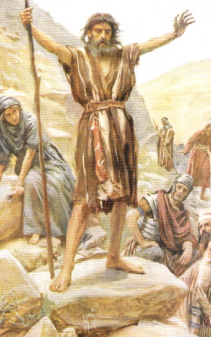
PMW 2024-045 by Kenneth L. Gentry, Jr.John Baptist preaching
We are continuing our survey of the opening chapters of Matthew, showing how Israel is presented as opposed to God’s will and the Gentiles will gradually begin entering God’s kingdom.

In chapter three Matthew presents us with the first sermon recorded in his Gospel. It is by Jesus’ forerunner John the Baptist, who introduces the Messiah to Israel. The very first words we hear out of John’s mouth are foreboding: “Repent, for the kingdom of heaven is at hand” (Matt. 3:1). These are also Jesus’ first words in his ministry, as recorded by Matthew: “Repent, for the kingdom of heaven is at hand” (4:17). John and Jesus are confronting Israel with her sin and calling her to repent (cf. Matt. 23:37).

In this sermon John warns the Jewish religious leaders (Matt. 3:7) that they need to “bring forth fruit in keeping with repentance” (v. 8). Later we will discover that Israel does not bring forth the fruit of repentance, for Jesus acts out a prophetic curse against fruitless Israel (21:19) and declares that he will secure another nation to bear the proper fruit (21:43). Continue reading
MATTHEW’S EARLY NEGATIVE EXPECTATIONS

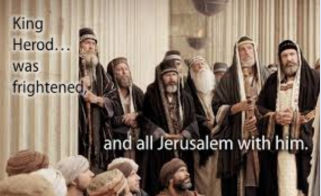
Jerusalem afraidPMW 2024-043 by Kenneth L. Gentry, Jr.

When reading Matthew, we should notice its narrative flow. Especially its presentation of Israel and her leaders as they oppose Christ from the very beginning. This flow leads inexorably to the Olivet Discourse and the judgment on the Temple.

MATTHEW 2:1
In Matthew 2:1 the Apostle reports that men “from the east” come to worship Jesus. This historical information is unique among the Gospels and is designed to stress Matthew’s particular thematic concern regarding the demise of Israel and the arising of the Gentiles in God’s plan. “The magi’s actions recall scenes such as those in Isa 60 and Ps 72 in which Gentiles bring gifts to acknowledge the final establishment of God’s reign on Mount Zion.” [1]

Because these Gentiles appear, “all Jerusalem [the capital of Israel and the holy city of the Jews] was troubled” at this news (2:3b). Thus, Matthew includes the story of Herod and the arriving of the Magi to show that “in this narrative the Jews and their king are ranged against the infant Jesus, but Gentiles do him homage.” [2] Continue reading

JESUS AND THE LAND

Promised Land 2PMW 2024-030 by Kenneth L. Gentry, Jr.

The question of “the Land” is of paramount importance for the dispensationalist. Dispensationalism is a whole systematic theology — not simply an eschatology — that has as one of its chief cornerstones the predominant role of Israel in God’s plan for history. If the way to a man’s heart is through his stomach, the way to a dispensationalist’s heart is through the Land of Israel. Unfortunately, the whole New Testament contradicts it.

The Land question is also of enormous significance in the current wider world of politics and international relations. Many Christians consider themselves to be “Christian Zionists,” and strongly urge Western governments to support Israel — regardless.
Continue reading

ABRAHAMIC COVENANT & THE LAND

Israel and the worldPMW 2024-013 by Kenneth L. Gentry, Jr.

A quick summation of Genesis 12 and 13 regarding the precovenantal promise of God to Abraham.

Gen. 12:1a
Now the LORD said to Abram
At this point the Genesis narrative moves out of primeval history and into patriarchal history toward which it has been heading since Gen. 1:1. Like Adam and Noah before him, Abraham initiates a new beginning in advancing God’s plan in history. Although the Abrahamic Covenant will not be established until a little later (15:17–21), here we have the pre-covenantal promise that leads to it. God speaks to Abraham through direct, objective revelation (cp. Gen. 12:7; 17:1; 18:1; Acts 7:2).
Continue reading

ISRAEL AND GOD’S PEOPLE (3)

Isaiah and jesusPMW 2024-012 by Kenneth L. Gentry, Jr.

I have offered two articles on Israel in my two previous installments of this study. I am currently rebutting the dispensational view of Scripture and theology, which presents a Judeo-centric focus. I will continue with my critique.

4. The new covenant church is not a mystery wholly unrevealed

Based on Ephesians 3, dispensationalist argue that the new covenant era, international church was a mystery that is “completely unrevealed in the Old Testament.” Certainly the clarity of the revelation of God’s expanding people increases in the New Testament. But that revelation was, in fact, given in the Old Testament.

Let’s look at dispensationalism’s key passage for this concept. Ephesians 3:5–6 reads: “which in other generations was not made known to the sons of men, as it has now been revealed to His holy apostles and prophets in the Spirit; to be specific, that the Gentiles are fellow heirs and fellow members of the body, and fellow partakers of the promise in Christ Jesus through the gospel.” We have already seen that the Old Testament anticipated this. Now we must note that Ryrie and the dispensationalists misread Paul’s statement. Consider the following.

To begin with, we must discern for whom the revelation was a mystery. Ephesians 3:3–6 reads: “By revelation he made known unto me the mystery . . . which in other ages was not made known unto the sons of men.” Thus, the “mystery” now revealed was not previously made known to the “sons of men,” that is, the Gentiles. It was made known to the “sons of Israel” through their prophets. The phrase “sons of Israel” appears often in the Old Testament (e.g., Exo 3:3, 14–15; 4:31; 5:14–15; 6:5; etc.), setting them over against the rest of the world, the Gentiles, the “sons of men.” When God speaks to Ananias he distinguishes between “the Gentiles” and “the sons of Israel” (Acts 9:15; cp. Luke 2:32; Acts 4:27).
Continue reading

INTERPRETING MESSIANIC PSALMS

PMW 2023-099 R. T. France

I am reading R. T. France’s excellent work, Jesus and the Old Testament. He has much that is helpful for the postmillennialist and the (orthodox) preterist. Below I will quote three paragraphs that ought to be an encouragement to my readers. These present to us a helpful hermeneutic approach to many Old Testament passages.

I am sure France did not intend them as postmillennial observations, but they do help us in understanding the postmillennial hope nonetheless. Continue reading

MESSIAH AND ISRAEL’S “RETURN”

PMW 2023-091 by Kenneth L. Gentry, Jr.Global map

Isa. 43:5–7 is a glorious prophecy. It reads:

“Fear not: for I am with thee: I will bring thy seed from the east, and gather thee from the west; I will say to the north, Give up; and to the south, Keep not back: bring my sons from far, and my daughters from the ends of the earth; Even every one that is called by my name: for I have created him for my glory, I have formed him; yea, I have made him.”

Despite initial appearances, these verses do not refer solely to Israel’s return from the Babylonian dispersion. Rather they refer beyond historic Israel to spiritual Israel gathered out from the nations through the worldwide spread of the gospel (Psa. 22:27–28; Isa. 2:2–4; Matt. 28:18–20; John 12:32; 1 Cor. 15:24–26). Isaiah is looking beyond the Babylonian exile to ultimate eschatological issues. Israel’s return from exile was an historical event that served as a typological pointer to worldwide redemption.

Continue reading