Category Archives: Israel

POSTMILLENNIALISM AND ISRAEL (2)

PIsrael (2)MW 2024-092 by Kenneth L. Gentry, Jr.

In my last posting I began consideration of an important debate topic separating dispensationalism from most of the rest of evangelical theology: the question of Israel. In this article I am beginning a brief survey showing what Scriptures teaches, while setting it over against dispensationalism’s view. How does the Bible see Israel?

1. THE OT ANTICIPATES THE EXPANSION OF GOD’S PEOPLE

The Old Testament writers foresee a time in which God will expand his people by bringing blessings on the Gentiles and including them within Israel. This hope is established early in Israel’s formative history when God establishes his covenant with Abraham: “As for Me, behold, My covenant is with you, / And you shall be the father of a multitude of nations” (Gen 17:4).

Perhaps the clearest and more remarkable expression of this appears in Isaiah 19:23–25. There we read that God will include Israel’s greatest enemies in his covenant:

“In that day there will be a highway from Egypt to Assyria, and the Assyrians will come into Egypt and the Egyptians into Assyria, and the Egyptians will worship with the Assyrians. In that day Israel will be the third party with Egypt and Assyria, a blessing in the midst of the earth, whom the Lord of hosts has blessed, saying, ‘Blessed is Egypt My people, and Assyria the work of My hands, and Israel My inheritance.’”
Continue reading

POSTMILLENNIALISM AND ISRAEL (1)

Israel (1)PMW 2024-091 by Kenneth L. Gentry, Jr.

Because of the prominence of dispensationalism and the Left Behind phenomenon — and whatever moon is now showing –– in evangelical circles, it is important for us to reflect on a fundamental emphasis in contemporary prophecy discussions: Israel. This is important in that Israel plays a prominent role in Scripture. But what is her role?

As all Christians know, throughout most of the Old Testament Israel is God’s special people — beginning in seed form with the calling of Abraham in Genesis 12. She is God’s elect nation (Deut 7:7–8 ; 10:15; Zech 2:8; Rom 3:1–3; 11:1) and the focal point of his redemptive mercies in history (Deut 4:7–8; Psa 147:19–20; Amos 3:2; Rom 9:4). Because of her commanding presence in old covenant history and her central role in Old Testament prophecy she becomes a crucial issue in understanding the Bible.
Continue reading

JESUS ENTERS JERUSALEM

PMW 2024-059 by Kenneth L. Gentry, Jr.Triumphal entry

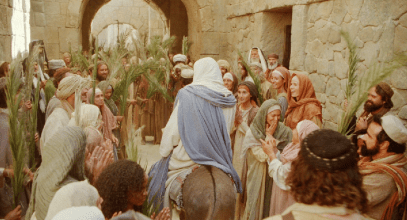
I have been doing a few surveys in Matthew’s Gospel. These are showing the failure of Israel and the expectation of Gentile salvation. I will skip now to the end of Matthew to continue this survey. By this means, I am tracing Matthew’s highly-structured presentation of Jesus’ ministry to show how it leads up to the Olivet Discourse in Matthew 24–25. Now in Matthew 21:10 Jesus enters Jerusalem (for the first time in this Gospel). Jerusalem is the capital of Israel, the home of God’s temple, the seat of the high priesthood and their religious rule over Israel.

Matthew is clearly organizing his material to emphasize Jesus’ climactic entry into Jerusalem to confront and rebuke Israel’s religious authorities. As noted above, this confrontation has been brewing since Matthew 16:21: “From that time Jesus Christ began to show His disciples that He must go to Jerusalem, and suffer many things from the elders and chief priests and scribes, and be killed, and be raised up on the third day” (cp. 20:18). Continue reading

MATTHEW READ WRONGLY

PMW 2024-051 by Kenneth L. Gentry, Jr.Confused man

My brief survey of Matthew’s Gospel is important for setting up the broader literary context of the Olivet Discourse with its warning of Israel’s judgment in AD 70. Both Jesus’ regular teaching and frequent actions, as well as Matthew’s overall historical progression and literary presentation powerfully highlight God’s approaching wrath upon Israel. This understanding of Matthew is so clear as to be undeniable. In fact, Lowery — though a dispensationalist — can even speak of “the strong denunciation of Israel that pervades the gospel” and which employs a “strong polemic against Israel.”[1]

This presentation of Israel’s disturbing spiritual condition and foreboding historical expectation is so obvious, strong, frequent, and widespread that many liberal historians and theologians (wrongly) charge Matthew’s Gospel as a prime source of anti-Semitism in the world. Continue reading

JESUS REJECTED TURNS TO THE GENTILES

PMW 2024-050 by Kenneth L. Gentry, Jr.Jesus commissions

I am now at the conclusion of Matthew’s Gospel. Though I did not survey the entire Gospel, I showed it’s beginning and ending provided the rationale for the destruction of the temple and the judgment of Israel. And in the process of Israel’s rejecting their Messiah, we have seen evidence for the inclusion of the Gentiles. This last point comes to full expression in the last words of the Gospel.

Matthew 27

In Matthew 27:1 “all the chief priests” discuss with the “elders of the people” how to kill Jesus. In verses 11–12 Jesus appears before the Roman procurator Pilate where the chief priests and elders accuse him. In verses 15–21 when Pilate tries to release Jesus, the chief priests resist him: “but the chief priests and the elders persuaded the multitudes to ask for Barabbas, and to put Jesus to death” (v. 20). When Pilate attempts again to release him, “they kept shouting all the more, saying, ‘Let Him be crucified’” (v. 22). Continue reading

JOHN, JESUS, AND THE JEWS

PMW 2024-045 by Kenneth L. Gentry, Jr.John Baptist preaching

We are continuing our survey of the opening chapters of Matthew, showing how Israel is presented as opposed to God’s will and the Gentiles will gradually begin entering God’s kingdom.

In chapter three Matthew presents us with the first sermon recorded in his Gospel. It is by Jesus’ forerunner John the Baptist, who introduces the Messiah to Israel. The very first words we hear out of John’s mouth are foreboding: “Repent, for the kingdom of heaven is at hand” (Matt. 3:1). These are also Jesus’ first words in his ministry, as recorded by Matthew: “Repent, for the kingdom of heaven is at hand” (4:17). John and Jesus are confronting Israel with her sin and calling her to repent (cf. Matt. 23:37).

In this sermon John warns the Jewish religious leaders (Matt. 3:7) that they need to “bring forth fruit in keeping with repentance” (v. 8). Later we will discover that Israel does not bring forth the fruit of repentance, for Jesus acts out a prophetic curse against fruitless Israel (21:19) and declares that he will secure another nation to bear the proper fruit (21:43). Continue reading

MATTHEW’S EARLY NEGATIVE EXPECTATIONS

Jerusalem afraidPMW 2024-043 by Kenneth L. Gentry, Jr.

When reading Matthew, we should notice its narrative flow. Especially its presentation of Israel and her leaders as they oppose Christ from the very beginning. This flow leads inexorably to the Olivet Discourse and the judgment on the Temple.

MATTHEW 2:1
In Matthew 2:1 the Apostle reports that men “from the east” come to worship Jesus. This historical information is unique among the Gospels and is designed to stress Matthew’s particular thematic concern regarding the demise of Israel and the arising of the Gentiles in God’s plan. “The magi’s actions recall scenes such as those in Isa 60 and Ps 72 in which Gentiles bring gifts to acknowledge the final establishment of God’s reign on Mount Zion.” [1]

Because these Gentiles appear, “all Jerusalem [the capital of Israel and the holy city of the Jews] was troubled” at this news (2:3b). Thus, Matthew includes the story of Herod and the arriving of the Magi to show that “in this narrative the Jews and their king are ranged against the infant Jesus, but Gentiles do him homage.” [2] Continue reading