Category Archives: Interpretation

“THE FINAL TRIUMPH OF GOD” REVIEW

PMW 2025-062 by Kenneth L. Gentry, Jr.

James P. Ware’s The Final Triumph of God: Jesus, the Eyewitnesses, and the Resurrection of the Body in 1 Corinthians 15 (Eerdmans, 2006) is one of the most compelling and insightful books I have read in many years. It is absolutely spell-binding in its careful exegetical observations regarding the physical resurrection of the body in 1 Corinthians 15. And in our day of the arising of a new neo-Gnosticism (!) it is a “must have” book. I highly recommend this book to anyone interested in Christ’s physical, bodily resurrection or our own. And to any who might want to witness to hyper-preterists (or liberals who hold the views). This might be a good tract to  give them.

Instead of my own personal review, I will simply cite most of the Foreword by A. Andrew Das. He focuses on the essence of the book and the importance of Ware’s own triumph! Continue reading

HYPERPRETERISM VS. THE GOSPEL (3)

PMW 2025-060 by Kenneth L. Gentry, Jr.

Introduction
This is my third and final article in a short series on 1 Corinthians. I am showing that Paul is warning the Corinthians that denying the physical resurrection ends up denying the gospel. Thus, 1 Corinthians should serve as a warning to any Christians being tempted by hyper-preterism and its neo-Gnostic spiritual resurrection of the body. Sadly, hyper-preterists who teach a “spiritual” resurrection instead of a “bodily” resurrection are adopting humanism over biblicism.

The wisdom of the world
Once again, I am beginning with Paul’s first major section opening the main body of his epistle: 1 Cor. 1–4. In this section, which is the foundation for the whole epistle, Paul is warning against the wisdom of the world (i.e., that of fallen man) as he sets it over against the wisdom of God, which is found in Paul’s preaching. In 1 Cor. 3:18 he expresses concern about some “among” the Corinthians who are teaching the wisdom of the world in the church there [1]:

“Let no man deceive himself. If any man among you [en humin] thinks that he is wise in this age [sophosen to aioni touto], he must become foolish, so that he may become wise. For the wisdom of this world [sophia tou kosmou toutou] is foolishness before God. For it is written, ‘He is the one who catches the wise in their craftiness’; and again, ‘The Lord knows the reasonings of the wise, that they are useless.’ So then let no one boast in men.” Continue reading

HYPERPRETERISM VS. THE GOSPEL (2)

PMW 2025-059 by Kenneth L. Gentry, Jr.

Introduction
This is the second in a three-part series on 1 Corinthians that will be showing that Paul warns that a denial of the physical resurrection ends up denying the gospel of Jesus Christ. This should be a deep concern for any young theologue toying with hyper-preterism and its neo-Gnostic convictions. This charge of neo-Gnosticism arises due to hyper-preterists denying the physical nature of the resurrection body, arguing that the resurrected body is composed of spirit.

In this series I am slowly building my case from Paul’s first letter to the Corinthians. Paul was no hyper-preterist! Continue reading

NEW LEXICON SUPPORTS PRETERISM!

PMW 2025-052 by Kenneth L. Gentry, Jr.

Introduction
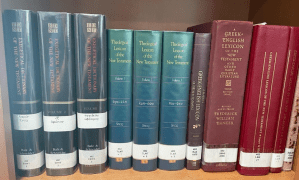
The academic world has recently released a new, updated Greek-English lexicon that is certain to replace the standard lexicons currently in use today. Research in ancient Greek continues unabated at major research universities, with more powerful research tools providing deeper insights into ancient culture and language. And this one will surely displace the universally accepted standard lexicons, such The Liddell-Scott-Jones Lexicon, Thayer’s Greek-English Lexicon, and the Bauer-Danker-Arndt-Gingrich Greek-English Lexicon.

The current batch of Greek-English lexicons has proven helpful to scholars for years. But some academic questions remained as linguistic hurdles impeded fully understanding the Greek, especially New Testament Koine Greek. Now we are witnessing a major upheaval with this publication of the latest, upgraded lexicon, which is invested more strongly in AI-enhanced research.

This new lexicon is called, quite appropriately, New Lexicon of the 21st Century and Beyond. And it certainly will be a tremendous boon for scholars — especially for preterist scholars, as we will see. Plus with the new layout and 100% computer-generated text, the cost of this lexicon will fall well below those currently available — perhaps even 50% less. Let me explain how this can be in this review. Continue reading

UNDERSTANDING COLLAPSING UNIVERSE PROPHECIES

PMW 2025-016 by Kenneth L. Gentry, Jr.Meteors

Two Errors ….

A number of prophetic passages (especially in the OT) speak of the universe collapsing. This has caused serious theological problems for two opposing eschatological schools.

Dispensationalism cannot interpret these passages in context because they approach them in a fully-literalistic sense. Thus they argue, these passages must be pointing solely to the distantly future second coming of Christ. Dispensationalists are committed to a half-truth in this interpretation, as I will show.

But then there is the hyper-preterist movement that interprets these passages as solely symbolic. They deem the falling-star passages as symbols of collapsing government. And these passages usually point to the collapse of Israel’s government under God’s wrath and judgment. Thus, they interpret these passages as picturing the coming AD 70 judgment of old covenant Israel. Hyper-preterists are committed to a half-truth also. Continue reading

PRETERISM, CONCERN, AND CONFUSION

ConfusionPMW 2024-086 by Kenneth L. Gentry, Jr.

I recently had a reader, whose name is “AJ,” express his concerns over preterism as presented on my blogsite. His comments were posted about my one-sentence answer to a brief question he asks regarding Revelation 18:3 and the merchants of the earth. Then he responds at length to that one-sentence reply. I will quote his two comments and my replies. Hopefully these will be of interest not only to AJ but to others.

AJ wrote:

“I respectfully have a question I hope you can answer. I have been researching preterism Versus Futurism and have a Litany of questions. But one I would like to ask here would you reference in your aforementioned quote of Revelations Is the merchants who stand Aloft at sea lamenting the destruction of the Great city. I know it goes on to say all of the merchants in Kings of the Earth grew wealthy from her, yet my research into the economic effects of Jerusalem in the first century ad indicate it had a very, very minor role in trade and certainly did not build the wealth of all the merchants and nations of the earth. There were a couple of coastal cities In that region that Much come up much more important for trade, so how can reasonably these verses about Jerusalem making the whole world wealthy be true? Thank you for taking the time to answer my question. God bless you.”
Continue reading

JESUS ENTERS JERUSALEM

PMW 2024-059 by Kenneth L. Gentry, Jr.Triumphal entry

I have been doing a few surveys in Matthew’s Gospel. These are showing the failure of Israel and the expectation of Gentile salvation. I will skip now to the end of Matthew to continue this survey. By this means, I am tracing Matthew’s highly-structured presentation of Jesus’ ministry to show how it leads up to the Olivet Discourse in Matthew 24–25. Now in Matthew 21:10 Jesus enters Jerusalem (for the first time in this Gospel). Jerusalem is the capital of Israel, the home of God’s temple, the seat of the high priesthood and their religious rule over Israel.

Matthew is clearly organizing his material to emphasize Jesus’ climactic entry into Jerusalem to confront and rebuke Israel’s religious authorities. As noted above, this confrontation has been brewing since Matthew 16:21: “From that time Jesus Christ began to show His disciples that He must go to Jerusalem, and suffer many things from the elders and chief priests and scribes, and be killed, and be raised up on the third day” (cp. 20:18). Continue reading