Category Archives: Dispensationalism

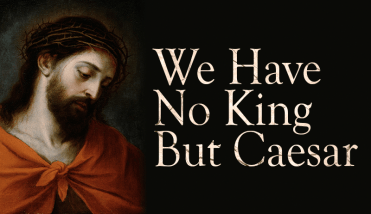
LITERALISM AND MESSIAH’S REJECTION

No KingPMW 2024-028 by Kenneth L. Gentry, Jr.

The two cornerstones of dispensationalism are: (1) Israel and the Church must be kept distinct as two separate peoples of God throughout all eternity. (2) Scripture must be interpreted literalistically unless it would lead to absurdity. Both of these foundational premises are absolutely erroneous. In this blog I will briefly demonstrate the tragedy of literalism for both first century Israel and present-day dispensationalism.
Continue reading

TEMPLE MEASURING AND EZEKIEL

PMW 2024-002 by Kenneth L. Gentry, Jr.

I appreciate the questions readers send to me. I regret that I am not able to answer them quickly, due to my schedule. However, here is one that is a favorite among dispensationalists. And it is an intriguing one.

Reader’s question:

You argue that John must be measuring an actual, historical temple in Rev 11:1-2. Yet Ezekiel measures a temple, even though it does not exist in history. This suggests that the temple does not need to exist for John to measure it. How do you explain this problem for your view?

My response:

Thanks for your perceptive question. Please consider the following response. Continue reading

DISPENSATIONALISM’S PROBLEM WITH REV 20

PMW 2022-083 by Kenneth L. Gentry, Jr.
Millennial cubeDispensationalists are prone to boast that Revelation 20 presents their system in clear and certain terms. They often declare that they can go to one text of Scripture and find their system. Unfortunately, this is not the case. This text actually presents them with serious problems. Consider the following.


First, the concluding period of earth history, which experiences the glorious victory of Christ, is a thousand years long, but its length appears in only one chapter of the entire Bible. Continue reading

FOUR BASIC MILLENNIAL CAMPS

PMW 2020-081 by Kenneth L. Gentry, Jr.

INTRODUCTION

Theological Terms

The technical theological term that describes the study of Bible prophecy is: “eschatology.” It is based on two Greek words: eschatos, which means “end, last”; logos, which means “word or study.” Thus, “eschatology” is technically “the study of the last things.”

Another technical theological term that has become so popular in modern discussions is: “millennium.” It is based on the Latin: mille, “thousand”; and annum, “year.” Thus, the term means “thousand years.” It is derived from Rev. 20:1–6, the only place in Scripture which associates 1000 years with Christ’s rule.

Basic Positions

In attaching prefixes to the term “millennium” we link the second coming of Christ to the millennium that is mentioned in Rev. 20: amillennial, premillennial, and postmillennial. These three most basic positions may be briefly defined in terms of their chronology as follows: Continue reading

DISPENSATIONALISM’S EXALTATION OF RACE

Races of worldPMW 2022-022 by Kenneth L. Gentry, Jr.

Dispensationalism is the bull in the china shop of biblical eschatology. The door needs to be opened and the bull released from the minds of earnest Christians. This will require an expose into the non-biblical nature of dispensationalism. I am continuing a series on the distortions of theology in the system.

A distinctive feature of dispensationalism is that the Millennial kingdom will be fundamentally Jewish in character, even to the point of rebuilding the temple, setting up David’s tabernacle, re-instituting the Jewish sacrificial system, and exalting the Jews: “This is the point: once Israel is restored to the place of blessing and the tabernacle of David is rebuilt, then will follow the third phase in the plan of God. That period will be the time of the millennium, when the nations will indeed by converted and ruled over by Christ” (House and Ice, Dominion Theology, 169; cp. Pentecost, Things to Come, ch. 30). Continue reading

CAN A LIBERAL BE POSTMILLENNIAL?

BlindPMW 2021-080 by Kenneth L. Gentry, Jr.

As I note on my “Definition” page on this blogsite, postmillennialism confidently anticipates a time in earth history (continuous with the present) in which the very gospel already operating will win the victory throughout the earth, fulfilling the Great Commission. “The thing that distinguishes the biblical postmillennialist, then, from amillennialists and premillennialists is his belief that the Scripture teaches the success of the great commission in this age of the church” (Greg L. Bahnsen, Victory in Jesus, 74).

Thus, we hold that the overwhelming majority of men and nations will be Christianized, righteousness will abound, wars will cease, and prosperity and safety will flourish. “It will be marked by the universal reception of the true religion, and unlimited subjection to the sceptre of Christ.” “It shall be a time of universal peace.” “It will be characterised by great temporal prosperity” (David Brown, Christ’s Second Coming, 399, 401). This causes us to “look forward to a great ‘golden age’ of spiritual prosperity continuing for centuries, or even for millenniums, during which time Christianity shall be triumphant over all the earth” (Lorraine Boettner, The Millennium, 29). Continue reading

MATTHEW 23:39, DISPENSATIONALISM & PRETERISM

PMW 2021-047 by Kenneth L. Gentry, Jr.

Matt. 23:39 is a favorite statement by Jesus that dispensationalism cling to as evidence of the future conversion of Israel. Read through their lens, it seems to state that Israel will one day be converted, and only then will the great tribulation begin (according to the order of verses following Matt 23:39). They hold that this would confirm dispensationalism and undermine preterism and postmillennialism.

Matthew 23:39 read:

“For I say to you, from now on you shall not see Me until you say, ‘Blessed is He who comes in the name of the Lord!’”

Continue reading