
Category Archives: Dispensationalism

JESUS WAS A PRETERIST (3)

PMW 2025-081 by Kenneth L. Gentry, Jr.

This is the final article in a three-part response to Dr. Wayne Briddle of Liberty University. He presented a paper critiquing orthodox preterism and asked me to reply. These articles represent my reply.

Matthew 10:23

As I noted (too briefly!) at the ETS meeting, I disagree with Dr. Briddle’s observation (drawn from Toussaint) in his third paragraph. He states: “At the time that Jesus sent out his apostles, he was enjoying great popularity. There is no evidence that the apostles were in this kind of danger until after the crucifixion of Christ.” I disagree with this on several grounds:

(1) Even if Jesus was enjoying popularity among the common folk at the time, we surely could not say that the religious leadership found him popular. And they were the ones who would have him crucified. In fact, in John 2 (near his first miracle) he gives the cryptic statement about destroying the Temple and his raising it up, which was really speaking of his crucifixion. Much earlier than 10:23 he urges his hearers to a better righteousness than that of the scribes and Pharisees (5:20) and he rebuts the sayings of the elders of old (5:21ff), so that the people are impressed with his teaching as one with authority (7:28-29). He warns about “false prophets” who are “ravenous wolves” (7:15). In Matthew 9:10 (before 10:23) the Pharisees were charging that “he casts out the demons by the ruler of the demons.” Continue reading

JESUS WAS A PRETERIST (2)

PMW 2025-080 by Kenneth L. Gentry, Jr.

In my previous article I began a brief response to Dr. Wayne Briddle of Liberty University regarding his critique of preterism. I recommend reading that article before reading this one. In this article I will briefly respond to various issues in a running, seriatim fashion.

Hyper-Preterism/Extreme Preterism

I do not know of any contemporary proponent of Hyper-Preterism who teaches that history may, in fact, come to an end. In fact, it seems to be a distinctive of this heterodox movement that it holds that the earth has been established “forever.” John Noe’s book drives this point home repeatedly. And as far as I can tell, this is commonly asserted in that movement (though Hyper-preterist Gary DeMar seems to be arguing that there may be an end to history, but the Bible doesn’t talk about it). Continue reading

JESUS AGAINST DISPENSATIONALISM

PMW 2025-070 by Kenneth L. Gentry, Jr.

I have quickly glanced at several of the kingdom parables in my previous posts. In this posting I will continue doing so. This time we come to two parables that are strongly postmillennial: The parables of the mustard seed and of the leaven. Let’s quickly review this powerful parables.

The Parable of the Mustard Seed (Mt 13:31–32) and the Parable of the Leaven (Mt 13:33). These two parables instruct us regarding the kingdom’s gradual development and ultimate outcome. I will consider these parables a little more closely since they greatly impact the postmillennial argument.

Continue reading

UNDERSTANDING COLLAPSING UNIVERSE PROPHECIES

PMW 2025-016 by Kenneth L. Gentry, Jr.Meteors

Two Errors ….

A number of prophetic passages (especially in the OT) speak of the universe collapsing. This has caused serious theological problems for two opposing eschatological schools.

Dispensationalism cannot interpret these passages in context because they approach them in a fully-literalistic sense. Thus they argue, these passages must be pointing solely to the distantly future second coming of Christ. Dispensationalists are committed to a half-truth in this interpretation, as I will show.

But then there is the hyper-preterist movement that interprets these passages as solely symbolic. They deem the falling-star passages as symbols of collapsing government. And these passages usually point to the collapse of Israel’s government under God’s wrath and judgment. Thus, they interpret these passages as picturing the coming AD 70 judgment of old covenant Israel. Hyper-preterists are committed to a half-truth also. Continue reading

THE “SECRET” RAPTURE

Gabriel hornPMW 2024-031 by Kenneth L. Gentry, Jr.

In response to a previous blog on the secret rapture, I received the following anonymous response:

“Because, you deceiver, no-one ever called it a ‘Secret Rapture’ EXCEPT anti-dispensationalists like yourself. You have created a straw man. knocked it down and proved nothing.”

I would use this response to point out the emotional nature of commitment to dispensationalism. This anonymous response was not an intellectual challenge to my blog, but an emotional outburst against it. I am not mistaken; I am a “deceiver.” What is worse, it was mistaken in its foundational point! The writer claims: (1) “no-one ever called it a ‘Secret Rapture’ EXCEPT anti-dispensationalists,” and because of this alleged fact (2) “you have created a straw man.”
Continue reading

JESUS AND THE LAND

Promised Land 2PMW 2024-030 by Kenneth L. Gentry, Jr.

The question of “the Land” is of paramount importance for the dispensationalist. Dispensationalism is a whole systematic theology — not simply an eschatology — that has as one of its chief cornerstones the predominant role of Israel in God’s plan for history. If the way to a man’s heart is through his stomach, the way to a dispensationalist’s heart is through the Land of Israel. Unfortunately, the whole New Testament contradicts it.

The Land question is also of enormous significance in the current wider world of politics and international relations. Many Christians consider themselves to be “Christian Zionists,” and strongly urge Western governments to support Israel — regardless.
Continue reading

NOT ONE STONE?

wailing wallPMW 2024-029 by Kenneth L. Gentry, Jr., Th.D.

From time-to-time when I speak at conferences on the Olivet Discourse, I will have dispensationalists raise a question that they believe presents a problem for the preterist interpretation. I have even seen this in some published articles and books. Perhaps you have heard it yourselves. In fact, I know at least one of you have because you wrote me to ask me about it!

Now what is this challenge that some raise against the AD 70 fulfillment of the first portion of the Olivet Discourse? The challenge is:

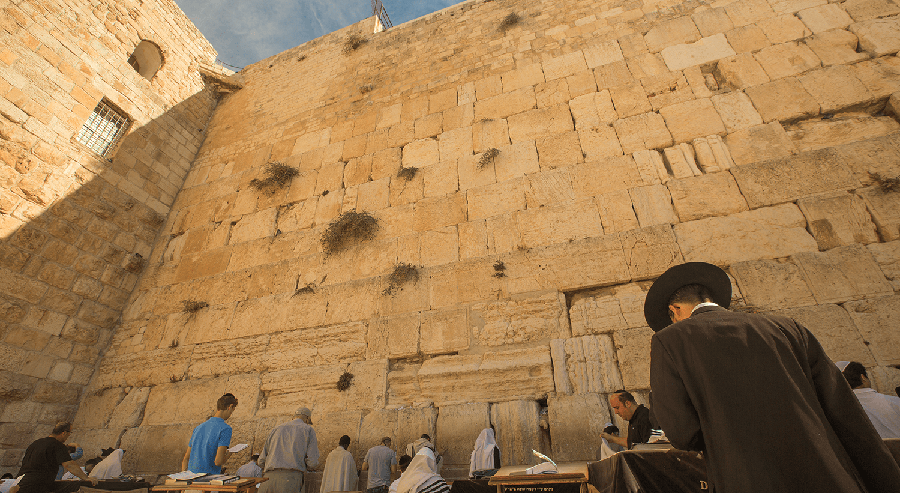
How can you teach that AD 70 fulfills Jesus’ prophecy in Matthew 24:3? After all, that verse says “not one stone here shall be left upon another, which will not be torn down.” But we all know that the huge Wailing Wall that exists today was a part of the temple.
Continue reading